The role of Ministries of Finance in driving climate action
The Coalition of Finance Ministers for Climate Action’s reference Guide for Ministries of Finance — now available on a website
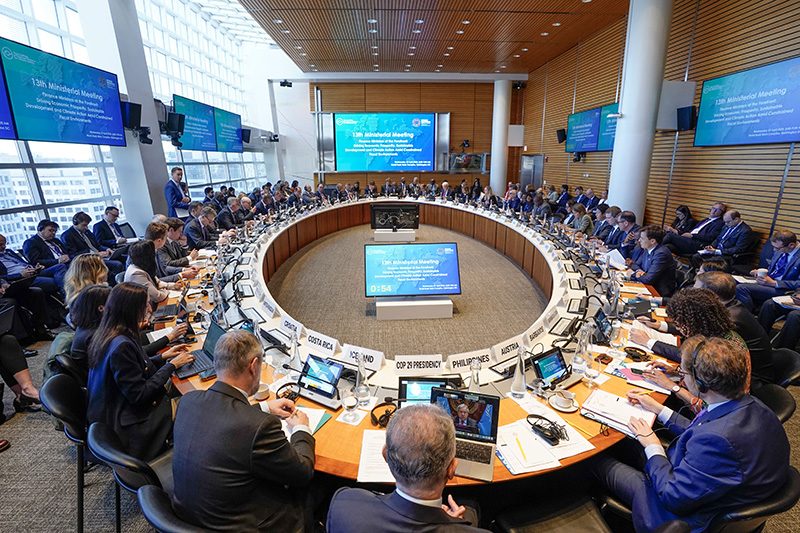
From a report to a living resource
The Role of Ministries of Finance in Driving Climate Action: A Guide to Economic Transformation and Resilience builds on the original Guide, first published in 2023. A single PDF of almost 250 pages, it was the first comprehensive overview of how the levers operated by Ministries of Finance can be used for climate action.
This website updates the original Guide’s content and makes it easier to find and use. You can navigate directly to the topic you need, move intuitively between related areas, and quickly search for specific content and case studies. The website also allows for the Guide to be periodically updated to reflect emerging research and changing global contexts as well as new case studies to be added.
[Please note that the website is being launched in stages, so some content and features, including the searchable Case Study Database, are not yet available.]
How the guide is organized
The Guide is divided into three Parts.
Part A sets out the strategic case for climate action by Ministries of Finance.
It explains why climate change, and the nature loss bound up with it, now sit squarely within the core mandate of a Ministry of Finance: growth, competitiveness, fiscal stability and resilience. And it shows how climate leadership can help ministries deliver those priorities rather than compete with them.
Read Part A to:
- Understand the economic and fiscal case for Ministries of Finance leading on climate, including the costs of delay and the growth opportunities of the transition.
- Recognize the levers ministries already operate and the skills needed to use them.
- See how the Guide’s Functions and Capabilities fits together, and where your ministry might start.
Part B is the practical core of the Guide: The Ministry of Finance Framework for Climate Action.
It organizes action into the three Functions of a Ministry of Finance: 1) Reforming economic strategy, 2) Reforming fiscal policy, and 3) Financing the transition to a low-carbon, climate-resilient, and nature-positive economy.
They are supported by three Capabilities that make action possible: 1) Leadership and governance, 2) Coordination and 3) Human and analytical capabilities.
Each Function and Capability is split into Action Areas, which all have a common structure:
- A summary.
- The context and role of Ministries of Finance.
- Barriers to action and ways to overcome them.
- Short case studies.
- Opportunities for action.
Read Part B to:
- Go straight to the Action Areas most relevant to your ministry’s current priorities, from budgeting and tax to greening the financial sector.
- Learn from ministries that have taken these steps, including what sustained their momentum.
- Understand how to build the internal capabilities that underpin action across every area.
Part C sets out priorities for action for Ministries of Finance.
It covers how Ministries of Finance can assess where they stand, set priorities suited to their country circumstances, sequence action, and navigate trade-offs. It closes with the case for collective leadership through the Coalition of Finance Ministers for Climate Action.
Read Part C to:
- Understand how the Ministry of Finance Framework for Climate Action can assist in assessing country-level progress and priorities for action.
- Discover principles to navigate trade-offs.
- Find out about the implementation support the Coalition provides.
In addition, the Case Study Database brings together expanded examples of Ministry of Finance actions from around the world.
Explore the Case Study Database to:
- Find examples of how Ministries of Finance have approached a specific question, policy, or challenge.
- See how different countries have sequenced, financed, and sustained similar reforms, and what lessons they drew from the experience.
- Search by country, region, topic, or theme.
How to use the Guide
The website allows you to access and navigate the Guide in different ways:
- Start with the Function or Capability you are most interested in.
- Explore the four Climate Themes: Energy Transition and Mitigation, Adaptation and Resilience, Nature and Biodiversity, and Just Transition.
- Discover the content most relevant to the division you work in.
- Dive straight into the case studies.
You can also read the Guide like a traditional report, starting with Part A (“the why”), followed by Part B (“the what”) and Part C (“the how”).
A phased launch
The Guide update is being released in several stages:
- October 2026 (Tranche 1): Part A and an initial set of Action Areas from Part B and case studies as a consultation draft.
- February 2027 (Tranche 2): The majority of Action Areas as a consultation draft.
- April 2027 (Tranche 3): The remaining Action Areas and Part C as a consultation draft.
- Mid-2027: Final release of all content and full website functionality.
- Case studies will be added to the database throughout.
Find out more about how to take part in the consultation.
Who is involved
This Guide is made for and by the Coalition. The update is coordinated by the United Nations Environment Programme, with support from the Grantham Research Institute on Climate Change and the Environment at the London School of Economics, based on guidance from the Coalition Co-Chairs and the Country Steering Group.
The Country Steering Group comprises Bangladesh, Bhutan, Burundi, Croatia, Denmark, Finland, Germany, Ireland, the Netherlands, Nigeria, Sierra Leone, Spain, and Uganda.
The following Coalition Institutional and Knowledge Partners provided contributions to the Guide: 2050 Pathways Platform, Asian Development Bank, Climate Policy Initiative, the Commonwealth, Council on Economic Policies, E3G, European Commission, Finance for Biodiversity, Grantham Research Institute on Climate Change and the Environment, Inter-American Development Bank, International Monetary Fund, NDC Partnership, Network for Greening the Financial System, Organisation for Economic Co-operation and Development, United Nations Development Programme, United Nations Environment Programme, World Bank, World Resources Institute, and World Wide Fund for Nature.
Additional contributions and feedback were provided by 21 organizations and individuals: Agence Française de Développement, Andy King, C40, Centre for Economic Transition Expertise, Collaborative Africa Budget Reform Initiative, DanChurchAid, International Budget Partnership, International Labour Organization, International Renewable Energy Agency, MIT Sloan, Murray Petrie, New Economics Foundation, ODI Global, Risk-informed Early Action Partnership, UK Export Finance, The UN Foundation, United Nations Conference on Trade and Development, United Nations Economic and Social Commission for Asia and the Pacific, United Nations Environment Programme Finance Initiative, United Nations Industrial Development Organization, and United Nations Office for Disaster Risk Reduction.
The full list of contributors and reviewers will be published with the final release.
Please refer to the original Guide for contributors to the first edition.
Disclaimer and copyright
This work is a product of the Coalition of Finance Ministers for Climate Action (“the Coalition”) and was prepared at the request of the Co-Chairs and Members of the Coalition. The views, findings, interpretations, and conclusions expressed are a synthesis of the diverse views of the authors, contributors and reviewers. While many Coalition members and partners may support the general thrust of the arguments, findings, and recommendations made in this report, the content does not necessarily reflect the views of the Coalition or its Members, or the host institutions of the authors, nor does this report represent an endorsement of any of the views expressed herein by any individual Member.
This work is licensed under CC BY-NC-SA 4.0.
It may be reproduced, in whole or in part, for non-commercial purposes provided full attribution is given.
© Coalition of Finance Ministers for Climate Action, 2026
The guide in numbers
Start reading