The role of Ministries of Finance in navigating the transition
Unlocking the defining economic opportunity of the 21st century
It covers:
• The macroeconomic and fiscal pressures Ministries of Finance are currently navigating.
• How the physical impacts of climate change and nature loss add to these pressures.
• Four broad economic opportunities relevant to Ministries of Finance: growth and competitiveness, fiscal resilience, energy security, and jobs and equity.
• The financing, sequencing, and distributional trade-offs involved in realizing these opportunities.
• The fiscal consequences of the timing of action, and how they compare to the costs of inaction.
The shift to a low-carbon, climate-resilient, and nature-positive economy is one of the defining economic transformations of our time. This transition involves no less than a fundamental reorganization of the global economy, including one of the largest structural reallocations of capital, labor, and technology in modern economic history (NCE, 2018). Managed well, it can be the defining economic opportunity of the 21st century (Stern, 2025). Managed badly or late, it becomes a source of mounting fiscal cost: stranded assets, rising contingent liabilities, and weaker growth. For Ministries of Finance (MoFs), this means the transition is both a risk to be managed and a structural opportunity to be shaped. The challenge at hand is to capture the productivity, investment, security, and stability gains of the transition while avoiding the costs of inaction or delay.
In recent years, the economic context for climate action has become more challenging at the same time as the consequences of a changing climate have become more immediate and widespread. Growth is low and uncertain across much of the world.Geopolitical tension and trade disruption are generating macroeconomic shocks, reshaping supply chains and investment patterns, and straining the international financial architecture (Osinbajo, 2026). Global public debt remains elevated—close to94% of GDP in 2025 and projected to reach 100% by 2029—debt-servicing costs are rising, and for many countries higher energy-import bills strain already limited fiscal space (IMF, 2026b). Investment has remained weak in many economies since before the global financial crisis, and substantial investment is already required to renew infrastructure and support structural transformation (Bhattacharya et al., 2025).
Competing development priorities, debt-service costs and financing terms affect the composition and timing of investment. These pressures are particularly acute in emerging markets and developing economies, where investment needs in cities, energy systems, and human capital remain large. Climate change and nature loss compound this existing economic challenge (ibid). Their physical impacts are intensifying, with consequences for productive capacity, infrastructure, household and firm balance sheets, public revenues and expenditure, and the cost of finance.
Well-designed climate action can help MoFs respond to these challenges
Climate change, including nature loss, has a growing claim on fiscal space, and managing it effectively is how MoFs can protect, and expand, that space. Renewable power can lower exposure to volatile fossil-fuel prices and the inflation they import (IRENA, 2025). Countries that expanded renewable energy capacity after the 2022 energy crisis were measurably more insulated from the 2026 price shocks (Ember, 2026; see Box A.3). Restoring natural capital helps protect the agriculture, water, and tourism revenues that nature-dependent economies rely on, and with them food security (Dasgupta, 2021). Investment in adaptation can reduce the macroeconomic shocks and contingent liabilities that erode fiscal space over time (Rising et al., 2026).
The transition offers significant opportunities
A well designed and built transition will increasingly help MoFs achieve their core objectives of macroeconomic stability, sustainable growth, and sound management of public finances. These opportunities can arise from the transition itself, for example, through shifts in markets, investment, technology and economic activity, lower energy costs and new jobs. They can also come from greater resilience due to reduced exposure of public finance, productive capacity, and livelihoods to climate- and nature-related shocks. Both transition-related and resilience-related opportunities can affect the objectives of MoFs through macroeconomic channels, including growth, productivity, employment, and external balances; and through fiscal channels, including revenues, expenditure, public assets and liabilities, and fiscal space.
How these opportunities materialize will differ across countries, depending on comparative advantage, natural resource endowments, institutional capacity, demographics, geography, and existing industrial structure. Against this backdrop, four broad economic opportunities are particularly relevant to MoFs (see Box A.1.):
- Sustainable growth, productivity, and competitiveness. The transition is creating markets for investment, new technologies, and industrial production. The combined global market value for clean-energy technologies has grown around 20% a year over the past decade, reaching nearly US$1.2tn in 2025 (IEA, 2026); and around 90% of net power-capacity additions in 2023 came from solar and wind (BloombergNEF, 2024).
- Responsible management of public finances and greater fiscal resilience. Adaptation and nature investment can reduce expected fiscal losses. Adaptation can provide a “triple dividend” of avoided losses, induced economic benefits, and wider social and environmental gains (Surminski and Tanner, 2016). Rising et al. (2026) estimate median economic benefit-cost ratios for adaptation investment of around 4 to 1 (albeit with substantial variation across interventions). Fiscal reforms can also raise revenue or reduce expenditure. With governments currently spending around US$725bn a year on explicit fossil-fuel subsidies, reforms in this area can free significant fiscal space (IMF, 2025a). Carbon pricing already raises over US$100bn for public budgets (World Bank, 2026).
- Energy autonomy and security. Net fossil-fuel importing countries currently spend around US$1.8tn a year on imports, and three technologies—electric vehicles, heat pumps, and renewables—could cut those imports by an estimated 70% (Ember, 2025; see Box A.3).
- Development, jobs, and equity. The transition can lower the cost of living and create jobs, with distributional outcomes affected by skills, social protection, and access to new opportunities. WRI (2026) projects, as a midpoint estimate, nearly 375million additional jobs over the next decade across energy, construction, manufacturing, and agriculture, with some 630 million workers facing job transitions along the way. The net gains therefore depend on skills and workforce investment keeping pace. Fiscal reform shows the same pattern.
Box A.1 Economic opportunities, benefits, and associated trade-offs of the transition
Opportunity 1. The transition is a driver of sustainable growth, productivity, and competitiveness. New industries, investment flows, and productivity gains are already shaping national economic trajectories. Clean energy is now the cheapest source of new power in most regions (Stern, 2025), and countries that move early are capturing the firms, jobs, and supply-chain positions emerging around batteries, grids, clean fuels, and processed critical minerals. Together, these dynamics lead to increased resource and energy efficiency, technology spillovers, and increasing returns to scale that can have cumulative effects (Stern and Zenghelis, 2025). Domestic value-added content, import dependence, and supply-chain constraints determine how much of the growth stays at home. Imported equipment may reduce project costs, while domestic production can support employment and tax revenues. The balance depends on relative costs, local capabilities, and the scale and duration of any public support (IEA, 2024b; AFD, 2026).
In emerging economies, there is a particular opportunity to leapfrog high-carbon pathways. Brazil is now leading in biofuels and bioenergy (WRI, 2025); Uruguay reached roughly 98% renewable electricity through a state-led transition (ITA, 2025); India has expanded solar capacity nearly fortyfold since 2014 (PIB, 2025); and Vietnam achieved the fastest proportional renewable scale-up on record by using its state-owned utility as a de-risking vehicle (Larsen, 2025).
Governments are increasingly using green industrial strategies to position their economies in the transition. Well-targeted measures can build capability, competitiveness, and growth in sectors that will matter as energy, transport, and industry decarbonize (Rodrik, 2014; Aiginger and Rodrik, 2020; Mazzucato et al., 2024). By contrast, poorly targeted support can lock in inefficient industries, create costly subsidies, or expose public budgets to long-term liabilities. Differences in energy costs and the timing of policy changes across trading partners can also affect competitiveness (see Function 1c. Shaping 21st century industrial and innovation strategies).
Cities provide a further opportunity for climate-related growth. Urban areas account for more than 80% of global GDP and subnational governments drive nearly 40% of public investment (OECD and UCLG, 2022). MoFs shape whether cities and, in many countries, regional and provincial governments can invest at the scale national commitments require, through the fiscal frameworks, intergovernmental transfers, and borrowing rules they set.
Opportunity 2: Acting on climate and nature is central to managing the public finances and building resilience. Well-designed adaptation can deliver a “triple dividend” of avoided damage (see Box A.2), induced economic benefits, and wider social and environmental gains (Surminski and Tanner, 2016), with median benefit-cost ratios around 4 to 1 and economic internal rates of return around 25% (Rising et al., 2026). Avoided losses are estimated against a scenario without adaptation and do not create new budget resources.
Fossil-fuel subsidy reform can release fiscal resources. Governments still spend around US$725bn a year on explicit fossil-fuel subsidies (IMF, 2025a), and in Nigeria, petrol subsidy costs in 2022 exceeded federal spending on health, education, and social protection combined (World Bank, 2022b). Carbon pricing now covers 29% of global emissions and raised over US$100bn in 2025, up from under US$20bn in 2016 (World Bank, 2026), and Ireland is an example of how such revenue can be used to fund further climate action and a just transition.
The transition will also change tax bases, and this is a challenge to manage as much as an opportunity to seize. Traditional revenue sources are already under pressure from higher vehicle efficiency, electrification, and the growth of undertaxed sectors (IMF and OECD, 2021). Changes in revenue systems affect the resources available for public investment and other expenditure as economies decarbonize. The timing of revenue reform affects receipts during the transition and incentives to adopt lower-emission technologies.
Opportunity 3. The transition is a driver of energy autonomy and security. Domestically produced renewable energy can lower import bills and energy costs as well as reduce the exposure of budgets and households to fossil-fuel price shocks. After the 2026 escalation in the Middle East, countries with higher renewable shares were less exposed to gas-price spikes (Ember, 2026). Pakistan’s rooftop-solar surge had helped avoid more than US$12bn in oil and gas imports by early 2026 (CREA, 2026); Switzerland held inflation to 3.5% in 2022 against a European Union average of 10%, partly because almost 100% of its electricity is low-carbon (Mandruzzato, 2022); and Finland limited the pass-through of the 2022 gas shock through high renewable shares and low gas dependence (EC, 2022).
The transition also involves challenges concerning access to critical minerals and their supply chains, the system costs of integrating non-firm wind and solar, and the grid stability and back-up investment that reliability requires (see Function 1c. Shaping 21st century industrial and innovation strategies).
Opportunity 4. When well designed, the transition can foster development, jobs, and equity. Nearly 887 million people in multidimensional poverty are directly exposed to climate hazards (UNDP and OPHI, 2025), and climate change could push 32–132 million more into poverty by 2030 (Jafino et al., 2020). Indonesia’s 2015 removal of gasoline and diesel subsidies freed around US$15.6bn for poverty reduction, human development, and infrastructure (IISD, 2020), although the gains held only until global prices spiked in 2022 and subsidies returned (IISD, 2022). Policy changes can correct market failures and support productivity, while also increasing costs for some vulnerable groups. A gender lens matters here too, both because climate impacts fall heavily on women and because closing the gender gap in the green economy can generate macroeconomic benefits (IRENA and ILO, 2023; BCG, 2021).
None of these gains, however, are automatic. Realizing them depends on deliberate design and sustained capacity, including well-designed and fiscally disciplined industrial strategy, management of eroding tax bases as economies decarbonize, continued investment in grid and mineral-supply resilience, and targeted social protection to ensure the benefits are shared equitably.
Source. Authors’ compilation.
Despite these opportunities, the fiscal implications of climate change and nature loss are already material and growing
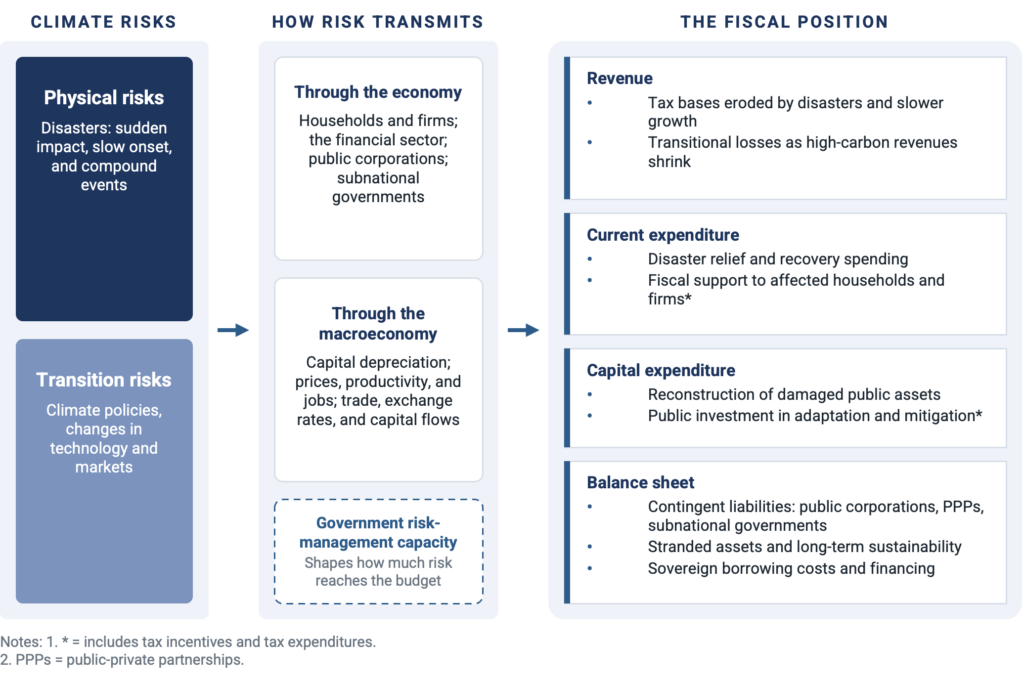
Countries face growing economic and budgetary shocks, a rising cost of capital as markets price climate and nature risk, reduced competitiveness and labor productivity, changes in relative production costs as carbon pricing expands across jurisdictions, and growing climate litigation. Globally, weather disasters accounted for 92% of US$224bn in natural-disaster losses in 2025. Total natural-disaster losses were below the inflation-adjusted US$368bn recorded in 2024 (Munich Re, 2026; see Box A.2).Figure A.1 illustrates risk transmission pathways and how they impact fiscal positions.
Box A.2. The costs and risks of climate change for public finances
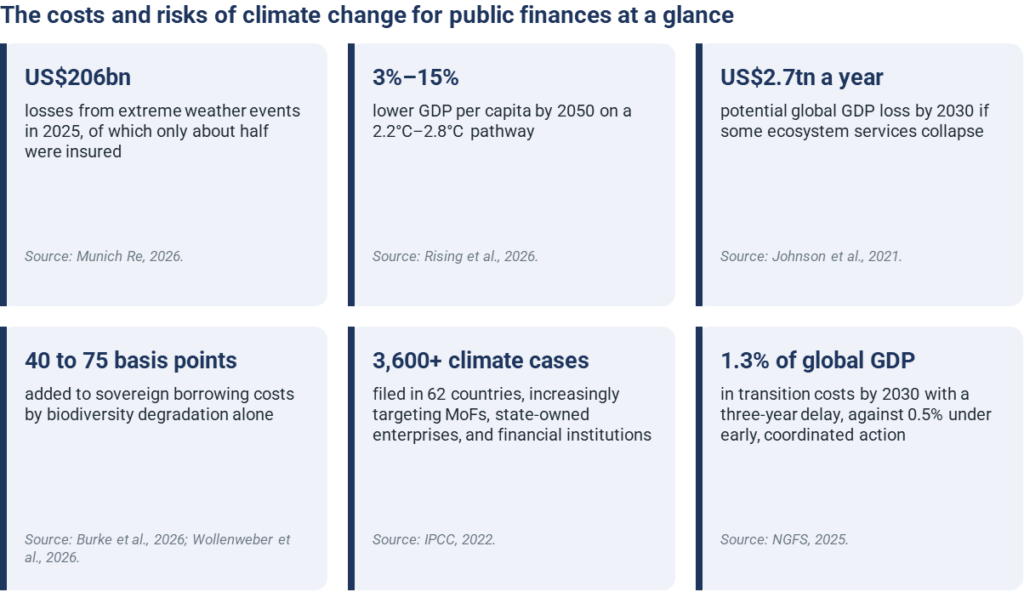
The physical impacts of climate change affect growth, the financial system, public finances, productivity, and inflation (CFMCA, 2025a). Left unaddressed, they pose significant challenges to the core objectives of an MoF (see Figure A.2):
- Economic and budget shocks. On a 2.2°C–2.8°C warming pathway, climate change could reduce average GDP per capita by 3%–15% by 2050, and by more than 20% in some in low- and lower-middle-income countries. These figures reflect higher temperatures and sea level rise alone; they do not account for changes in the frequency and severity of other extreme climate-related events (Rising et al., 2026). The collapse of some ecosystem services could cut global GDP by US$2.7tn a year by 2030, with the sharpest effects in poorer countries (Johnson et al., 2021). Physical damage raises spending on reconstruction, disaster relief, and stranded-asset write-downs while eroding the tax base. Globally, extreme weather events caused about US$206bn of losses in 2025, of which only half were insured (Munich Re, 2026).
- Reduced competitiveness and labor productivity. The green economy has passed US$5tn and could exceed US$7tn a year by 2030 (WEF, 2025). Carbon pricing changes the relative costs of carbon-intensive production across jurisdictions. The EU Carbon Border Adjustment Mechanism applies to covered imports and is intended to reduce carbon leakage. EU importers bear the compliance obligation, while effects on producers and consumers depend on pricing, trade responses, and carbon prices paid in the country of origin (European Commission, 2026). Productivity falls as temperatures rise, especially for weather-exposed labor, with an estimated global decline of 0.6% by 2050 and 1.4% in lower and lower-middle-income countries (Rising et al., 2026). This estimate concerns labor productivity and is distinct from the GDP-per-capita estimate above.
- Sovereign borrowing costs. Climate and nature risk is increasingly priced into sovereign borrowing. Biodiversity degradation alone raises government borrowing costs by 40–75 basis points on short- and medium-term debt, with stronger effects for higher-risk economies (Agarwala et al., 2026; Wollenweber et al., 2026).
- Litigation and contingent liabilities. More than 3,600 climate cases have been filed in 62 countries, and cases increasingly target MoFs, state-owned enterprises, and financial institutions (Setzer et al., 2026).
- Cost of delayed action. Doing too little too late roughly doubles the eventual cost. NGFS (2025) scenarios estimate transition costs of 1.3% of global GDP by 2030 with a three-year delay, compared with 0.5% under early, coordinated action.
Climate and nature risks can be assessed alongside other fiscal risks, with attention to uncertainty, contingent liabilities, and the scope to reduce expected losses. The analytical approaches discussed in Capability 3, Enhancing economic decision-making tools and data-driven analysis, inform this assessment.
Figure A.2. Selected climate-related costs and risks
Source: Values as cited in Box A.2.
Source. Authors’ compilation.
Figure A.1. Fiscal risks and impacts of climate change
Source: Murray, 2025; adapted from Dunz and Power, 2021.
Realizing these opportunities and managing the risks requires a substantial step-up in investment
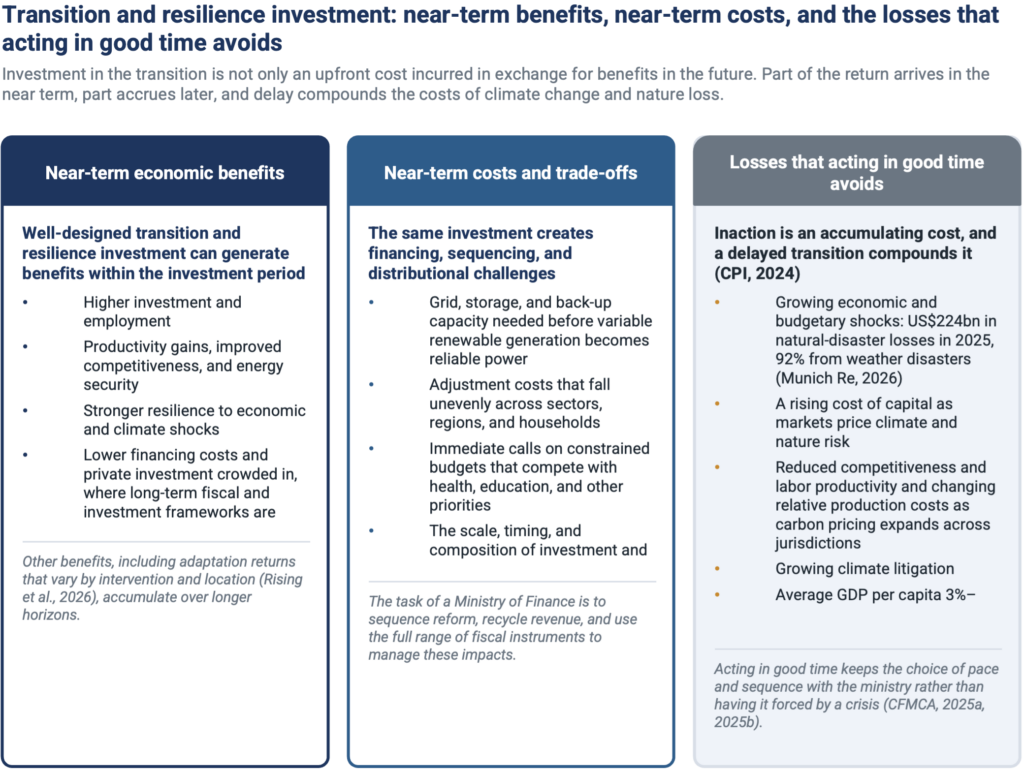
However, many countries are operating under constrained macroeconomic and financial conditions (see Part A, Investment needs, financing conditions, and the role of Ministries of Finance). Importantly, this investment is not simply an upfront cost incurred in exchange for benefits in the future. As outlined above, well-designed transition- and resilience-related investment can generate significant near-term macroeconomic benefits, in addition to other advantages that accumulate over longer time horizons. The scale, timing, and composition of investment, and the respective roles of public and private finance, will nevertheless create important financing and sequencing challenges. Policy design, implementation capacity, fiscal space, and exposure to international competition shape the gains and the scope for public support.
At the same time, the transition also creates adjustment costs that fall unevenly across sectors, regions, and households, leading to immediate calls on constrained budgets that compete with health, education, and other priorities. MoFs can use reform sequencing, revenue recycling, and funding for social protection and skills to manage these distributional impacts and support equitable access to new opportunities (Malerba, 2022). Credible long-term fiscal and investment frameworks can also reduce uncertainty to lower financing costs and crowd in private investment.
Delay can mean forgone growth, competitiveness, and energy security gains alongside rising fiscal costs (Stern, 2025; see Figure A.3). Inaction is not a neutral choice but an accumulating cost that far outweighs the cost of climate action (CPI, 2024). Limiting the extent and duration of warming above 1.5°C reduces adaptation costs and the risk of irreversible losses (UNEP, 2026). Acting in good time is therefore how MoFs can keep the choice of pace and sequence in their own hands rather than having it forced by a crisis (CFMCA, 2025a, 2025b).
Figure A.3. Investment expenditure and the costs of delayed adjustment
Source: compiled from the evidence cited in Part A.1 and Box A.2; citations as shown on each panel.
Box A.3. How MoFs responded to the 2026 energy crisis
About three-quarters of the world’s population live in net fossil-fuel importing countries (Ember, 2026). Reliance on fossil fuels has repeatedly translated into energy insecurity and price volatility, from the oil crises of the 1970s and Russia’s war against Ukraine to the 2026 Strait of Hormuz disruption (Godfrid and Pimenta, 2026). The examples in this box illustrate how short-term relief affects fiscal resources and incentives for longer-term investment. These selected examples do not describe the overall response. Broad fossil-fuel price support also accounted for a large share of crisis measures.
Short-term relief with transition linkages. France paired targeted fuel support for transport, fisheries, and agriculture with structural measures, including a target of one million heat pumps a year by 2030 and higher electric vehicle subsidies. Chile replaced general fuel subsidies with targeted vouchers and a kerosene price freeze, following IMF, IDB, and OECD guidance to shift from broad to targeted support. The Netherlands combined an emergency energy fund for vulnerable households, a zero-interest heat fund, and a second-hand electric vehicle scheme financed through existing budget lines and the removal of poorly performing tax deductions.
Subsidy reform as crisis response. Nigeria has moved from broad petrol subsidies toward market-based pricing, cushioned by targeted cash transfers through the National Social Register, while positioning domestic gas and electrification as structural alternatives. In 2024/25,Ecuador introduced a price-band system capping monthly fuel price increases at 5%, funding a fleet-modernization scheme from the savings. In 2025, Egypt continued phased reform with a 30% adjustment across petroleum products, directing savings to a conditional cash-transfer program.
Structural decoupling through renewables. Spain illustrates the long-term payoff of this approach. In Spain, gas set the electricity price 75% of the time in 2019, dropping to 19% of cases by 2025 after the country added over 58 GW of solar and lifted renewables above half of the energy mix. The structural shift to solar is the main reason it was less exposed to the 2026 Strait of Hormuz disruption than to Russia’s war against Ukraine in 2022, and its current response pairs temporary relief with faster permitting, grid planning, and electrification. Spain also requires weekly price reporting from all petrol stations, enabling analysis of whether tax cuts are passed on to consumers.
Source: Authors’ compilation.
The role of Ministries of Finance in shaping the transition
It covers:
• The functions and levers through which Ministries of Finance can influence the transition.
• Current levels of awareness and engagement among Ministries of Finance.
Ministries of Finance (MoFs) play a critical enabling role in turning the transition to a low-carbon, climate-resilient, and nature-positive economy into reality. MoFs differ in mandate, structure, and culture (Allen et al., 2015; see Part C, Priorities for action for Ministers and Ministries of Finance), and exercise different combinations of economic, fiscal, financial, and coordination functions.
However, they share a set of priorities around growth and the sustainability of the public finances that climate action can help them meet, and a common set of Functions and Capabilities suited to the economy-wide change the transition requires (see Part A, The role of Ministries of Finance: A Framework for Climate Action).
MoFs usually control several levers that are essential for whole-of-economy climate action:
- Helping shape national visions, plans, and investment strategies, giving them a critical role in determining their country’s transition pathway.
- Managing responsibilities commonly include taxation, budgeting, and debt management, enabling them to design or oversee the policy reforms needed to drive structural transformation.
- Overseeing the expenditure of all main departments and assessing spending proposals, giving them direct or indirect influence (within expenditure limits and legislative approval processes) over roughly a third of global GDP—well over US$30tn. They also have a crucial role collaborating with line ministries to drive the necessary investment in the sustainable, resilient, and inclusive transformation of their economies.
- Acting as shareholders and/or regulators of the activities of state-owned enterprises, sovereign wealth funds, and national and multilateral development banks and set the remits of central banks and export credit agencies. This places them in a critical position to help guide these institutions toward a green trajectory and set or shape the rules of the financial sector.
- Using or contributing to analytical tools, from macrofiscal forecasts and medium-term frameworks to fiscal-risk assessments, public-investment appraisal, and debt-sustainability analysis to assess investment, fiscal risks, and debt sustainability. This helps understand economy-wide trade-offs and shapes the spending decisions of other government departments related to climate action.
- Playing a key role in shaping the global financial architecture and international norms and priorities around climate action as members of regional and global networks and coalitions.
MoFs already understand the urgency of climate action
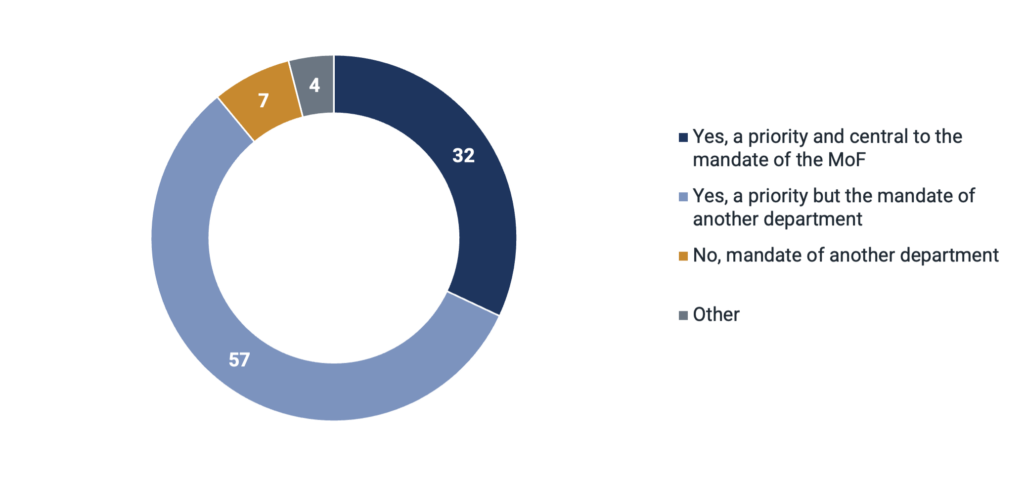
A global survey of nearly 60 MoFs, run by the Coalition of Finance Ministers for Climate Action’s initiative on Economic Analysis for Green and Resilient Transitions, finds widespread acknowledgement of physical climate and transition risks. This indicates high levels of awareness of climate change and its consequences, although levels of concern vary across risk categories and are highest among emerging market and developing economies (CFMCA, 2025c). Nearly 90% of respondents recognize that the transition to a green and resilient economy is a core economic issue (see Figure A.4).
Figure A.4. Does the Ministry of Finance consider climate action a core economic issue? (%)
Source: CFMCA, 2025c.
No. of respondents: 56
MoFs around the world are already taking meaningful action
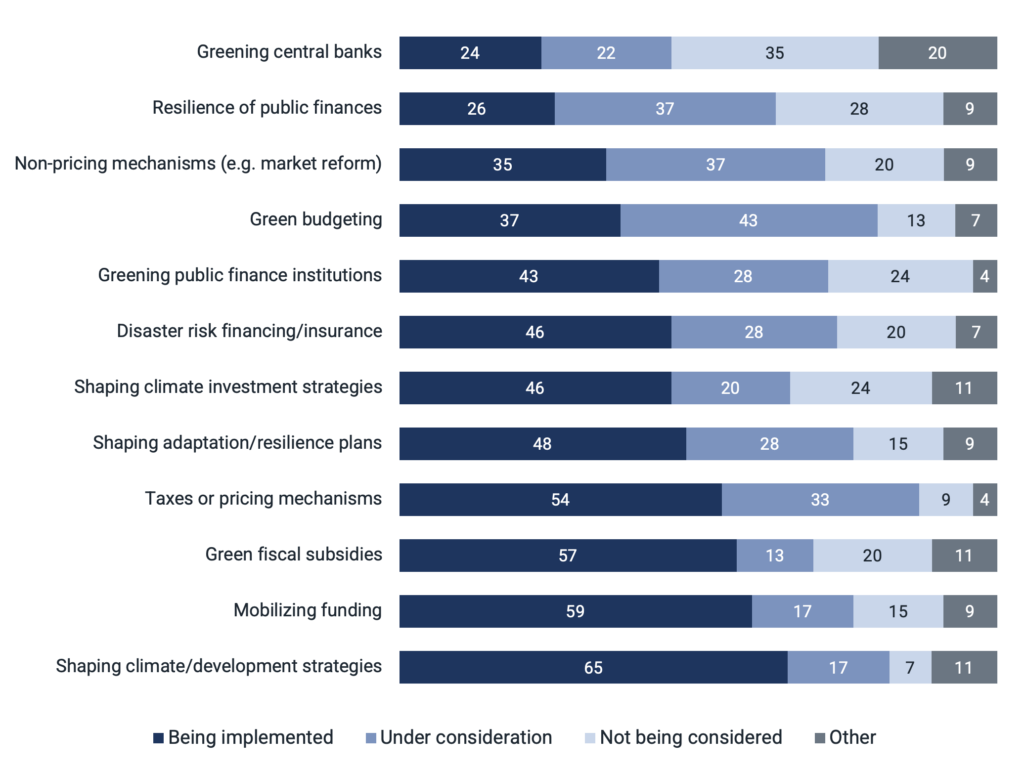
They are developing the tools, data, and capacity to integrate climate into their core functions. Many MoFs are actively implementing, or involved in implementing, climate policies in a range of different areas, including shaping national climate strategies, mobilizing funding, and providing green fiscal subsidies. However, they are less active in other areas, including greening central banks, strengthening the resilience of public finances, greening the budget process, and implementing non-pricing mechanisms (see Figure A.6). Many MoFs also remain at early stages of integrating these issues into their core macroeconomic, fiscal, and financial functions. A majority of those surveyed having not yet integrated physical climate risk or decarbonization considerations into their core analytical functions and processes, such as tax policy, forecasting, or policy appraisal (CFMCA, 2025c).
MoFs face many barriers, but they don’t need to start from scratch
In the process of advancing integration, they can build on existing mandates, analytical approaches, and institutions, as well as international experience, while progressively strengthening their capabilities over time (CFMCA, 2026). Their response to COVID-19 showed how quickly they can act and how much they can move: over US$18tn was deployed on rescue and recovery by mid-2022 (CFMCA, 2021b; O’Callaghan et al., 2022a). The transition asks for the same qualities in a different form: coordinated action across economic, fiscal, and financial policy, and readiness to use the full range of the MoF’s tools to enable structural change.
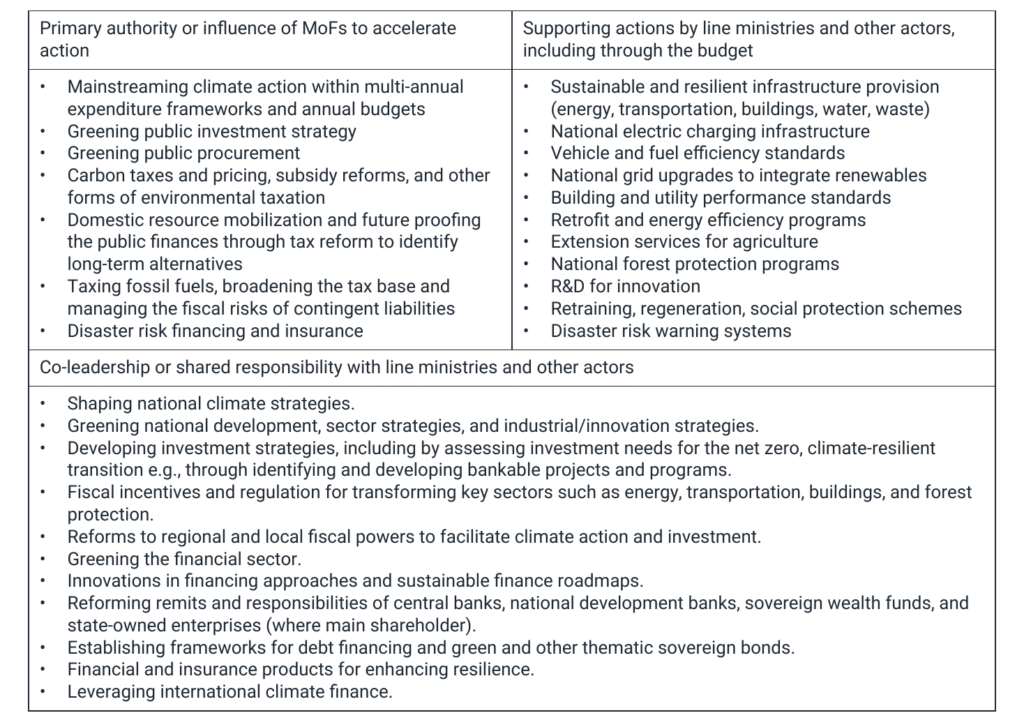
Deploying that toolkit is only part of the task; much of the role of MoFs is enabling action undertaken by line ministries, subnational governments, public enterprises, financial institutions, firms, and households. A successful transition needs the active involvement of MoFs, but they cannot deliver it alone. They act directly where they operate the levers—reforming tax systems, carbon pricing, subsidy reform, and fiscal incentives—and they enable others by aligning incentives, removing bottlenecks, and ensuring resources are used well (see Figure A.5). This means working alongside ministries of environment, energy, transport, and planning and co-leading or sharing responsibilities in such areas as national economic and industrial strategy, greening the financial sector, and reform of the global financial architecture.
Figure A.5. Which climate-related policies are Ministries of Finance engaging with? (%)
No. of respondents: 46
Source: CFMCA, 2025c.
Investment needs, financing conditions, and the role of Ministries of Finance
It covers:
• The size of the investment gap relative to current commitments and actual financing flows, and the reasons the gap persists.
• How the public-private financing mix varies by sector, country, and stage of market development.
• The three main channels through which Ministries of Finance can influence investment: shaping national economic and investment strategies, holding fiscal and budgetary instruments, and shaping the financing conditions under which investment takes place.
Despite increasing recognition of the importance of climate action, national climate and nature commitments still fall short. UNEP’s 2025 assessment projects warming over this century of 2.3°C–2.5°C under full implementation of Nationally Determined Contributions, compared with 2.8°C under current policies (UNEP, 2025). The world is not on track to halt and reverse biodiversity loss by 2030 (CBD Secretariat, 2024).
To put the transition to a low-carbon, climate-resilient, and nature-positive economy on track, a significant step-up in investment is needed. The Independent High-Level Expert Group on Climate Finance assesses that global climate and nature-related investment needs amount to US$6.3–6.7tn a year by 2030 and US$7–8.1tn by 2035, with US$2.3–2.5tn by 2030 in emerging and developing economies other than China (Bhattacharya et al., 2024). These needs span mitigation, adaptation and resilience, natural capital, and a just transition, the four themes treated in the thematic overview pages that accompany this Guide. Figure A.6 shows the regional and thematic breakdown of investment needs.
Figure A.6. Investment needs by region, 2030 and 2035
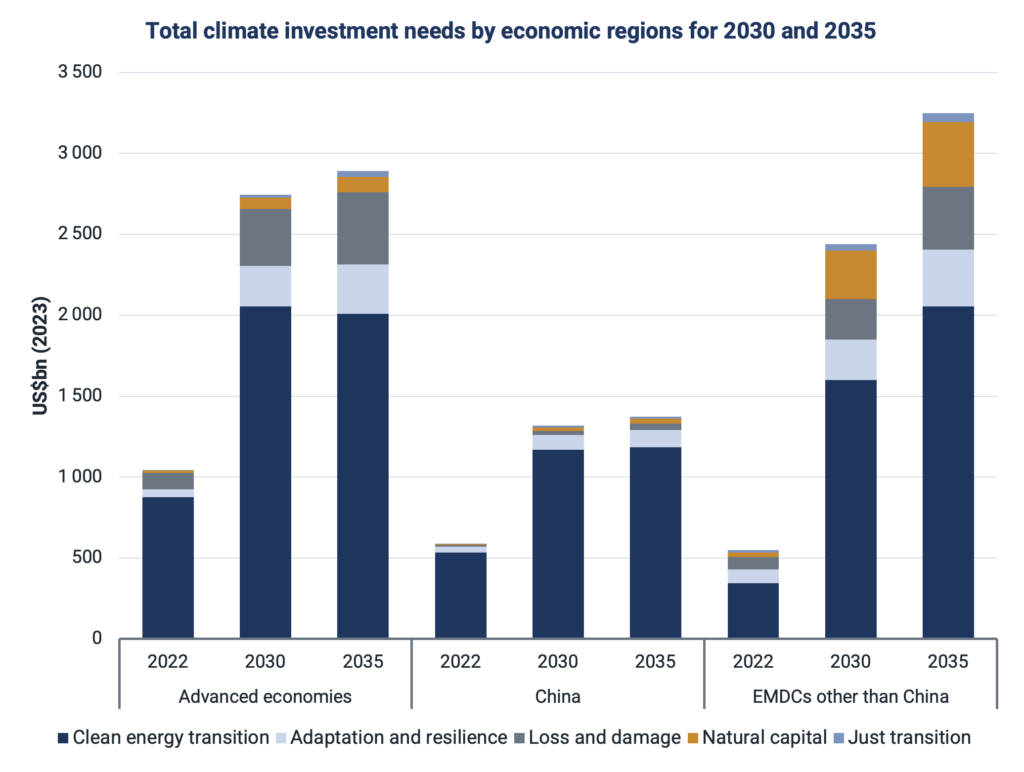
Source: Bhattacharya et al., 2024, Figure 1.1.
Note: EMDC = emerging market and developing economies.
The source assessment includes a separate category for loss and damage in addition to the four themes discussed in this Guide
Actual flows remain well short of these needs
Countries need to make long-term investment and policy choices under constrained macroeconomic and financial conditions (CPI, 2025). Public debt and debt-service burdens are high, fiscal space is limited, and governments face competing claims on budgets from development priorities and recurrent expenditure. While the investment gap does not reflect a shortage of global savings, continued incentives for high-carbon activity, policy and institutional misalignment, and weak pipelines of bankable projects keep high-return climate investment underfunded while capital flows to high-carbon and nature-degrading uses (Bhattacharya et al., 2025). For many emerging market and developing economies, the terms on which investment can be financed are an additional constraint (ibid.).
Closing the investment gap requires shifts in the scale and composition of finance and the roles of public and private actors
The public-private mix varies by country and by category. It also shifts with market maturity, as technologies early on their adoption curve and countries at earlier stages of financial development need a larger public share. The private sector is well placed to finance much renewable generation, where revenue streams are clear; some estimates put the private share of energy and land-use investment near 70% (Vivid Economics, 2021). However, complementary public investment in grids, storage,and back-up may still be required.
Adaptation and natural capital, as well as countries with shallower capital markets, need a more active public role. In emerging and developing economies other than China, around 60% of the required investment is expected to be domestic, complemented by external finance of around US$1.3tn a year by 2035 (Bhattacharya et al., 2025).
MoFs occupy a central position in mobilizing the required investment:
- First, they contribute to shaping national economic and investment strategies, including through macrofiscal frameworks, public investment appraisal, and the assessment of economy-wide trade-offs (see Function 1, Reforming economic strategy through shaping national development and climate plans).
- Second, they hold or influence many of the fiscal and budgetary instruments that enable the implementation of these strategies and affect incentives, resource allocation, and adjustment across the economy (see Function 2, Reforming fiscal policies). Currently, incentives are not always pointing in the right directions: governments spend around US$725bn a year on explicit fossil-fuel subsidies, and roughly US$1.8tn on explicit environmentally harmful subsidies (IMF, 2025a; Bhattacharya et al., 2025); and while carbon pricing covers under 30% of emissions, prices are often too low to shift incentives (World Bank, 2026).
Third, they shape the financing conditions under which investment takes place, including the allocation between public and private balance sheets, debt management, publicly backed financial institutions, financial policy, and engagement with domestic and international sources of capital (Function 3, Financing the transition through reforming the financial system and instruments). Public finance can fund investment directly and mobilize private capital through project preparation and risk-sharing. Guarantees and other public support also create fiscal exposures. MoFs rarely provide or direct that private capital themselves, though some steer it through state-owned banks and development finance institutions; mostly they shape the conditions under which it flows, through expenditure, taxation, regulation, and risk allocation.
International efforts are now converging around implementation of the scale-up agenda
At COP29, Parties agreed the New Collective Quantified Goal on Climate Finance and mandated the COP29 and COP30 Presidencies to prepare the Baku to Belém Roadmap to 1.3T. At COP30, Parties took note of the Roadmap and reaffirmed the call for all actors to enable climate finance for developing countries from public and private sources to total at least US$1.3tn annually by 2035 (UNFCCC, 2024, 2025).
Complementing this process, the COP30 Circle of Finance Ministers contributed analysis of MoF instruments in its 2025 report. The G20 Sustainable Finance Working Group addresses institutional and market barriers through its Sustainable Finance Roadmap, a voluntary and flexible framework endorsed in 2021 (G20 SFWG, 2021). The V20, Finance in Common, and other international other international initiatives are advancing complementary implementation efforts through their respective processes. This Guide builds on these developments to help MoFs translate the global agenda into practical, country-level action.
The role of Ministries of Finance: A Framework for Climate Action
It covers:
• The three core Functions through which Ministries of Finance can mainstream climate action: economic strategy and vision, fiscal policy, and financial policy and oversight of the financial system.
• The three Capabilities that underpin these Functions: leadership and governance, coordination, and human and analytical capabilities.
• The common barriers Ministries of Finance face in mainstreaming climate action and approaches used to address them.
The Ministry of Finance Framework for Climate Action is the organizing structure behind Part B (see Figure A.7). It is based on the existing core Functions of Ministries of Finance (MoFs)—what they do—and their Capabilities—how well they can do them. The opportunities for actions set out in these Functions and Capabilities are not prescriptive. Rather, the Guide aims to provide a comprehensive menu of options to help MoFs mainstream climate action into economic, fiscal, and financial policy according to their specific national circumstances.
The selection and sequence of policies depend on an MoF’s mandates, interactions, available resources, and implementation capacity. Some combinations reinforce each other (see Function 2, Creating fiscal incentives and regulations for transforming key sectors), while others can work against one another. As not many analytical tools are currently well equipped to capture these interactions in advance, one option is an iterative policy cycle. This involves piloting different approaches and combinations, evaluating them after implementation, and adjusting where they prove to weaken rather than strengthen each other (see also Part C, Priorities for action for Ministers and Ministries of Finance).
Figure A.7. The Ministry of Finance Framework for Climate Action.
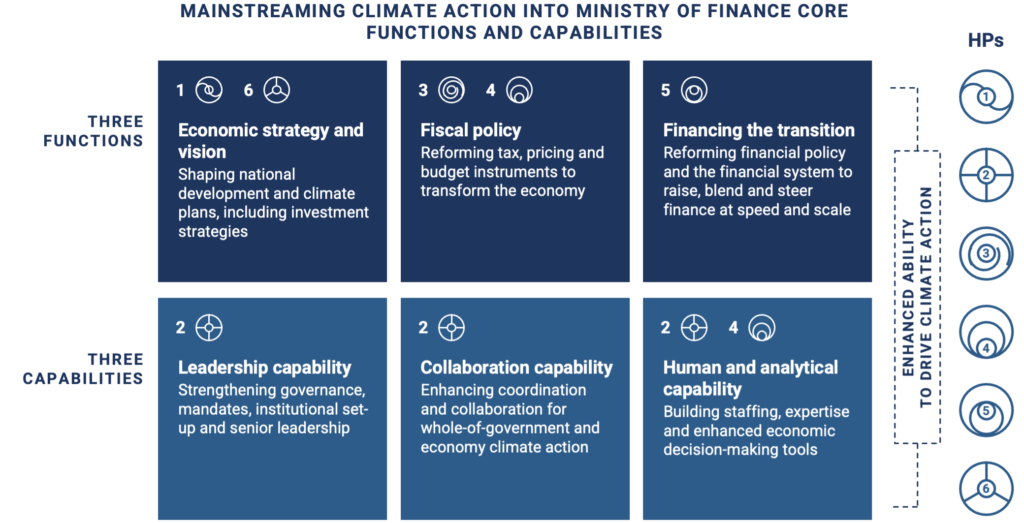
Source: Authors’ compilation.
Strengthening Functions
MoFs can mainstream climate action into the three Functions that form the core of their responsibilities
Mainstreaming means incorporating climate considerations into the exercise of existing functions, including fiscal forecasting, debt-sustainability analysis, and public-investment appraisal. The actions below illustrate applications within these functions, subject to the MoF’s mandate (see Table A.1).
- Economic strategy and vision. Using the MoF’s oversight of, or involvement in, national development and industrial strategies, sector plans, and investment planning. This allows it to participate in national climate and related strategies, green development, and sector plans; shape industrial and innovation strategy; and assess investment needs. These actions reflect climate risk, including resilience to more frequent and severe climate shocks, in macrofiscal forecasting and the medium-term fiscal framework.
- Fiscal policy and budget management. Using the MoF’s primary responsibility for fiscal policy, taxation, and the budget to design carbon pricing and environmental taxation; reform fossil-fuel subsidies; introduce fiscal incentives; reform multi-annual and annual budgets; green public investment and procurement; manage contingent liabilities; and bringing the overall tax system in line with green and resilient growth. The MoFs’ central role in budget cycle is a particularly important entry point.
- Financial policy and oversight of the financial system. Using the MoF’s responsibility for the regulation of state-owned banks and enterprises, sovereign wealth funds, export credit agencies and financial institutions, engagement with independent central banks, and relationships with international financial institutions and development banks. This allows it to green the financial system and mobilize finance through green-bond frameworks, private-capital mobilization, disaster-risk finance and insurance, and international climate finance, including nationally led country platforms and transition planning.
Table A.1. Core MoF Functions and opportunities to mainstream climate action
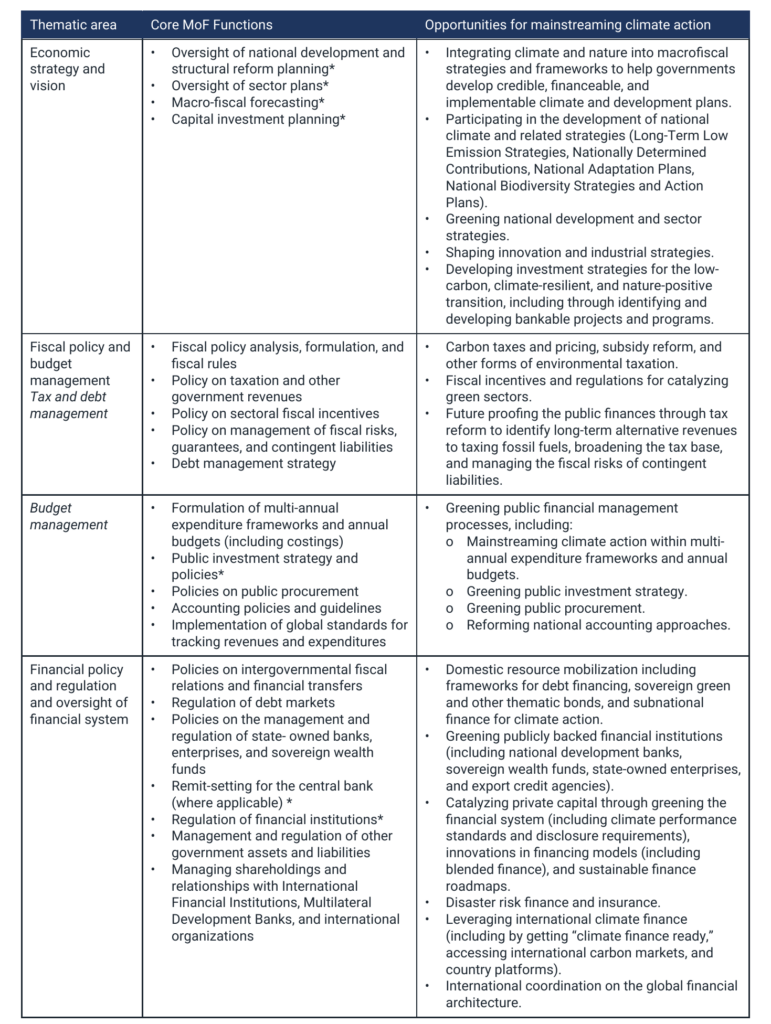
Source: Adapted from Allen at al. (2015, 2016), which summarizes the core policy, regulation, and transactional functional areas covered by most MoFs, updated here to identify key “entry points” for mainstreaming climate action.
Note: *Areas most often shared with independent agencies or other agencies.
Enhanced action by MoFs means working with other line ministries and actors across these Functions
While MoFs need to be proactive where they have direct responsibility, in certain areas it is important that they enable and support the leadership of line ministries and other actors, including through the power of the budget. Similarly, they will need to co-lead or share responsibility in other areas. Table A.2 provides a snapshot of the typical splits of responsibility that can be considered.
Table A.2. The role of MoFs in climate action in relation to other actors
Source: Authors’ compilation.
Strengthening Capabilities
Strong Functions depend on the Capabilities to exercise them
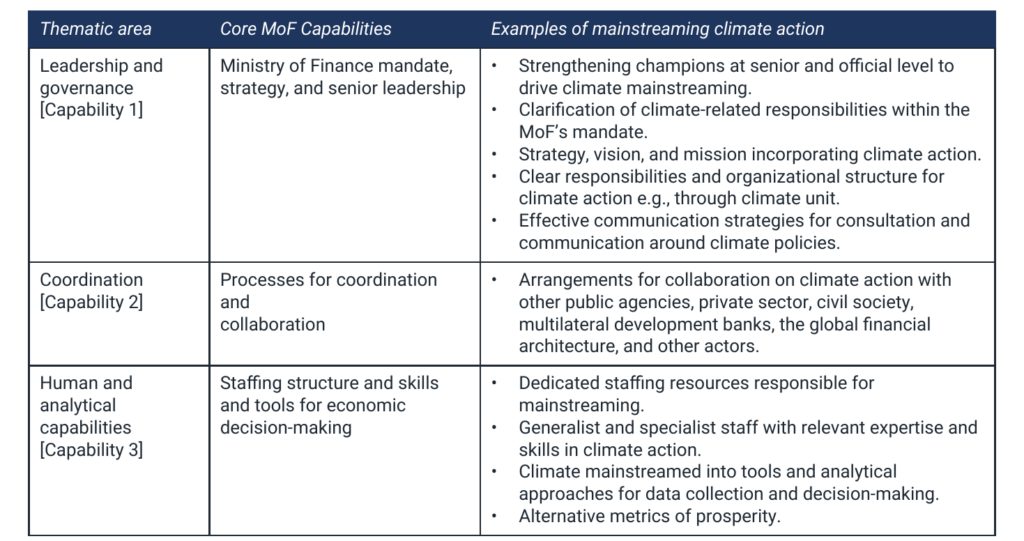
Capability is more than the volume of people and money; it is the ability to turn inputs into outcomes through clear roles, strong coordination, and the right skills (ODI, 2016; World Bank, 2013). The Framework distinguishes between three Capabilities(see Table A.3):
- Leadership and governance: strengthening the range of champions for climate action at the political and official level; clarifying the MoF’s vision and mission; formalizing its mandate to drive climate action; and creating clear responsibilities and organizational structures for climate leadership, supported by effective strategies for consultation and communication.
- Coordination: driving effective collaboration across government and with the private sector, civil society, and international financial institutions.
- Human and analytical capabilities: ensuring dedicated staffing resources, upgrading expertise in climate policy, and ensuring access to suitable tools and analytical approaches for economic analysis.
Experience across MoFs highlights a number of joint barriers and challenges, but also differences in analytical capacity, institutional arrangements, and available resources.
- Awareness is ahead of practice. A recent survey of MoFs indicates that they are increasingly aware of the pressing need to address climate action. And while MoFs are actively implementing a range of climate policies (or are involved in theirimplementation), responses vary by country and development status (CFMCA, 2025c).
- Annual budgets and multi-year planning and investment operate over different horizons. Medium-term frameworks and climate scenarios provide ways to assess expenditure and returns beyond the annual appropriation, alongside near-term fiscal pressures.
- Limited vertical and horizontal coordination across government. MoFs are built along sectoral lines and often see line ministries and subnational governments as competitors rather than partners. Standing coordination mechanisms and cross-cutting structures let the MoF convene the system instead of duplicating it.
- Mandates are often informal. The macrocriticality of climate change means MoFs have an implicit mandate to act on climate. However, in some countries they lack formal mandates, leaving action resting on individuals and vulnerable to staff turnover. Seeking an explicit mandate (e.g., through a government program, strategy, or legislation) can help improve coordination and serve as a baseline for expanding capabilities (see CFMCA, 2025d).
- Limited expertise and analytical capacity. In many MoFs, there is a notable gap between the demand for and the availability and use of suitable economic modeling and analytical tools to inform climate action (CFMCA, 2025c). This requires a strong response by MoFs, in partnership with supporting agencies, to rapidly enhance the supply of analytical tools and capabilities.
- Climate–related spending is considered a cost rather than an investment. Appraisal that distinguishes productive investments from expenditure allows well-designed climate action to be recognized and financed as what it is: an investment with an economic, fiscal, or risk-reduction return, not merely a new demand on a tight budget. Expected benefits, recurrent costs, debt-service implications, and uncertainty inform the comparison with other spending priorities and the costs of climate change.
- Bandwidth is scarce and reform tires. Competing macroeconomic pressures and the political cost of sustained change can exceed what an MoF can manage at once. Sequencing, building climate into existing processes, and long-term international support can keep the agenda moving.
Table A.3. Core MoF Capabilities and opportunities to mainstream climate action
Source: Authors’ compilation, based on ODI (2016) and World Bank (2013).
Navigating the Framework
Part B turns the Framework into practice, with each Function and Capability split into Action Areas. Read more about how to navigate the Guide and its framework.
It also highlights examples of good practice by MoFs across the core Functions and Capabilities. More detailed examples are brought together in the accompanying Case Study Database.
References
Agarwala M, Burke M, Klusak P, Kraemer M, Volz U, Sovacool BK (2026) Biodiversity loss will decrease the future creditworthiness of nations. Nature Ecology & Evolution. https://doi.org/10.1038/s41559-026-03081-7
Agence Française de Développement [AFD] (2026) Climate and Nature Economic Policy Scenarios (CNEPS) for Ministries of Finance, public development banks, and financial authorities: What is at stake for the post-COP30 implementation agenda. AFD Policy Paper. Paris: Agence Française de Développement.
Aiginger K, Rodrik D (2020) Rebirth of industrial policy and an agenda for the twenty-first century. Journal of Industry, Competition and Trade 20: 189–207.
Allen R, Hurcan Y, Murphy P, Queyranne M, Yläoutinen S (2015) The evolving functions and organization of finance ministries. IMF Working Paper 15/232. Washington, DC: International Monetary Fund.
Bhattacharya A, Songwe V, Soubeyran E, Stern N (2025) Delivering an integrated climate finance agenda. Fourth report of the Independent High-Level Expert Group on Climate Finance. London: Grantham Research Institute on Climate Change and the Environment, London School of Economics and Political Science. https://www.lse.ac.uk/granthaminstitute/publication/delivering-an-integrated-climate-finance-agenda/
Bhattacharya A, Songwe V, Soubeyran E, Stern N (2024) Raising ambition and accelerating delivery of climate finance. Third report of the Independent High-Level Expert Group on Climate Finance. London: Grantham Research Institute on Climate Change and the Environment, London School of Economics and Political Science.
BloombergNEF (2024) Energy transition investment trends 2024. New York: BloombergNEF.
Boston Consulting Group [BCG] (2021) Why climate action needs a gender focus. Boston: Boston Consulting Group.
Centre for Research on Energy and Clean Air [CREA] (2026) The hedge that paid off: How Pakistan’s solar boom is shielding it from the Hormuz crisis. Helsinki: Centre for Research on Energy and Clean Air. https://energyandcleanair.org/the-hedge-that-paid-off-how-pakistans-solar-boom-is-shielding-it-from-the-hormuz-crisis/
Climate Policy Initiative [CPI] (2025) Global landscape of climate finance 2025. San Francisco: Climate Policy Initiative. https://www.climatepolicyinitiative.org/publication/global-landscape-of-climate-finance-2025/
Climate Policy Initiative [CPI] (2024) The cost of inaction. San Francisco: Climate Policy Initiative. https://www.climatepolicyinitiative.org/the-cost-of-inaction/
Coalition of Finance Ministers for Climate Action [CFMCA] (2026) Helsinki Principle 4 Initiative overview.
Coalition of Finance Ministers for Climate Action [CFMCA] (2025a) How Ministries of Finance can drive adaptation and resilience. Helsinki Principle 4 (HP4) Thematic Series. https://greenandresilienteconomics.org/
Coalition of Finance Ministers for Climate Action [CFMCA] (2025b) How Ministries of Finance can manage climate-related fiscal risks. Helsinki Principle 4 (HP4) Thematic Series. https://greenandresilienteconomics.org/
Coalition of Finance Ministers for Climate Action [CFMCA] (2025c) A global survey of Ministries of Finance: The pressing policy questions Ministries of Finance face in driving green and resilient transitions and their use of analytical tools to address them. Report for the Economic Analysis for Green and Resilient Transitions initiative.
Coalition of Finance Ministers for Climate Action [CFMCA] (2025d) How Ministries of Finance can build capabilities for economic analysis and modeling to drive green and resilient transitions.
Coalition of Finance Ministers for Climate Action [CFMCA] (2021b) Building momentum for a strong recovery and sustainable transformation. 2021 green recovery report.
Dasgupta P (2021) The economics of biodiversity: The Dasgupta Review. London: HM Treasury.
Dunz N, Power S (2021) Climate-related risks for Ministries of Finance: An overview. Washington, DC: Coalition of Finance Ministers for Climate Action.
Ember (2026) The electric fast-tracks for emerging markets. London: Ember.
Ember (2025) The electrotech revolution. London: Ember.
European Commission [EC] (2026) Carbon Border Adjustment Mechanism. Brussels: European Commission, Directorate-General for Taxation and Customs Union.
European Commission [EC], (2022). 2022 Country Report – Finland. Brussels: European Commission.
G20 Sustainable Finance Working Group [G20 SFWG] (2021) G20 Sustainable Finance Roadmap. Rome: G20 Italian Presidency.
Godfrid D, Pimenta M (2026) What are the impacts of energy crises and how can they be avoided? London: Grantham Research Institute on Climate Change and the Environment, London School of Economics and Political Science.
International Energy Agency [IEA] (2026) Energy technology perspectives 2026. Paris: International Energy Agency. https://www.iea.org/reports/energy-technology-perspectives-2026/executive-summary
International Energy Agency [IEA] (2024b) Energy technology perspectives 2024. Paris: International Energy Agency. https://www.iea.org/reports/energy-technology-perspectives-2024
International Institute for Sustainable Development [IISD] (2022) Indonesia’s energy support measures. Winnipeg: International Institute for Sustainable Development. https://www.iisd.org/publications/digital-story/indonesia-energy-support-measures
International Institute for Sustainable Development [IISD] (2020) Achieving a fossil-free recovery. Winnipeg: International Institute for Sustainable Development.
International Monetary Fund [IMF] (2026b) Fiscal Monitor, April 2026. Washington, DC: International Monetary Fund.
International Monetary Fund [IMF] (2025a) Underpriced and overused: Fossil fuel subsidies data 2025 update. IMF Working Paper 2025/270. Washington, DC: International Monetary Fund. https://www.elibrary.imf.org/view/journals/001/2025/270/article-A001-en.xml
International Monetary Fund [IMF], Organisation for Economic Co-operation and Development [OECD] (2021) Tax policy and climate change: IMF/OECD report for the G20 Finance Ministers and Central Bank Governors, April 2021, Italy. Washington, DC, and Paris: International Monetary Fund and OECD.
International Renewable Energy Agency [IRENA] (2025) Renewable power generation costs in 2024. Abu Dhabi: International Renewable Energy Agency.
International Renewable Energy Agency [IRENA], International Labour Organization [ILO] (2023) Renewable energy and jobs: Annual review 2023. Abu Dhabi and Geneva: International Renewable Energy Agency and International Labour Organization.
International Trade Administration [ITA] (2025) Uruguay: Energy. Country Commercial Guide. Washington, DC: International Trade Administration, U.S. Department of Commerce. https://www.trade.gov/country-commercial-guides/uruguay-energy
Jafino BA, Walsh B, Rozenberg J, Hallegatte S (2020) Revised estimates of the impact of climate change on extreme poverty by 2030. World Bank Policy Research Working Paper 9417. Washington, DC: World Bank.
Johnson JA, Ruta G, Baldos U, Cervigni R, Chonabayashi S, Corong E et al. (2021) The economic case for nature: A global Earth-economy model to assess development policy pathways. Washington, DC: World Bank.
Larsen M (2025) How to resist the Wall Street Consensus: The maneuverability of a Vietnamese green state within international financial subordination. Review of International Political Economy 32(3): 593-616. https://doi.org/10.1080/09692290.2024.2414977
Malerba D (2022) The effects of social protection and social cohesion on the acceptability of climate change mitigation policies: What do we (not) know in the context of low- and middle-income countries? European Journal of Development Research 34: 1358–1382.
Mandruzzato G (2022) Switzerland: A safe haven from inflation. GAM Investments.
Mazzucato M, Doyle S, Kuehn von Burgsdorff L (2024) Mission-oriented industrial strategy: Global insights. IIPP Policy Report 2024/09. London: UCL Institute for Innovation and Public Purpose.
Munich Re (2026) Natural disaster figures for 2025. Press release, 18 January. Munich: Munich Re. https://www.munichre.com/en/company/media-relations/media-information-and-corporate-news/media-information/2026/natural-disaster-figures-2025.html
Murray P (2025) Green public financial management. In: Allen R, Krause P (eds) Contemporary issues and challenges in public financial management. Responding to global crises. London: Palgrave Macmillan, pp. 269-314.
Network for Greening the Financial System [NGFS] (2025) NGFS Declaration on the Economic Cost of Climate Inaction. Press release, November 5 2025. Paris: Network for Greening the Financial System. https://www.ngfs.net/en/press-release/ngfs-issues-declaration-economic-cost-climate-inaction-cop30
New Climate Economy [NCE] (2018) Unlocking the inclusive growth story of the 21st century: Accelerating climate action in urgent times. New Climate Economy Report. Washington, DC: Global Commission on the Economy and Climate.
O’Callaghan B, Yau N, Hepburn C (2022a) Global Recovery Observatory: Quarterly update Q1 2022. Oxford: University of Oxford.
ODI (2016) The capabilities of finance ministries. London: Overseas Development Institute.
Organisation for Economic Co-operation and Development [OECD], United Cities and Local Governments [UCLG] (2022) 2022 synthesis report: World Observatory on Subnational Government Finance and Investment. Paris: OECD Publishing.
Osinbajo Y (2026) Iran war costs for Africa confirms global financial architecture is broken. Project Syndicate, April 10. https://www.project-syndicate.org/commentary/iran-war-costs-for-africa-confirms-global-financial-architecture-is-broken-by-yemi-osinbajo-2026-04
Press Information Bureau [PIB] (2025) India’s solar momentum. Press release, December 6. New Delhi: Press Information Bureau, Government of India. https://www.pib.gov.in/PressReleasePage.aspx?PRID=2199729
Rising J, Godfrey N, Watkiss P, Surminski S, Baeza Breinbauer D, Gutiérrez-Hurtado MP et al. (2026) The macroeconomic case for investing in climate adaptation. London: Grantham Research Institute on Climate Change and the Environment, London School of Economics and Political Science. https://www.lse.ac.uk/granthaminstitute/publication/the-macroeconomic-case-for-investing-in-climate-adaptation/
Rodrik D (2014) Green industrial policy. Oxford Review of Economic Policy 30(3): 469–491.
Secretariat of the Convention on Biological Diversity [CBD Secretariat] (2024) NBSAPs and national targets dashboard. Web page. https://www.cbd.int/nbsap
Setzer J, Higham C, Chan T (2026) Global trends in climate change litigation: 2026 snapshot. London: Grantham Research Institute on Climate Change and the Environment, London School of Economics and Political Science.
Stern N (2025) The growth story of the 21st century: The economics and opportunity of climate action. London: LSE Press.
Stern N, Zenghelis D (2025) Powering growth: Why clean investment could unlock a turnaround in UK productivity. London: Grantham Research Institute on Climate Change and the Environment, London School of Economics and Political Science.
Surminski S, Tanner T (eds) (2016) Realising the triple dividend of resilience: A new agenda for disaster risk management. Cham: Springer.
United Nations Development Programme [UNDP], Oxford Poverty and Human Development Initiative [OPHI] (2025) Global Multidimensional Poverty Index 2025. New York and Oxford: United Nations Development Programme and Oxford Poverty and Human Development Initiative.
United Nations Environment Programme [UNEP] (2026) Limiting overshoot: Navigating exceedance of 1.5°C and pathways towards return. Nairobi: United Nations Environment Programme. https://www.unep.org/resources/limiting-overshoot-navigating-exceedance
United Nations Environment Programme [UNEP] (2025) Emissions gap report 2025. Nairobi: United Nations Environment Programme. https://www.unep.org/resources/emissions-gap-report-2025
United Nations Framework Convention on Climate Change [UNFCCC] (2025) Global Mutirão: Uniting humanity in a global mobilization against climate change. Decision 1/CMA.7. Bonn: United Nations Framework Convention on Climate Change.
United Nations Framework Convention on Climate Change [UNFCCC] (2024) New collective quantified goal on climate finance. Decision 1/CMA.6. Bonn: United Nations Framework Convention on Climate Change.
Vivid Economics (2021) Net zero financing roadmaps. London: Vivid Economics. https://www.gfanzero.com/netzerofinancing/
Wollenweber A, Wang D, Ranger N (2026) Kicking away the green ladder: The asymmetric sovereign risk from nature degradation. Grantham Research Institute on Climate Change and the Environment Working Paper 442. London: London School of Economics and Political Science. https://www.lse.ac.uk/granthaminstitute/publication/kicking-away-the-green-ladder-the-asymmetric-sovereign-risk-from-nature-degradation/
World Bank (2026) State and trends of carbon pricing 2026. Washington, DC: World Bank.
World Bank (2022b) Nigeria development update, June 2022: The continuing urgency of business unusual. Washington, DC: World Bank.
World Bank (2013) Beyond the annual budget: Global experience with medium-term expenditure frameworks. Washington, DC: World Bank.
World Economic Forum [WEF] (2025) Already a multi-trillion-dollar market: CEO guide to growth in the green economy. Geneva: World Economic Forum. https://www.weforum.org/publications/already-a-multi-trillion-dollar-market-ceo-guide-to-growth-in-the-green-economy/
World Resources Institute [WRI] (2026) Climate action and job creation. Web page. https://www.wri.org/insights/climate-action-job-creation
World Resources Institute [WRI] (2025) State of climate action 2025. Washington, DC: World Resources Institute.