Nationally Determined Contributions (NDCs)
This Action Area covers:
• How Ministries of Finance’s interactions with Nationally Determined Contributions have evolved across recent cycles.
• The costing methodologies available to them.
• How they can embed Nationally Determined Contributions into budgets and medium-term expenditure frameworks.
Context and role of Ministries of Finance
Well-designed Nationally Determined Contributions (NDCs) can serve as the basis for national investment strategies, identifying priority sectors, investment needs, and financing gaps in ways that support growth and deliver wider benefits, including improved health, energy security, and stronger private investment (OECD, 2025b; IIGCC, 2024). They can also serve as a tool for Ministries of Finance (MoFs) to balance climate ambition against growth, inflation, fiscal sustainability, external competitiveness, and employment. Realizing these benefits while managing the trade-offs depends on robust integrated economic analysis and impact assessment, credible costing, and realistic financing strategies. It also requires feeding outputs into medium-term macroeconomic frameworks, long-term growth and structural-transformation strategies, productivity and competitiveness policy, and fiscal risk management.
MoFs are well positioned to translate climate ambition into affordable short- to medium-term priorities
Embedding NDC targets in the instruments MoFs already own—namely medium-term fiscal frameworks, public investment management, fiscal risk management, and debt sustainability analysis (see Function 2, Reforming fiscal policies)—grounds climate commitments in countries’ fiscal realities. It treats them as inputs to economic and development planning rather than a parallel exercise.
Past NDC cycles point to unrealized potential for MoFs at the center of climate action
First‑generation NDCs revealed that many climate commitments were not fully implementable (CFMCA, 2020). This was in part because climate action targets were not aligned with development priorities or broader fiscal and economic capacity, andthe involvement of MoFs was limited. This experience led to growing recognition across countries of the need for stronger and earlier engagement of MoFs throughout the entire NDC cycle. Evidence from the 2025 NDC update cycle reflects greaterMoF engagement yet still highlights substantial unrealized potential for deeper participation (Ministry of Finance of Brazil, 2025).
Analysis of 55 emerging and developing market economies’ NDCs indicates that MoF engagement increased in the most recent cycle, with around 82% of surveyed countries reporting ministry involvement in updates or planning processes. This broader engagement has translated into progress across a range of MoF‑related activities, though advancement has been uneven across areas. Limited gains are observed in core analytical functions typically led by MoFs, including macroeconomic and macrofiscal assessments to inform NDCs (33%) and cost–benefit analyses of NDC measures (25%). By contrast, stronger progress is observed in the linkage between NDCs and national finance strategies or investment plans (87%) and the identification of domestic and international funding sources and financing mechanisms (91%) (NDC Partnership, 2026).
Despite improved participation and engagement, MoF involvement has not reached its full potential
As countries move into the implementation phase of their current NDCs and begin preparing for the next cycle, MoFs have a clear opportunity to deepen their engagement. This is particularly true for the early stages of the process, where fiscal, macroeconomic, and investment considerations can most effectively shape credible and implementable climate plans. In Asia-Pacific for instance, a survey reveals that NDCs in the region continue to treat climate targets primarily as environmental (see Box F1a(ii).1).
Box F1a(ii).1: NDCs in the Asia-Pacific region
A recent survey analyzing 41 NDCs found that many do not fully integrate macroeconomic considerations, limiting their effectiveness in aligning climate ambitions with socioeconomic prosperity (ESCAP, 2026). While nearly 90% of NDCs mention GDP or its components—and many discuss trade, exports, employment and productivity—explicit references to core macroeconomic policy tools are scarce. Only 12% explicitly reference “fiscal policy,” with none mentioning “fiscal revenues” or “fiscal expenditures” in detail. “Monetary policy” does not appear in any NDCs, while “interest rates” and “inflation” are noted in just 10% and 15%, respectively. Debt and taxes receive moderate attention (32% and 49%, respectively), but carbon taxes appear in only 15%. This indicates that NDCs treat climate targets primarily as environmental or sectoral commitments rather than embedding them within broader economic strategy frameworks.
These omissions hinder holistic planning. The survey emphasizes that the energy transition, which is central to most NDCs, involves substantial short-term costs (e.g., impacts on GDP growth, inflation, fiscal sustainability, and job displacement in fossil fuel sectors) alongside long-term benefits. Without rigorous macroeconomic modeling of trade-offs, such as effects on public finances, financial stability, labor markets, or distributional impacts, countries risk policy incoherence, stranded assets, regressive burdens on vulnerable groups, and undermined implementation feasibility. For instance, rapid decarbonization can crowd out investments or strain fiscal space in fossil-dependent economies like Indonesia or Malaysia, yet NDCs rarely assess these dynamics or sequence policies with monetary/fiscal tools.
The survey proposes a three-step framework to bridge this gap: priority goals, socioeconomic trade-off analysis, and feasibility diagnostics. It highlights how a lack of macroeconomic integration reduces NDC credibility and durability. For MoFs, strengthening NDCs with such assessments would better support macroeconomic stability, sustained growth, and wellbeing amid the transition and improve the chances of achieving ambitious NDC climate action goals.
Source: Based on a contribution by Michał Podolski (ESCAP).
Reflecting NDC commitments in public financial management systems is critical for effective implementation
MoFs are well-placed to do this by mapping NDC measures to budget programs, medium‑term fiscal frameworks, and public investment plans, and by embedding climate priorities into annual and multi‑year budget processes through core public financial management cycles. A costed NDC provides the essential foundation to integrate NDCs into national budgets (see box F1a(ii).2). It allows climate commitments to be reflected in concrete expenditure lines and programming decisions while ensuring consistency with available fiscal space and broader macrofiscal constraints (CFMCA and NDC Partnership, 2024).
Box F1a(ii).2. MoFs’ role in NDC costing
Costing is a central way for MoFs to become more involved in NDC preparation. Estimating the cost of implementing NDC targets against business-as-usual scenarios is a foundational step that enables governments to make informed strategic decisions on fiscal policy, investment priorities, and financing needs. This includes the identification of funding gaps that may require external support. MoFs play a central role in this process by ensuring that costing is credible, policy‑relevant, and aligned with macroeconomic and fiscal realities. As holders of core responsibilities for economic analysis, budgeting, and public investment, MoFs are well positioned to lead or coordinate NDC costing exercises, using fit-for-purpose methodologies, and international good practices to assess fiscal, economic, and distributional impacts. Table 1 summarizes common practices used. In practice, countries often combine more than one of these approaches rather than applying a single methodology in isolation.
Table 1. Common practices for NDC costing
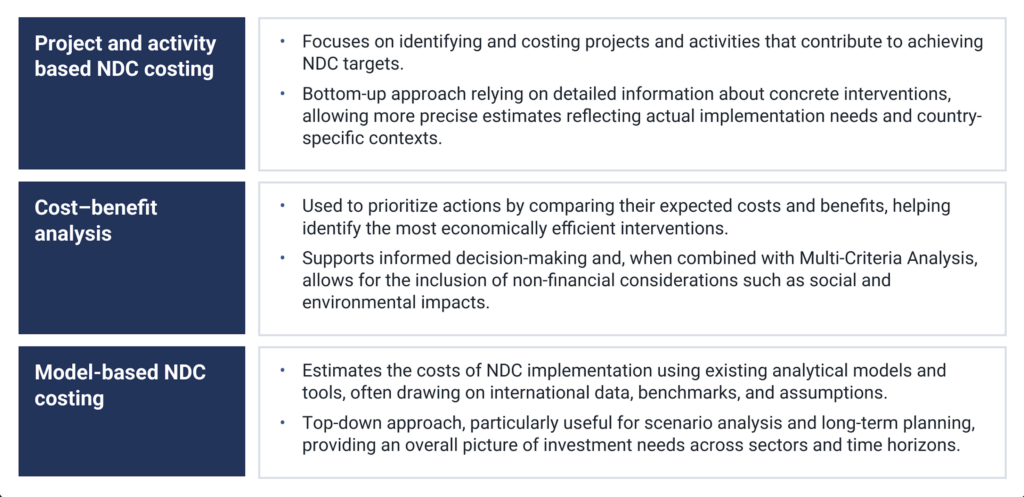
Source: NDC Partnership, 2024.
Costing enables Ministries of Finance to identify and quantify financing gaps by comparing estimated implementation costs with available and projected resources. This clarifies where domestic budgets can be reprioritized and where additionalpublic, private, or international climate finance will be required (Caldwell et al., 2023,; UNEP, 2022a). Cost and cost–benefit information also allow MoFs to prioritize and sequence NDC measures over time, distinguishing near-term, high-return actions from higher-cost investments that depend on enabling reforms or concessional finance.
This works on two fronts. First, it disciplines target-setting, helping ensure that commitments do not outpace what fiscal space and institutional capacity can deliver, since targets that cannot be financed or implemented erode credibility as surely as unambitious ones fall short. Second, it structures delivery once targets are set, improving implementation feasibility (Caldwell et al., 2023). Robust costings capture both direct and indirect costs, including employment impacts, potential job losses, and reskilling needs to assess feasibility within medium- to long-term fiscal constraints.
NDC costing can be an iterative and evolving process rather than a one‑off exercise. MoFs can play a key role in progressively refining cost estimates as improved data, analytical tools, and institutional capacity become available. Scenario analysis, such as baseline, moderate, and high‑ambition pathways, allows MoFs to test the fiscal and macroeconomic implications of different policy choices and levels of implementation effectiveness, supporting more resilient and informed decision‑making over time.
Burkina Faso completed a quantified cost–benefit analysis of its NDC measures. Its NDC 3.0 reports a cost-effectiveness ratio of US$44.8 per ton of CO₂ equivalent reduced for mitigation actions and US$46.4 per ton for adaptation actions—an improvement from the US$63.7 per ton recorded in the 2021 NDC. The benefit-to-cost ratios across actions are assessed as high, providing a concrete investment signal. The analysis is grounded in a cost–benefit analysis framework, drawing on two modeling tools applied across different sectors: the IEA’s Greenhouse Gas Abatement Cost Model for energy, transport, and habitat and infrastructure; and the FAO’s EX-Ante Carbon Balance Tool for agriculture, forestry and land use, waste, and water resources (NDC Partnership, 2026).
Source: Based on a contribution by Joaquim Leite and Adrian Flores Aguilar (NDC Partnership).
There are concrete actions MoFs can take to integrate NDCs into budgets.
- Link NDC measures to budget classifications and programs. Ensure traceability from policy commitments to specific expenditures (see Function 2, Using the budget to drive transformation in all sectors of the economy). This mapping enables climate priorities to be systematically incorporated into budget preparation and execution processes, reducing the risk that NDCs remain disconnected from fiscal decision-making (CFMCA 2024; UNDP, 2025).
- Integrate climate priorities into medium-term expenditure and fiscal frameworks. MoFs can plan climate-related spending and related social investments over multiple budget cycles. This can improve the predictability of funding and align climate ambition with fiscal sustainability and debt considerations, which are critical for sequencing investments and managing trade-offs within limited fiscal space (CFMCA and NDC Partnership 2024; OECD, 2025b). For many developing countries, sequencing reforms is more challenging than identifying climate priorities: this approach helps ensure that commitments do not outpace available fiscal space and institutional capacity (see Function 2, Using the budget to drive transformation in all sectors of the economy).
- Apply climate budget tagging to budget allocations and expenditures that contribute to NDC and development objectives. When embedded within public financial management systems, climate budget tagging supports monitoring and reporting, improves accountability for climate spending, and provides data that can inform future NDC revisions and financing strategies (UNDP, 2025; CFMCA 2024; see Function 2, Using the budget to drive transformation in all sectors of the economy).
- Use general or thematic taxonomies. Defining which activities, projects, and expenditures are considered climate aligned can provide a common classification framework across public budgets, public investment pipelines, and private finance. When used alongside climate budget tagging, taxonomies can improve consistency between fiscal policy, investment planning, and financial markets; help reduce greenwashing risks; and support the mobilization of public and private finance toward NDC-aligned investments (OECD, 2025b; Caldwell et al., 2023; see Function 3, Accessing deep pockets of private capital to finance the transition).
Implementation also depends on whether the workforce has the skills to deliver it
Beyond these budgetary and financial mechanisms, implementation also depends on a less visible constraint: whether the workforce has the skills needed to deliver NDC commitments. MoFs have a role to play here too, ensuring these workforce and skills needs are costed and financed alongside physical investment (see Box F1a(ii).3)
Box F1a(ii).3 NDCs, skills, and the just transition
The ability to implement NDC commitments depends not only on finance, technology, and infrastructure but also on whether workers and enterprises have the skills and capabilities required to deliver them. Renewable energy deployment, building renovation, resilient infrastructure, industrial decarbonization, and adaptation measures can all be slowed by shortages of appropriately skilled workers. Anticipating these requirements can help reduce implementation risks and improve the effectiveness of public and private climate and nature investment. Skills are also an important part of a just transition, as workers in sectors undergoing structural change may need opportunities to reskill or upskill to move into new or alternative income generating activities. Addressing this can help to limit prolonged unemployment and income losses and associated pressures on social protection systems. This recognition is increasingly reflected in the latest generation of NDCs: 81%of NDC 3.0 refer to skills development (ILO, 2025). However, the extent to which these commitments are linked to concrete financing and implementation arrangements varies considerably.
For MoFs, the key issue is to ensure that the skills implications and associated financing needs of NDC measures are considered alongside physical investment requirements. Depending on national institutional arrangements, this could include:
- Costing skills needs. Where priority climate measures depend on new or changing workforce capabilities, the cost of training, reskilling, apprenticeships, and employment services can be considered alongside infrastructure and technology costs.
- Linking skills to budgets and investment plans. Skills identified through the NDC process can be built into national budgets, medium-term expenditure frameworks, and NDC investment and financing strategies, rather than addressed only once implementation bottlenecks emerge.
- Working across government and with social partners. Ministries responsible for labor, education, and skills, as well as employers’ and workers’ organizations, can provide information on workforce and training needs and practical constraints faced by enterprises and workers.
Depending on country circumstances, skills measures linked to transition priorities may be supported through public budgets, fiscal incentives, public financial institutions, or wider climate and transition financing packages. Integrating skills development considerations into NDC planning can therefore help countries move from identifying what climate investment is needed to considering what capacities and financing are required to deliver it.
Some NDCs are already making this connection more explicit. Canada’s NDC 2.0 underscores its commitment to safeguarding workers’ livelihoods during the green transition through dedicated legislation. It emphasizes aligning skills development with labor market needs to support a low-carbon economy and references substantial investments in training programs to equip workers with skills for emerging sectors, especially clean energy.
Australia’s NDC 2.0 also places a strong emphasis on workforce skills development as a crucial component of the clean energy transition. It signals this commitment through dedicated funding, such as the Powering Regions Fund, aimed at enhancing workforce skills and capabilities specifically for the clean energy transition. The Australian Government will invest a further AUD100m (US$72m) to train 10,000 New Energy Apprentices in the jobs of the future and establish an AUD10m (US$7.2m) New Energy Skills Program to provide additional training pathways.
Source: Based on a contribution by Ekaterina Chubarova (ILO).
Barriers to action and ways to overcome them
Despite the recognition of MoFs’ relevance to climate action, several barriers continue to limit their ability to contribute effectively to the development and strengthening of climate plans. While there are distinct challenges depending on the context, a number of common constraints and solutions emerge across countries. The barriers below therefore affect all four Action Areas in Function 1, Participating in the development and implementation of climate and related strategies, rather than any single one.
Limited institutional coordination
Weak coordination between MoFs and Ministries of Environment or other designated lead agencies often results in delayed or narrowly scoped involvement of the MoF in climate planning processes. When planning and finance ministries are excluded from drafting and brought in only to validate finished work, they can neither own the strategy nor coordinate its implementation (World Bank, 2026).
Approach
Strengthen governance and coordination arrangements as a whole-of-government approach. Clear governance structures are critical to ensuring timely and meaningful participation of all relevant institutions throughout the climate planning process. In many cases, countries have already set up governance structures dedicated to NDC delivery, which can also be used for LT-LEDS and NAPs (see Capability 2, Coordination and collaboration for whole-of-economy climate action). These typically include a steering committee to provide political leadership and strategic direction; technical committee(s) to guide analysis, coordinate data, and ensure outputs respond to the needs of different ministries; and a core group responsible for day-to-day coordination.
Climate (Finance) Units and Country Platforms have proven to be effective mechanisms for strengthening inter-institutional coordination, particularly between MoFs, Ministries of Environment, line ministries, private sector, and other relevant sectoral stakeholders (see Capability 1, Formalizing governance structures and organizational set-up and Function 3, Leveraging international climate finance and reforming the global financial architecture).
Capacity and data constraints
Many MoFs face shortages in both human and technical capacity, including the tools and expertise to systematically analyze the links between climate change, economic performance, and fiscal outcomes. A survey conducted by the Coalition of Finance Ministers for Climate Action found that 78% of MoFs identify limited data availability as major constraint to advancing climate‑related analytical work (CFMCA, 2025a).
For NBSAPs specifically, indicators that directly measure biodiversity outcomes (such as ecosystem condition, species abundance, restoration areas, or biodiversity footprints) remain limited in mainstream financial decision-making, and biodiversity value is largely absent from GDP accounting, tax base projections, and medium-term expenditure frameworks (UNEP FI, 2024a).
Approach
Invest in capacity, data, and analytical tools. To engage effectively in climate planning processes, MoFs require sufficient human and technical capacity, underpinned by robust data systems and analytical tools (see Capability 3, Enhancing economic decision-making tools and data-driven analysis). This includes strengthening their ability to assess climate related risks, costs and benefits, and macrofiscal impacts as well as developing systems to monitor progress and track climate finance flows.
Investments in monitoring, reporting, and verification frameworks can enhance transparency, accountability, and evidence-based decision-making. Embedded advisory support models, which place climate finance experts within MoFs, have proven effective in facilitating knowledge transfer and sustaining capacity gains beyond the duration of technical assistance (Caldwell et al, 2022; see Function 1, Shaping 21st century industrial and innovation strategies, Function 2, Reforming fiscal policies and Function 3, Financing the transition through reforming the financial system and instruments).
Social dimensions are considered too late
Social and labor market implications are often identified too late in the planning cycle, largely due to lack of coordination with ministries responsible for labor, skills, social protection, and enterprise development. Climate plans may be technically sound but difficult to implement where workers, enterprises, and affected communities have not been engaged, where skills constraints are not anticipated, or where compensation and support measures are not costed.
Approach
Include social and labor-market analysis at the formulation stage. This can be addressed by working with Ministries of Labor and supported by structured engagement with social partners. Workers’ and employers’ organizations can provide early information on sectoral employment exposure, skills gaps, business preparedness, compliance costs, value-chain disruption, and informal-work realities. This improves the assumptions used in climate planning and helps ensure that compensation, training, enterprise support, and social protection measures are designed before implementation bottlenecks or opposition emerge (ILO, 2025).
Weak accountability and feedback mechanisms
Many countries lack robust processes and tools, such as monitoring, reporting, and verification systems and climate finance tracking frameworks, that integrate accountability, learning, and systematic feedback into the revision and strengthening of climate plans, particularly for adaptation finance.
Approach
Institutionalize monitoring, reporting, and verification systems and climate finance tracking frameworks, and build the feedback loops that connect them back into plan revision. Established public financial management instruments—climate budget tagging and tracking, disaster budget tagging, climate public expenditure and institutional reviews, and Public Expenditure and Financial Accountability Climate assessments—can be extended beyond NAPs to LT-LEDS, NDCs, and NBSAPs, so that evidence on what is and is not working feeds systematically into successive rounds of planning.
Constraints in accessing climate finance
The complexity of the global climate finance architecture requires significant technical expertise and administrative capacity, posing particular challenges for smaller MoFs and those in Small Island Developing States (UN-OHRLLS, 2022). For biodiversity finance, an additional constraint is the weakness of market signals: financial institutions still treat biodiversity primarily as a source of risk rather than as an opportunity for value creation, and the role of the private sector in achieving biodiversity targets is less clearly defined than for netzero targets, limiting capital allocation to nature-positive activities (UNEP FI, 2024a).
Approach
Develop climate finance and investment strategies, including within broader growth, development or Sustainable Development Goals strategies(see Function 1, Greening national development and sector strategies). MoFs are well placed to lead the development of climate finance and investment strategies that translate climate priorities into actionable and credible financing plans. This includes identifying domestic budgetary resources, coordinating public investment, improving enabling environments, mobilizing private capital, and improving access to international climate finance. The NDC Partnership and Green Climate Fund’s Climate Investment Planning and Mobilization Framework provides a structured, country-driven approach to institutional coordination, investment prioritization, and public-private financing (NDC Partnership, 2025).
Political economy pressures on engagement
MoFs face institutional disincentives to deep engagement in climate planning that go beyond capacity gaps: the political cost of quantifying fiscal constraints on NDC ambitions; the risk of conflict with sectoral ministries that carry stronger political weight; and the short horizons that electoral cycles impose on long-term strategy work (see Box F1a(i).1; World Bank, 2023).
Approach
MoFs can navigate these dynamics directly. On interministerial coordination, an MoF can use its center-of-government position to make climate objectives a condition of the budget and financing processes it manages.
On subsidy and pricing reform, sequencing compensation and social protection payments ahead of price increases—and reporting both the reform and the compensation transparently in public finance documents—builds the public trust needed to sustain the coalition behind reform (see Function 2, Transforming economic incentives through carbon pricing, subsidy reform and other fiscal policy measures).
Regarding electoral cycles, embedding commitments in legal and institutional frameworks and linking milestones to financing conditions with development partners allows commitments to persist across administrations. For example, Costa Rica is trying to write its Long-Term Low Emission Development Strategy, the National Decarbonization Plan, into national law (World Bank, 2023).
Several global initiatives can support countries with the development and implementation of NDCs, NAPs, and LT-LEDS
These initiatives provide technical assistance, financing support, capacity building, and platforms for peer learning. The NDC Partnership, the NAP Global Network and the 2050 Pathways Platform provide country-tailored technical assistance, peer exchange, and financing support across NDCs, NAPs, and LT-LEDS, respectively. UNDP BIOFIN does the same for the financial side of NBSAPs.
The Initiative for Climate Action Transparency strengthens the tracking and reporting side through its Climate Finance Transparency Framework. The Country Platform Hub supports governments in designing and operationalizing country platforms that align national climate and development priorities with financing strategies and investor engagement, and the ILO is supporting countries with leveraging NDCs as a vehicle of a just transition (see also Function 3, Setting up country platforms).
Opportunities for action
It is beneficial for MoFs to treat active engagement in national climate and biodiversity planning as institutional responsibility, working in close collaboration with the relevant agencies on all four instruments. The following opportunities jointly cover all four Action Areas discussed in Function 1, Participating in the development and implementation of climate and related strategies.
Early engagement enables MoFs to embed fiscal, macroeconomic, and investment considerations from the outset. They can shapecredible, implementable plans rather than merely validating or financing plans that have already been designed without them. MoFscan use their center-of-government position and convening power to improve coherence across LT-LEDS, NDCs, NBSAPs, and NAPs.
Modeling and developing scenarios can help assess the impacts of climate change as well as cost mitigation and adaptation policies.This includes transition-enabling measures such as reskilling, active labor-market policies, social protection, enterprise preparedness,and regional diversification where relevant.
This includes:
- Integrating climate action into national and sectoral development plans to improve alignment with wider economic priorities and maximize their impact (OECD, 2025b; see Function 1, Reforming economic strategy through shaping national development and climate plans).
- Translating climate planning instruments into actionable, credible climate finance and investment strategies, identifying domestic resources, sequencing public investments, mobilizing private capital, and improving access to international climate finance. This includes helping prepare project pipelines and strengthening the enabling environment for climate investments (see Function 1, Reforming economic strategy through shaping national development and climate plans).
- Translating commitments into budgets and medium-term expenditure frameworks, as well as other key MoFs levers such as fiscal policies, public procurement, and debt management (See Function 2, Reforming fiscal policies and Function 3, Financing the transition through reforming the financial system and instruments).
- Developing financing strategies and mobilizing funding (see Function 3, Financing the transition through reforming the financial system and instruments).
Strengthen monitoring and accountability, including by improving tracking of climate and biodiversity finance and expenditures to understand whether strategies are successful in mobilizing finance and feeding insights into successive revisions.
Focus on being included in relevant processes and increasing engagement over time as expertise and experience deepen. MoFs with limited staff and data have typically begun with the analytical entry points closest to existing budget and planning processes and widened engagement as capacity grows.
Real-world examples
Rwanda
The Ministry of Economy and Finance (MINECOFIN) coordinated the second NDC revision, participating in every stage and chairing sessions to discuss and agree the main interventions and key performance indicators. It jointly directed the development of the NDC implementation framework with the Ministry of Environment, along with support from the NDC Partnership, and led the development of monitoring, reporting, and verification systems. MINECOFIN was also instrumental in engaging the private sector and civil society in the NDC’s revision.
Key performance indicators have been incorporated into the monitoring, reporting, and verification system and will be used to track NDC implementation and integrate climate change interventions in policies, strategies, and single action plans (CFMCA, 2022). Since 2023, MINECOFIN has continued this leadership role through Rwanda’s third NDC; coordinating the preparation of an updated, economy-wide contribution aligned with Vision 2050; the revised Green Growth and Climate Resilience Strategy; and the Second National Strategy for Transformation (Government of Rwanda, 2025, 2020b, 2023a, 2024a).
Under NDC 3.0, MINECOFIN holds the lead tracking role for NDC-related finance flows and co-chairs the Public Finance Management Sector Working Group’s Climate Finance Cluster, providing a platform for whole-of-government transparency and accountability on climate finance (Government of Rwanda, 2024b, 2025).
Morocco
The MoF performed detailed costing and budgeting for revised NDC commitments to ensure they were precisely integrated into the national fiscal framework. It deployed a climate budget tagging tool that provided policymakers with transparency regarding how specific budget lines contributed to climate efforts. Additionally, the MoF developed a Green Finance Strategy to assess financing gaps for NDC investments and prepared a framework for the issuance of sovereign green and sustainable bonds (CFMCA, 2024).
Uruguay
Participating extensively in the design of the country’s NDC 3.0, the MoF defined core objectives and estimated the necessary costs and investments. This involvement allowed the Government to prioritize proposed measures based on technical cost–benefit evaluations. The MoF implemented green budget tagging and produced a Public Expenditure Identification Guide to monitor resources allocated to climate and disaster risk. To improve economic forecasting, the MoF integrated climate change into its macro-modeling and designed direct economic incentives, such as subsidies for electric buses, to facilitate the decarbonization of the transport sector (CFMCA, 2024).
Brazil
The MoF updated the financial frameworks required for the 2025 NDC cycle, which included leading the budgeting, funding allocation, and economic analysis of both mitigation and adaptation policies. It worked to establish a regulated carbon market and a sustainable taxonomy to create verifiable green investment avenues and attract necessary private capital. Furthermore, the MoF launched the Brazil Climate and Ecological Transformation Investment Platform as a strategic tool to connect government plans directly with project financing (CFMCA, 2024).
Chile
The Ministry of Environment is the NDC lead agency, but a strong institutional framework enables the MoF to participate in different components of the NDC process. A multi-agency group worked on scenario analysis of mitigation options to determinethe optimal NDC climate targets, with the MoF then evaluating the set of measures that were financially profitable. The Ministry of Energy calculated costs for mitigation options, while the MoF provided the GDP forecast for modelling different scenarios. This approach enabled the government to develop a good understanding of the costs and benefits associated with climate action and identify what could be achieved within current economic realities (CFMCA, 2020).
Norway
The Ministry of Climate and Environment has the overarching cross-sectoral responsibility for coordination and implementation of the NDC. The MoF is responsible for implementing the economic measures, particularly carbon taxes and emissions trading, which are central to the NDC. It regularly prepares projections of greenhouse gas emissions as part of this process (CFMCA, 2020).
NDC Partnership (Joaquim Leite, Adrian Flores)
Caldwell M et al. (2022) Paying for the Paris Agreement: A primer on government options for financing Nationally Determined Contributions. Washington, DC: World Resources Institute.
Coalition of Finance Ministers for Climate Action [CFMCA] (2025a) A global survey of Ministries of Finance: The pressing policy questions Ministries of Finance face in driving green and resilient transitions and their use of analytical tools to address them. Report for the initiative “Economic Analysis for Green and Resilient Transitions.”
Coalition of Finance Ministers for Climate Action [CFMCA] (2024) Strengthening Ministries of Finance’ capacity and engagement in NDCs. Thematic Policy Note.
Coalition of Finance Ministers for Climate Action [CFMCA] (2022) Ministries of Finance and Nationally Determined Contributions. Raising ambition and accelerating climate action.
Coalition of Finance Ministers for Climate Action [CFMCA] (2020) Ministries of Finance and Nationally Determined Contributions. Stepping up for climate action.
Government of Rwanda (2025) Nationally Determined Contribution (NDC 3.0). Kigali: Republic of Rwanda.
Government of Rwanda (2024a) National Climate and Nature Finance Strategy of Rwanda 2024–2030. Kigali: Ministry of Finance and Economic Planning.
Government of Rwanda (2024b) Second National Strategy for Transformation (NST2) 2024–2029. Kigali: Republic of Rwanda.
Government of Rwanda (2023) Green Growth and Climate Resilience Strategy (revised). Kigali: Republic of Rwanda.
Government of Rwanda (2020) Vision 2050. Kigali: Republic of Rwanda.
Institutional Investors Group on Climate Change [IIGCC] (2024) Making NDCs investable: The investor perspective. London: Institutional Investors Group on Climate Change.
International Labour Organization [ILO] (2025) Just Transition Assessment Model (JTAM). Geneva: International Labour Organization.
NDC Partnership (2026) Global Call report on Ministry of Finance engagement in NDCs. Unpublished document.
NDC Partnership (2025) Climate Investment Planning and Mobilization Framework (CIPMF). Web page. https://climateinvestment.ndcpartnership.org
NDC Partnership (2024) NDC costing approaches: Reflections from CAEP support experience. Unpublished document.
Organisation for Economic Co-operation and Development [OECD] (2025b) Investing in climate for growth and development. The case for enhanced NDCs. Paris: OECD Publishing.
United Nations Development Programme [UNDP] (2025) Guidance note on public financial management for NDCs and NAPs. New York: United Nations Development Programme.
United Nations Environment Programme [UNEP] (2022a) Implementing Nationally Determined Contributions. Nairobi: United Nations Environment Programme.
United Nations Environment Programme Finance Initiative [UNEP FI] (2024a) From Kunming-Montreal to Cali. Geneva: UNEP Finance Initiative.
United Nations Office of the High Representative for the Least Developed Countries, Landlocked Developing Countries and Small Island Developing States [UN-OHRLLS] (2022) Accessing climate finance: Challenges for SIDS and LDCs. New York: UN-OHRLLS.
World Bank (2026) From paper to practice: How to make long-term strategies work. Washington, DC: World Bank.
World Bank (2023) Within reach: Navigating the political economy of decarbonization. Washington, DC: World Bank.