Participating in the development and implementation of climate and related strategies
Introduction
For Ministries of Finance (MoFs), Long-Term Low Emission Development Strategies (LT-LEDS), Nationally Determined Contributions (NDCs), National Adaptation Plans (NAPs), and National Biodiversity Strategies and Action Plans (NBSAPs) are less climate documents than blueprints for managing future fiscal risk, investment needs, and economic transformation. The development and implementation of climate and environmental planning instruments offer an opportunity for MoFs to align low-carbon, climate-resilient and nature-friendly pathways with socio-economic development goals. This ensures economic and financial stability as well as the long-term financing of climate action. When MoFs are actively involved, these strategic plans and roadmaps are more than climate commitments; they can be powerful tools to drive investments and growth, mobilize finance, and embed climate risks and opportunities into economic and financial planning and management.
Systematic engagement in climate and biodiversity planning instruments helps MoFs ensure that plans, targets, and measures reflect national macroeconomic, fiscal, and financial realities, and that economic and financial risks are mitigated. It also means that costs are considered early and financing plans are credible, which can help release the investment these plans require.
Because the plans also shape structural economic change across sectors, regions, enterprises, and labor markets, MoFs also have a direct interest in ensuring that employment, skills, enterprise development, social protection, and distributional impacts are considered from the outset. This helps anticipate transition-related fiscal pressures build the social support that makes climate commitments durable.
MoFs have stepped up their engagement in climate action planning, yet progress has been uneven
Experience from recent NDC and LT-LEDS cycles shows that countries with strong MoF engagement are more likely to present coherent portfolios of mitigation and adaptation actions, clearer investment signals, and more credible financing strategies (2050 Pathways Platform, 2025a; CBD Secretariat, 2025a). Similarly, countries that involved planning ministries in long-term strategies from the drafting stage record substantially higher alignment between the strategy and the National Development Plan (World Bank, 2026). Successful engagement typically means involvement from multiple teams including those responsible for:
- Budgets.
- Public debt.
- Allocating resources across ministries.
- Tax collection.
- Forecasting macroeconomic trends.
- Oversight of state-owned enterprises.
- Coordination with financial-sector authorities.
Despite their differences, the four planning instruments are deeply interconnected
When developed in isolation, NDCs, NAPs, LT-LEDS, and NBSAPs frequently diverge in ambition, timelines, underlying assumptions, and financing approaches. This can weaken their overall coherence, credibility, and implementation. However, taken together they can provide complementary entry points to guide budgeting, manage risks, shape long-term investment strategies, and protect the economic base (see Table 1).
This architecture ensures that short-term decisions, long-term transformation, risk management, and resource sustainability are addressed in a structured and internationally recognized framework. Ultimately, they work best when considered as part of a country’s broader national growth, development, or Sustainable Development Goal strategy rather than as stand-alone climate documents (see Function 1, Greening national development and sector strategies).
Table F1.a.1. Integrated climate and nature planning frameworks
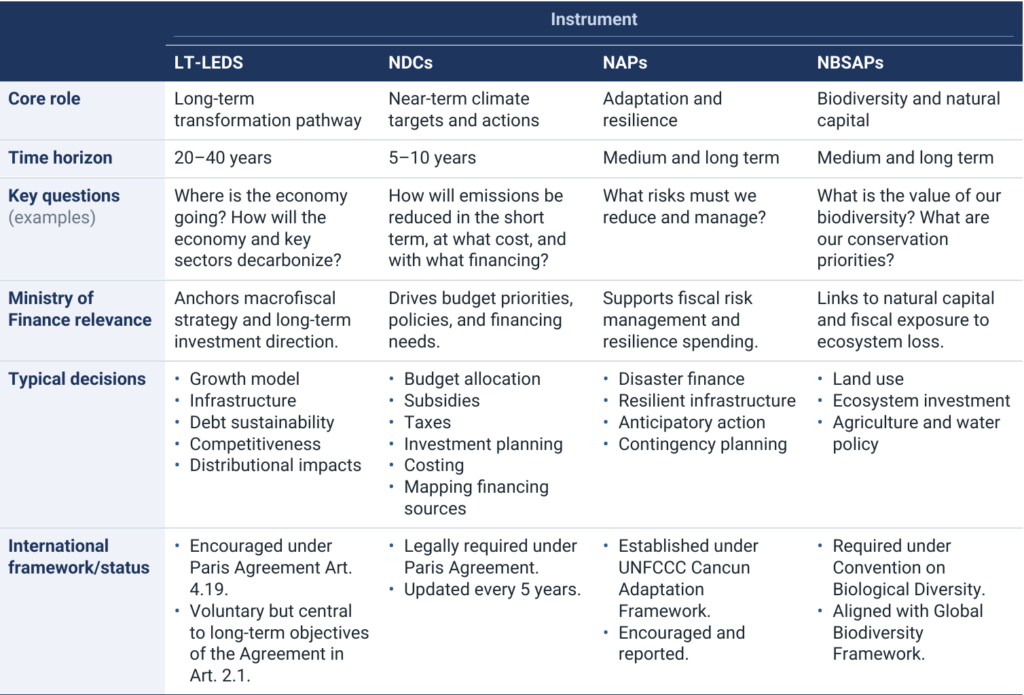
Source: Based on contribution from Marcella Jaramillo (2050 Pathways).
Ministries of Finance play a pivotal role in bringing these instruments together and can play a range of similar roles across three key stages in their development (see Figure 1).
Figure 1. Role of Ministries of Finance in the key stages of climate plans
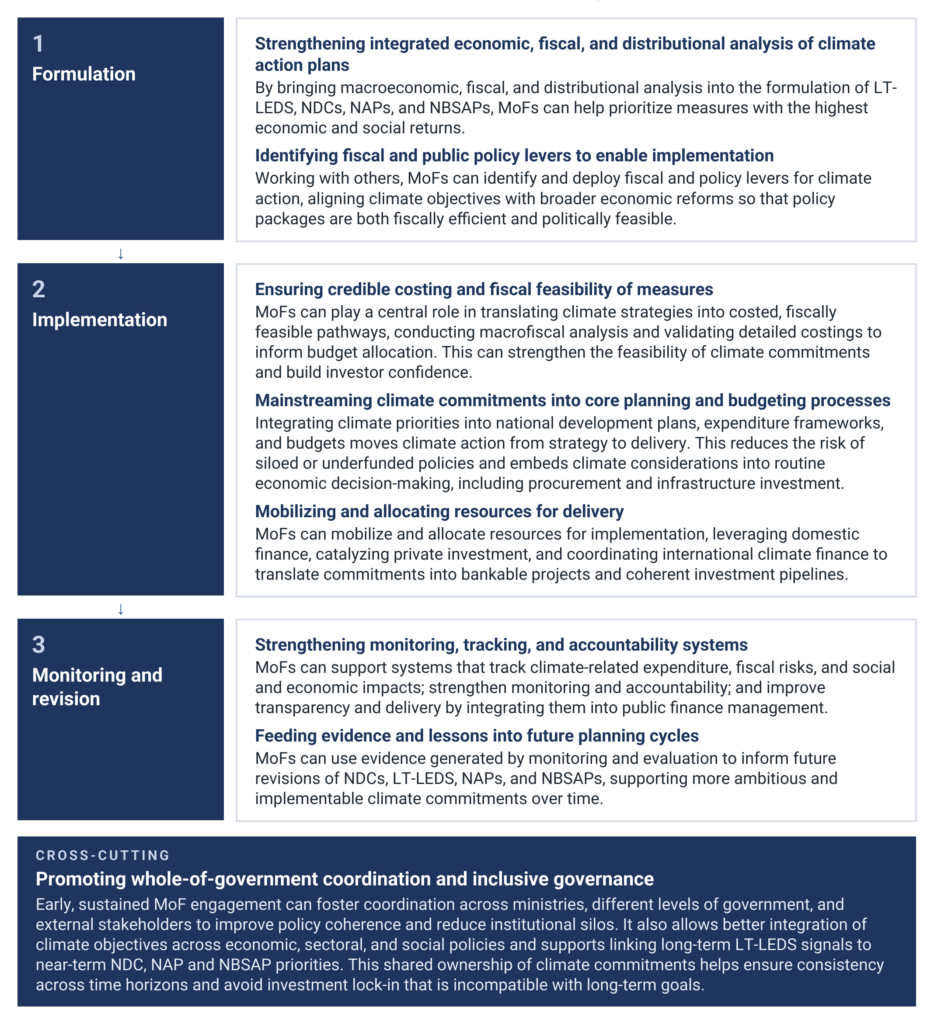
Source: NDC Partnership; CFMCA (2024).
The remainder of this Action Area discusses the four planning instruments and the role of MoF in more detail.
Long-term low-emission development strategies (LT-LEDS)
Nationally Determined Contributions (NDCs)
National Adaptation Plans (NAPs)
National Biodiversity Strategies and Action Plans (NBSAPs)
2050 Pathways Initiative (Marcela Jaramillo); NDC Partnership (Joaquim Leite, Adrian Flores).
2050 Pathways Platform (2025a) Beyond targets: Demystifying long-term climate strategies. Paris: 2050 Pathways Platform.
Coalition of Finance Ministers for Climate Action [CFMCA] (2024) Strengthening Ministries of Finance’ capacity and engagement in NDCs. Thematic Policy Note.
Secretariat of the Convention on Biological Diversity [CBD Secretariat] (2025a) Review of revised and updated NBSAPs. Montreal: Secretariat of the Convention on Biological Diversity.
World Bank (2026) From paper to practice: How to make long-term strategies work. Washington, DC: World Bank.