Combining instruments into coherent policy packages
It covers:
• How packages are composed for different objectives.
• The order in which instruments are introduced.
• How a MoF identifies and resolves conflicts between instruments.
• How distributional effects are assessed and integrated into package design.
• The coordinating role a MoF can play across government.
Context and role of Ministries of Finance
A coherent package of instruments, not any single tax or subsidy, is what can allow MoFs to contain the cost of the transition to a low-carbon, climate-resilient, and nature-positive economy. It is also enables the opportunities for growth and competitiveness that the transition can offer. Decarbonization requires simultaneous action on multiple market failures. Carbon pricing corrects for the negative externality of emissions, but technology spillovers, capital-market imperfections, behavioral barriers, distributional impacts, and network effects are market failures that pricing alone does not resolve.
Each action calls for its own instrument, and empirical evidence supports this logic. An analysis of 1,500 climate policies across 41 countries found that the 63 cases of large emission reductions it identified relied mostly on combinations of instruments, with standalone measures rarely succeeding (Stechemesser et al., 2024). This evidence suggests that a key consideration is not whether countries combine instruments, but rather which ones they blend and how. A coherent policy package, in the sense used here, is a coherent one with each instrument addressing a distinct market failure and none counteracting another.
The composition of a policy package varies by objective
Mitigation-focused packages typically combine carbon pricing with complementary regulatory standards, public investment, and targeted fiscal support. One such combination is a carbon tax alongside building performance standards, concessional finance for energy retrofits, and reformed electricity tariffs. It can also include assistance for low-income households, skills measures for retrofit workers, and adjustment support for affected micro, small and medium enterprises.
Each element depends on a delivery system, such as a social registry for targeted transfers, a credit channel for concessional finance, or an inspection service for building standards. Where they are not yet in place, a package can start with what existing systems can support and widen as capacity develops.
Packages can also pursue mitigation, adaptation, biodiversity, and social inclusion objectives in parallel
For example, investments in building insulation paired with skills development reduce emissions while increasing resilience to heat stress. Nature-based solutions, such as reforestation and mangrove restoration, sequester carbon and reduce flood risk while creating opportunities for local employment. In agriculture-dependent economies, improved water management and climate-resilient crops raise yields on existing land, strengthening food security while reducing pressure on forests and wetlands.
Payments for ecosystem services reinforce this by compensating landowners and communities for maintaining land-based carbon storage, watershed regulation and biodiversity habitat. Designing these investments together can allow governments to concentrate scarce fiscal resources on interventions with the highest combined benefit (Coalition of Finance Ministers for Climate Action [CFMCA], 2026).
Policy sequencing matters as much as the composition
Evidence from G20 economies shows that carbon pricing has consistently come late in the reform cycle; countries often adopt it after accumulating longer sequences of other instrument types like regulatory standards, grants and subsidies, and public procurement and investment (Linsenmeier et al., 2022). Countries with longer prior policy sequences also tend to set carbon pricing at higher initial price levels, which suggests that earlier adoption reduces the barriers to more stringent pricing.
This pattern reflects both economic logic and political economy, as when clean alternatives remain costly and limited, pricing signals can generate resistance without driving investment. This essential political economy consideration highlights why the social and labor dimensions of a just transition are suggested as a key factor for package design from the outset rather than at implementation. This can include directing carbon tax and levy revenues to targeted cash transfers; retraining programs; transition funds and broader support packages linked to green business development; green job creation; workers’ transition; and regional diversification (see Function 2, Carbon Pricing, Subsidy Reform & Fiscal Incentives).
Revenue may also flow to the general budget without earmarking, as most tax revenue does, which preserves budget universality and spreads the interest in the pricing instrument across ministries; earmarking makes the link between the charge and its use visible to those who pay it. When several measures rely on the same revenue stream, the policy package needs to specify how the revenue will be divided among them and which measures require additional funding from other sources.Integrating these measures into the package from the outset supports policy durability (Hallegatte et al., 2023).
The instrument mix evolves as technologies develop and the constraints on adoption change
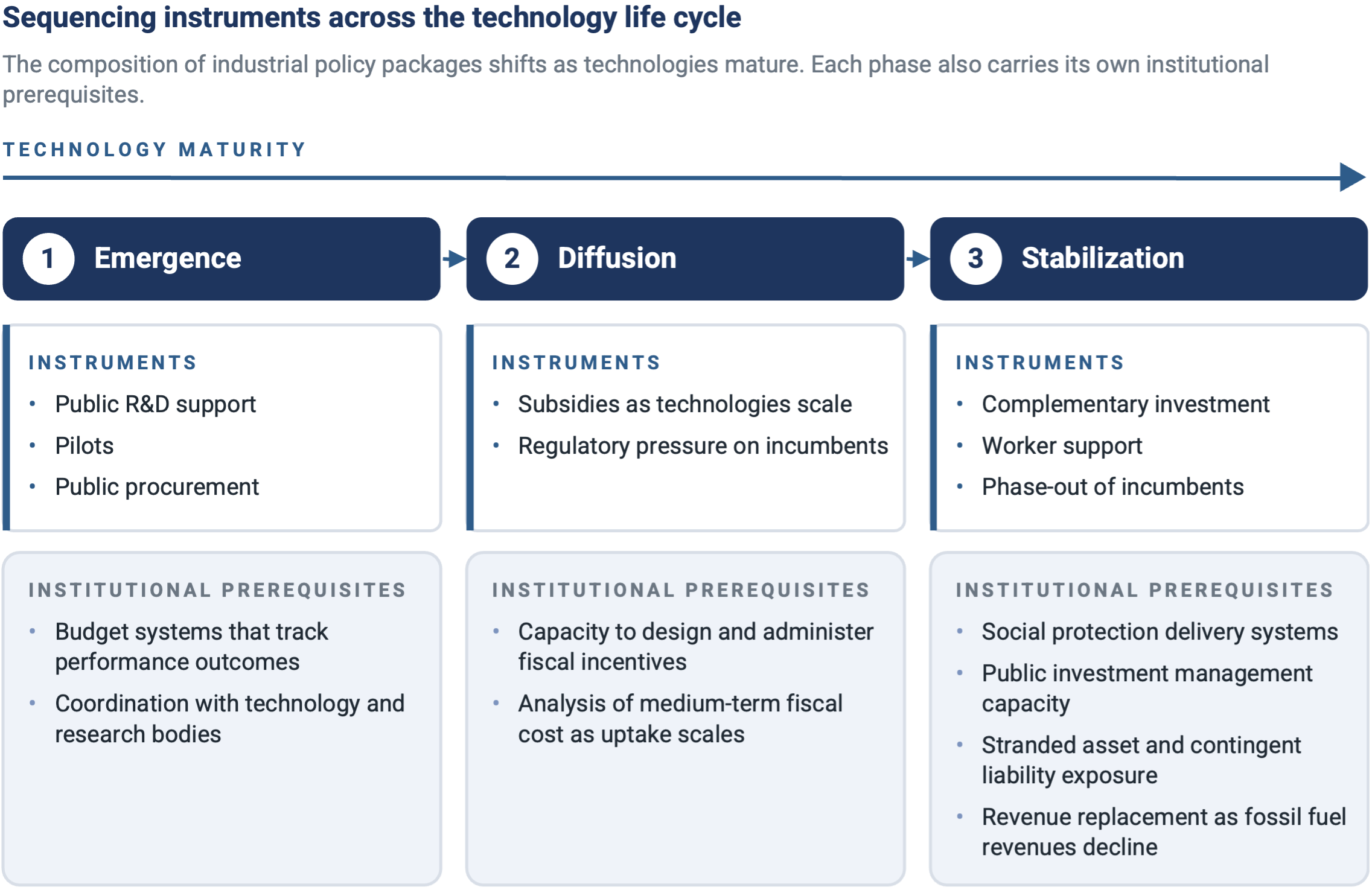
Public R&D support, pilots, and procurement can boost emerging technologies. During the diffusion phase of the technology life cycle, subsidies and regulation can encourage wider adoption. Complementary investment, worker support, and measures governing the phase-out of incumbent technologies can support adjustment as the transition progresses. These instruments illustrate how a package can evolve across technology stages, with their timing reflecting country conditions and implementation needs (Figure 1; CFMCA, 2026; Never and Kemp, 2017; see Function 1, Shaping 21st century industrial and innovation strategies).
Figure F2a(iii).1. Sequencing instruments across the technology life cycle, from emergence to diffusion to stabilization
Source: Coalition of Finance Ministers for Climate Action (2026).
Combining instruments introduces the risk of conflicting signals
Carbon pricing and fossil fuel subsidies operating simultaneously can neutralize each other’s incentive effects, so targeted, time-limited support may still be needed to cushion the adjustment. A carbon tax applied on top of a binding emissions trading system may reduce the carbon price in the scheme without reducing total emissions if the volume cap is not adjusted.
This dynamic is known as the waterbed effect, which the European Union partially addresses through the Market Stability Reserve Mechanism (CFMCA, 2026). Systematic mapping of instrument combinations across sectors identifies these interactions before they become embedded. A basic inventory of existing instruments and their frequency, which a small team can maintain, can highlight direct conflicts such as a fuel subsidy operating alongside a fuel levy. Integrated analytical tools and regular cross-government review extend that mapping where capacity allows.
MoFs can provide the institutional backbone for package coherence
Beyond designing fiscal instruments within their direct mandate, MoFs can act as a coordinating authority, that is, a distinct function inside interministerial commissions rather than simple membership. That role includes offering a second opinion on the climate compatibility of regulatory proposals from line ministries; and commissioning or maintaining integrated macroeconomic and sectoral models that capture cross-policy interactions. It also includes building climate criteria into budget frameworks, for example through climate budget tagging or requirements set in the budget circular.
Joint modeling exercises across ministries can identify in advance where overlaps or contradictions would undermine package effectiveness. Italy and France pursue the same aim through committee and planning structures. Documented practice of this kind comes from administrations with established modeling and coordination capacity, so this Action Area does not have a comparable case from a low-income or donor-dependent administration. The barriers section below and Capability 2, Coordination and collaboration for whole-of-economy climate action, treat the institutional design options behind this coordination; the focus here is what coordination delivers for package coherence.
Barriers and ways to overcome them
Several barriers impede coherent package design, and most apply across MoF functions. The appropriate response will depend on national circumstances, institutional mandates and available capacity.
Each policy package obstacle below is paired with what a MoF can do in a constrained environment. The wider menu is given in the Policy package opportunities for action section.
Competing objectives and policy trade-offs are not evaluated before implementation begins
Governments balance economic growth, energy access, social protection, climate commitments, and fiscal sustainability, but the trade-offs between those goals are often unquantified. The nature of these trade-offs varies by context. Fossil fueldependent economies face the fiscal implications of reducing extractive revenues while building alternative tax bases (see Function 2, Identifying alternative revenue streams to taxing fossil fuels). Least-developed countries balance expanding energy access against meeting mitigation commitments. Fossil fuel importing countries face the near-term task of securing and diversifying supply, including investment in import infrastructure and long-term contracts, even where the long-term goal is to phase out those fuels. Emerging-market economies weigh carbon competitiveness risks and industrial transition costs against their own decarbonization timelines and measures adopted in partner markets. Small island developing states often prioritize adaptation over mitigation due to their high climate vulnerability.
Approach. Compare alternative policy packages to make trade-offs explicit before implementation.
MoFs examine the fiscal implications of different instrument combinations alongside their economic, social, and climate effects. Comparing packages reveals tensions between objectives, the distribution of costs and benefits across sectors and households, and differences between near-term and longer-term outcomes. This analysis informs the composition, scale, and sequencing of the package, reflecting national priorities, fiscal capacity, and implementation constraints (CFMCA, 2026).
Fiscal instruments are designed without the sector regulators
Ministries operate within defined sectoral mandates, and coordination with energy, industry, and transportation regulators is not systematic. The result is packages assembled in parallel rather than in sequence, for example carbon pricing introduced while fossil fuel subsidies persist in the same sector or industrial policy advanced without coordination with trade measures. Without a formal mechanism for cross-government coordination and review, policy incoherence and its effects may only surface after instruments are in place.
Approach. Use the coordination processes that already exist and establish a standing route for reviewing interactions between fiscal, regulatory, and investment measures.
Italy’s Interministerial Committee for Ecological Transition (Comitato interministeriale per la transizione ecologica), whose members include the Minister of Economy and Finance, coordinates the National Policy on the Ecological Transition (Government of Italy, 2021). France prepares its national low-carbon strategy and multiannual energy plan as one exercise, published by both the Ministry of Ecological Transition and the MoF (Government of France, 2026).
In the absence of a standing body, a joint review of a defined set of instruments provides a more limited basis for coordination. Such a review examines how those instruments interact, while leaving the wider portfolio outside its scope. Institutional collaboration is treated in depth in Capability 2, Coordination and collaboration for whole-of-economy climate action.
Analytical tools have limited capacity to assess interactions between policy instruments
In many MoFs, macroeconomic tools can assess the fiscal cost of a carbon tax or a subsidy in isolation but cannot simulate how those instruments interact when combined or estimate net emissions abatement across overlapping or conflicting measures. This leaves policymakers without the evidence base and capacity needed to identify conflicts in advance or to optimize the composition of a package before implementation (CFMCA, 2026).
Gaps in analytical capacity also include a limited ability to identify import-heavy transition pathways before they are locked in. Without supply-chain and domestic value-added analysis, MoFs may approve packages that meet emissions objectives but underdeliver on employment, industrial development, and revenue while increasing external vulnerability (Magacho et al., 2023).
Approach. Develop analysis of instrument interactions alongside domestic modeling capacity.
About one in five MoFs has a dedicated internal climate-economy model and about one in eight uses an external model, while three quarters report needing support to build in-house capability (Surminski and Baeza Breinbauer, 2025).
An inventory of existing and proposed measures can provide an initial analysis of their objectives, coverage and potential conflicts. Published tools, partner analysis and external expertise can support more detailed examination of their combined effects as domestic capacity develops (CFMCA, 2026; see Capability 3, Enhancing economic decision-making tools and data-driven analysis). Supply chain and domestic value-added analyses can extend this work to employment, imports, and external exposure, which emissions-focused analysis alone may leave unresolved (Magacho et al., 2023). Subsequent reviews incorporate any changes in the package or economic conditions as well as evidence gathered from implementation.
Unevenly distributed costs can undermine support for reform
Carbon pricing and fossil fuel subsidy reform concentrate short-term costs on identifiable groups: energy-intensive industries, fuel suppliers, smaller businesses, and lower-income households facing higher energy costs. These groups may generate organized opposition capable of blocking or diluting packages. Where package design does not address these losses directly, backlash can slow or reverse reform. Short electoral cycles compound the problem: the transition requires sustained multi-year commitments, but governments face incentives to defer costly measures and bring forward visible near-term benefits.
These dynamics explain why long-standing carbon pricing efforts have slowed or been reversed in several countries as concentrated, visible losses mobilize opposition faster than scattered gains build support. Carbon pricing introduced without compensation or complementary investment has proven vulnerable to freezes and repeal (Hallegatte et al., 2023).
Approach. Examine how support for affected groups and access to alternatives influence the feasibility and durability of a package.
Distributional analysis examines how the combined measures affect household incomes, business costs, and employment, informing the coverage and timing of transfers, worker support, and complementary investment. Their financing and delivery form part of package design, alongside the measures that impose adjustment costs (Hallegatte et al., 2023).
The financing requirements of a policy package exceed available fiscal space
Particularly in lower-income and heavily indebted economies, public investment in clean energy, concessional finance for industry, and social protection accompanying subsidy reforms often exceed domestic fiscal capacity. High real interest rates raise the cost of long-term commitments, while uncertainty about future carbon revenue trajectories introduces budgetary risk for governments that have factored those revenues into medium-term planning.
Approach. Assess the full package to make financing requirements and fiscal exposure visible over time.
MoFs consider direct expenditures, tax expenditures, and revenue effects alongside guarantees and other contingent liabilities. Comparing these commitments with available resources informs the scale and sequencing of measures within the medium-term fiscal framework (see Function 2, Using public financial management and the budget to drive transformation).
External finance can meet part of the investment requirement, although its contribution depends on the volume, terms, and timing of support. South Africa’s Just Energy Transition Investment Plan illustrates the difference between an initialinternational financing pledge and the investment needs of a wider program (The Presidency of South Africa, 2022). Assessing externally financed measures within the overall package also clarifies their debt implications, future budget costs, and relationship to domestic priorities.
Different instruments require different institutional capabilities during the technology life cycle
The instruments appropriate at each stage of technology development carry distinct institutional prerequisites. Emergence-phase instruments require budget systems capable of tracking performance outcomes and coordination mechanisms between the MoF and technology or research bodies. Diffusion-phase instruments require capacity to design and administer fiscal incentives, whether as tax expenditures or direct spending programs, and the analytical capacity to assess their medium-term fiscal cost as adoption scales up. Stabilization-phase instruments, including worker transition support and complementary investment, require social protection delivery systems and public investment management capacity. The fiscal dimensions of incumbent phase-out sit with the MoF, including stranded asset risks, contingent liabilities, and revenue replacement as fossil fuel revenues decline.
Approach. Align the composition and pace of a package with the systems available to implement it.
Different instruments depend on different capabilities, including performance monitoring for innovation support, tax administration for fiscal incentives, and delivery systems for public investment and social protection. These requirements change as the instrument mix evolves with technology development (CFMCA, 2026; Never and Kemp, 2017).
Assess administrative readiness to inform the initial scope of the package and the preparatory work needed for subsequent measures. Worker support, revenue replacement, and fiscal-risk assessment can begin before incumbent activities contract, reflecting the time required to establish delivery arrangements and manage future commitments (see Function 1, Shaping 21st century industrial and innovation strategies, Function 2, Managing the fiscal risks of cascading contingent liabilities and Capability 3, Enhancing economic decision-making tools and data-driven analysis).
Opportunities for action
MoFs can work with relevant ministries and public institutions to improve coherence across climate-policy packages, rather than designing individual fiscal instruments in isolation. Their budget coordination and analytical functions can support instrument combinations that address multiple market failures, follow the maturity of the technologies they support, and avoid mutual contradiction. MoFs may wish to consider the pursuing opportunities for action, which broadly increase incomplexity but are options rather than a prescribed sequence. A ministry may pursue advanced actions where it has capacity while building foundations in others.
Map existing fiscal instruments, regulations, and public investment commitments across climate-relevant sectors, along with their impacts on vulnerable groups such as small businesses, informal workers, and low-income households. The aim is to identify which market failures the portfolio addresses, where instruments overlap or conflict, and where substantive gaps remain. The OECD’s Climate Actions and Policies Measurement Framework tracks the adoption and ambition of climate policies across countries and can structure this mapping; countries outside its coverage can apply the same classification to their own instrument inventory. Adding instruments to an unmapped portfolio risks compounding incoherence rather than resolving it (D’Arcangelo et al., 2024).
Distinguish between problems that price signals can address and those requiring regulation, public investment, or targeted support. Carbon pricing can address the emissions externality but may not, by itself, overcome infrastructure gaps, innovation spillovers, information failures, or split incentives. MoFs can work with line ministries and relevant public institutions to assess the fiscal and distributional implications, administrative feasibility, and interactions of proposed measures, for example, combining building standards with renovation finance or vehicle standards with investment in charging infrastructure. Where relevant, package assessments can also consider externalities beyond carbon, including nature loss (see Function 2, Carbon Pricing, Subsidy reform and Fiscal Incentives).
Assess expected receipts alongside the costs of household support, transition investment, and other package measures. Revenue can support these expenditures through the general budget or through designated allocations, depending on national budget arrangements. These choices shape the package’s distributional effects, financing, and public support. Explicit provision for each expenditure commitment avoids counting the same receipts against several uses and makes any additionalfinancing requirement visible. For example, in a carbon-pricing package, revenues could help fund household support or transition investment, be allocated through the general budget, or be directed to designated programs depending on national arrangements (see Function 2, Carbon Pricing, Subsidy Reform & Fiscal Incentives and Using Public Financial Management and the Budget to Drive Transformation).
Structure engagement with employers’ and workers’ organizations to highlight distributional impacts, employment effects, enterprise adjustment needs, and implementation bottlenecks before measures are finalized. This can also build the public trust and political coalitions that sustained reform needs.
Establish cross-ministerial coordination mechanisms, formal or informal, that give the MoF a standing role in reviewing the climate compatibility of regulatory and spending proposals from line ministries before they are finalized. Structured diagnostics such as the Capability Assessment Framework, which helps Ministries of Finance assess their institutional, analytical and coordination capabilities for integrating climate action into their core functions and identify priorities for strengthening them can identify priority coordination gaps and support reform without a prior formal mandate, as Spain’s experience demonstrates (see Capability 2, Coordination and collaboration for whole-of-economy climate action).
Deploy fiscal incentives with time-limited conditionality aligned to medium-term expenditure frameworks, phasing support out as technologies reach commercial viability. This helps ensure that support evolves with the technologies it is intended to develop rather than becoming a permanent fiscal commitment.
Deploying subsidies, public investment, and regulatory standards before carbon pricing, and where fiscal conditions allow, is one sequencing option. Because this order front-loads expenditure ahead of the revenue that pricing later provides, its profile can be set against the medium-term expenditure framework from the outset. Where carbon pricing already operates, the task is instead to adjust the surrounding mix. Announce carbon price trajectories in advance and embed them in legislation where possible to provide investment certainty beyond electoral cycles (Linsenmeier et al., 2022; Tchorzewska et al., 2025).
Build analytical capacity to simulate the net fiscal and abatement impact of instrument combinations rather than single measures in isolation (see Capability 3, Enhancing economic decision-making tools and data-driven analysis). Joint modeling platforms shared between the MoF and other ministries reduce the risk of instrument conflicts going undetected before implementation and provide the evidence base for regular package review and course correction. UK TIMES, an energy system model developed by University College London with the UK Department for Energy Security and Net Zero, is maintained across government rather than inside a single department (UCL Energy Institute, 2018). The CFMCA report How Ministries of Finance Can Support Coherent Climate Policy Packages: Available Analytical Tools and Emerging Good Practice surveys the analytical tools available for this (CFMCA, 2026).
Real-world examples
European Union
The Fit for 55 package is projected to deliver a 54% reduction in net emissions below 1990 levels by 2030—just short of the 55% target—provided current and planned policies and measures are implemented in full (European Environment Agency, 2025). The projection aggregates the measures Member States report; it does not disaggregate the contribution of individual instruments or their interactions. The architecture is centered on the EU Emissions Trading System (ETS), which creates the carbon-price signal and generates revenues to both support clean investment and mitigate distributional impacts. Complementary instruments seek to protect that price signal from carbon leakage and align it with the wider EU industrial strategy. The ETS applies a carbon price to electricity and heat generation, energy-intensive industry, aviation, and maritime transport. A portion of its auction revenues finances the Innovation Fund, which supports first-of-a-kind clean technologies at commercialscale. ETS revenues also underpin the Social Climate Fund, which combines EU resources with national co-financing to support vulnerable households, micro-enterprises, and transport users. The Carbon Border Adjustment Mechanism complements the ETS by applying a corresponding carbon cost to specified imports, with the stated aim of reducing carbon-leakage risks; its design and trade implications are outlined in Function 1, Shaping 21st century industrial and innovation strategies. The Clean Industrial Deal, adopted in February 2025, builds on this architecture by linking decarbonization instruments to lead markets for clean technologies and products as well as a broader strategy for industrial competitiveness (European Commission, 2025).
Costa Rica
The MoF used earmarked fossil fuel and water taxes to fund a forest conservation program. Dedicating that revenue to the program also withholds it from the general budget envelope, which is the cost side of the arrangement. The National Fund for Forest Finance (Fondo Nacional de Financiamiento Forestal) pays private landowners for conservation and restoration using fossil fuel and water tax revenues. Forest cover rose from a low of 21% in 1987 to 52% in 2013 (World Bank, 2020). Restoration returned biodiversity and ecosystem services that support a tourism sector whose receipts usually represent more than 19% of annual exports (ibid.).
Brazil
Modeling capacity can anchor green industrial package design, for example through the Ecological Transformation Plan (Plano de Transformação Ecológica) and the New Industry Brazil (Nova Indústria Brasil) agenda. They draw on tools such as ESTEEM, a dynamic input–output structure which assesses how climate investment affects domestic value added, employment, imports, and the balance of payments (Magacho and Spinola, 2025); and FSMAT, a stock-flow consistent disequilibrium model that compares financing strategies for the transition (Valdecantos and Espagne, 2025). Analysis of this kind helps a MoF judge whether a package is not only green but also growth-enhancing and consistent with the fiscal envelope.
South Africa
Assembled under acute fiscal stress, the National Treasury combined a phased carbon tax with 254 bn rand of debt relief for the state electricity public utility Eskom, conditioned on restructuring and transition commitments. The Just Energy Transition Investment Plan sits alongside them. It programs R1.48 tn (about US$98 bn) of investment needs for 2023–2027 across electricity, new energy vehicles, and green hydrogen, seeded by a US$8.5 bn international pledge (National Treasury of South Africa, 2023; The Presidency of South Africa, 2022).
The package ties fiscal risk management to the transition rather than treating the two as separate problems. This case also highlights a distinct financing constraint: the US$8.5 bn pledge amounts to under a tenth of the programmed need, so the domestic budget and domestic capital markets remain the primary sources of finance.
India
Solar module manufacturing capacity grew from 15 GW in 2020 to 74 GW by 2025, making India the second-largest producer globally; by 2024, it already accounted for 71% of all the country’s power sector additions (Casey, 2025; Norman, 2025).
On-budget support through the Production Linked Incentive scheme was narrow (around US$1.8 bn annually), and only paid out once manufacturing capacity and sales were secured. This was complemented by depreciation and transmission charge waivers (Raizada et al., 2024; Rajshekar, 2024).
The larger share was organized off-budget through state-owned banks, development finance institutions, and 25-year power purchase agreements from state distribution companies (Larsen, 2025). The arrangement separates fiscal capacity from state financing capacity, with the contingent liabilities associated with the distribution companies rather than as direct costs in the budget (International Energy Agency, 2024).
United Kingdom
Greenhouse gas emissions fell by 44% from 1990 to 2019, driven mainly by power generation as coal gave way first to gas and then to renewables (UK Office for Budget Responsibility, 2021). The package paired instruments that raised the cost of coal, notably the carbon price floor overlaying the EU ETS, with instruments that cut the cost of renewables like feed-in tariffs for small-scale generation and Contracts for Difference guaranteeing larger producers a fixed price. Levies on electricity bills financed both, so part of the package cost fell on households and industrial consumers. Standards sat alongside these, such as the 2030 ban on the sale of new petrol and diesel cars.
Council on Economic Policies (CEP) (Patrick Lenain), UNCTAD (Rachid Amui, Chantal Line Carpentier, Claudia Contreras, Clovis Freire, Lorena Jaramillo Castro, Malick Kane, Jingyuan Wu) Grantham Research Institute (GRI) (Mathias Larsen).
African Risk Capacity (2025) Africa RiskView. Johannesburg: African Risk Capacity Group. https://www.arc.int/africa-riskview
Casey J (2025) India almost trebles cell manufacturing capacity to 25 GW in 12 months to March 2025. PV Tech.
Coalition of Finance Ministers for Climate Action (2026) How Ministries of Finance Can Support Coherent Climate Policy Packages: Available Analytical Tools and Emerging Good Practice. Report for the HP4 initiative.
D’Arcangelo F M, Pizarro R, Nachtigall D, et al. (2024) The Climate Actions and Policies Measurement Framework: A Database to Monitor and Assess Countries’ Mitigation Action. Environmental and Resource Economics 87: 191–217.
European Commission (2025) The Clean Industrial Deal: A Joint Roadmap for Competitiveness and Decarbonisation. COM(2025) 85 final. Brussels, 26 February 2025.
European Environment Agency (2025) “Trends and projections: greenhouse gas emissions largely on track to 2030 targets”, Press release, 6 November 2025.
Government of France (2026) Programmation pluriannuelle de l’énergie 2026-2035 and Stratégie nationale bas-carbone. Paris: Ministère de l’Économie et des Finances; Ministère de la Transition écologique.
Government of Italy (2021) Presidenza del Consiglio dei Ministri, Dipartimento per la programmazione e il coordinamento della politica economica (DIPE). Comitato interministeriale per la transizione ecologica (CITE). Rome. Established by decreto-legge1 marzo 2021, n. 22, art. 4, converted by legge 22 aprile 2021, n. 55.
Hallegatte S, Godinho C, Rentschler J, Avner P, Dorband II, Knudsen C, et al. (2023) Within Reach: Navigating the Political Economy of Decarbonization. Climate Change and Development Series. World Bank.
IEA (2024) World Energy Investment 2024: India. Paris: International Energy Agency.
Larsen M (2025) Green industrial policy under financial constraints: insights from India’s state-led decarbonization. World Development 195: 107–153.
Linsenmeier M, Mohommad A, and Schwerhoff G (2022) Policy Sequencing Towards Carbon Pricing: Empirical Evidence from G20 Economies and Other Major Emitters. IMF Working Paper No. 2022/066. International Monetary Fund.
Magacho G, Espagne E, Godin A, Mantes A, and Yilmaz D (2023) Macroeconomic exposure of developing economies to low-carbon transition. World Development 167: 106–231.
Magacho G, and Spinola D (2025) Integrating Ecological, Productive, and Macrofinancial Spheres with ESTEEM: A System Dynamics Framework to Assess Brazil’s Transformation Plan. CAFE Working Paper 38. Birmingham City Business School, Birmingham City University.
National Treasury of South Africa (2023) Budget Review 2023, Annexure W3: Eskom debt relief. Pretoria: National Treasury.
Never B, and Kemp R (2017) “Developing green technologies and phasing them in”. In: Altenburg, T. and Assmann, C. (eds.) Green Industrial Policy: Concept, Policies, Country Experiences, pp. 87-101. Geneva and Bonn: UN Environment and German Development Institute. ISBN 978-92-807-3685-4.
Norman J (2025) Despite a Record Year, India Needs to Double Renewables Deployment by 2030 to Meet Energy Targets. Global Energy Monitor.
Raizada S, Sharma D, Laan T, and Jain S (2024) Mapping India’s Energy Policy 2023. Winnipeg: International Institute for Sustainable Development.
Rajshekar M (2024) Chasing the sun: unlikely firms are betting on solar. Carbon Copy.
Stechemesser A, et al. (2024) Climate policies that achieved major emission reductions: Global evidence from two decades. Science 385 (6711). https://doi.org/10.1126/science.adl6547
Surminski S, and Baeza Breinbauer D (2025) How Ministries of Finance Can Assess and Manage Physical Climate Risks and Adaptation: Available Analytical Tools and Emerging Good Practice. Coalition of Finance Ministers for Climate Action.
Tchorzewska KB, Del Rio P, Garcia-Quevedo J and Martinez-Ros E (2025) Carrot first, stick second? Environmental policy-mix sequencing and green technologies. Technological Forecasting and Social Change 210: 123835.
The Presidency of South Africa (2022) South Africa’s Just Energy Transition Investment Plan (JET IP) 2023-2027. Pretoria: The Presidency.
University College London (2018) National Grid adopts UCL’s UKTIMES model. 28 February. https://www.ucl.ac.uk/bartlett/news/2018/feb/national-grid-adopts-ucls-uktimes-modelUK Office for Budget Responsibility (2021). Fiscal risks report. London: OBR.
Valdecantos S and Espagne E (2025) FSMAT: Incorporating Climate Finance into a Stock-Flow Consistent Disequilibrium Framework. Compendium of Practice. Coalition for Capacity on Climate Action (C3A).
World Bank (2020) Costa Rica REDD+ Emission Reductions Program. Washington, D.C.