Using public financial management and the budget to drive transformation
It covers:
• Climate considerations across the budget cycle, from macro
• How medium-term fiscal and expenditure frameworks can connect climate and development plans to funded programs while managing fiscal risks.
• Classification and climate budget tagging and spending reviews as inputs to allocation decisions.
• How execution, performance monitoring, reporting, and audit can track delivery and inform future budgets.
• How the scope and pace of reform can reflect available capacity and build on existing public financial management systems.
Context and role of Ministries of Finance
Financing the transition works through existing budget processes
The budget is the central instrument available to a Ministry of Finance (MoF) for allocating public resources, shaping incentives, and supporting private finance mobilization in line with the transition. Development strategies, Nationally Determined Contributions (NDCs), and adaptation plans remain unfunded commitments unless their priorities are reflected in the budget. Yet most expenditure is already committed to debt service, the wage bill, and statutory transfers. The practical task is therefore to use a limited discretionary margin and, over time, redirect the existing stock of spending rather than assume that new resources are available.
MoFs have taken on major new claims before, from pensions to universal health coverage and mass schooling, and have built systems to appraise, finance, and sustain them (Schuknecht and Tanzi, 1995). Financing the transition draws on the same processes, though its front-loaded capital costs and long, uncertain payback periods are more similar to infrastructure investment. Much of the required spending remains ordinary investment that an MoF would assess on its economic merits irrespective of whether it carries a climate label. However, where investments also delivers demonstrable climate benefits, they may support access to concessional finance and help establish additionality for financing partners.
The budget cycle provides the organizing frame
MoFs plan, allocate, execute, and account for public money through the budget cycle. It runs from macro–fiscal forecasting and fiscal strategy through budget preparation and approval to execution, accounting, reporting, and audit (Allen et al., 2015). Public financial management (PFM) comprises the institutions, rules, and systems through which governments manage public resources. Green PFM integrates climate and environmental considerations into these existing arrangements rather than creating parallel systems (IMF, 2021).
Each phase of the budget cycle offers a different entry point
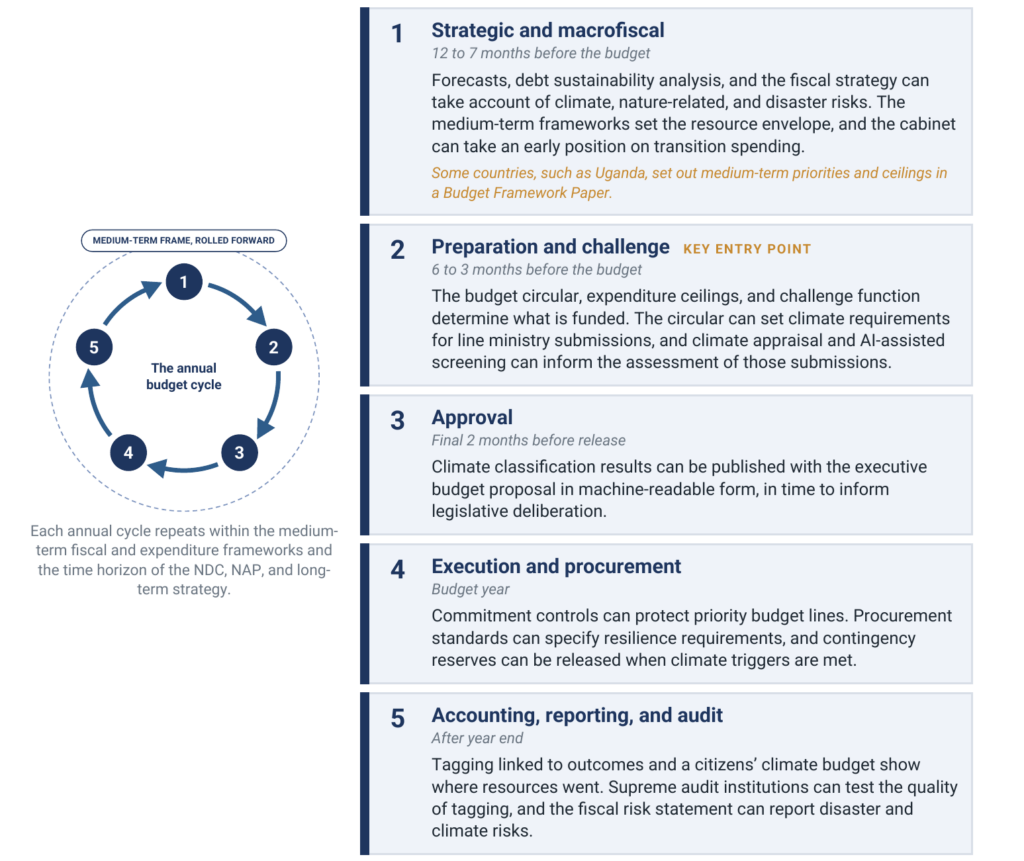
This Action Area focuses on budget formulation and considers what each of the following the entry points in the PFM cycle require in administrative cost, capacity, and political economy (see Figure 1):
- In the strategic and macro
–fiscal phase, climate, nature-related, and disaster risks may enter forecasts, debt sustainability analysis, and the fiscal strategy that setsthe resource envelope.
- During preparation, the circular, expenditure ceilings, and challenge function determine what is funded.
- At approval, published classification results can inform legislative deliberation.
- For execution and procurement, the question is whether spending produces the intended outputs.
- Accounting, reporting, and audit show where resources went and allow findings to inform future circulars
..
Figure 1. The public financial management cycle and where climate action enters
Source: Adapted from Appendix 2, Key entry points for mainstreaming climate action in budget formulation prepared by Peter Murphy, (Expert Advisory Group) and IMF (2021).
Note: Timings are indicative.
Budget formulation has the greatest influence over allocations
Budget formulation is the main point at which an MoF can influence allocations to support growth, competitiveness, and resilience as the economy decarbonizes (Petrie, 2021). The aim is to finance the transition while protecting the public balance sheet against climate and disaster shocks. However, in most countries existing budget allocations fall short of the operating and capital expenditure required, including the funds needed to implement the climate and development strategies covered in Function 1.
Public sources provided US$796bn of climate finance in 2024, about 40% of the US$2.008tn total, while the average annual requirement to 2030 is estimated at US$7.8tn (Climate Policy Initiative, 2026). For developing countries other than China, the Independent High-Level Expert Group on Climate Finance puts the requirement at US$2.3–2.5tn a year by 2030 (Bhattacharya et al., 2024).
The budget can also support finance beyond its own resources. A credible fiscal framework, a pipeline of appraised projects, and clear signals through tagging, standards, guarantees, and blended finance facilities can help attract concessional and private capital rather than substitute for it (see Function 3, Driving innovations in financing models, including blended finance; and Part A, Why Ministries of Finance matter for climate action and economic transformation).
Using the budget to support the transition starts before allocation
Recording the climate relevance of allocations already decided is necessary but not sufficient; it reports where the money went rather than deciding where it should go. The main decisions come earlier, when the MoF and relevant line ministries determine what will be funded, including through program-based budgeting in countries that use it. The MoF can specify what a submission needs to assist line ministries and streamline the approval process. Climate proposals can then be assessed against the same considerations as other major spending proposals, including effects on growth, public finances and stability, and value for money.
Conventional appraisal may understate the returns to adaptation where it does not adequately capture avoided losses and wider economic, social, and environmental benefits (Brandon et al., 2025). The same applies to ecosystem assets such as watersheds, wetlands, and forests that regulate water, reduce flood risks, and protect soils. Their contribution as natural infrastructure can be reflected in appraisal and in the performance indicators used to assess subsequent spending (see Function 2, Greening public investment management).
The budget also has a role in managing physical and transition risks
General fiscal buffers remain important because governments need to respond to many types of shock, not only climate-related ones. Physical climate risk is difficult to reduce to a single estimate because hazards evolve; tail risks can be large; and substantial exposures may sit in the losses and guarantees of state-owned power and water utilities. Fiscal risk statements can present ranges and identify contingent liabilities. Governments may also provide for these risks through reserves and, where available on appropriate terms, risk-transfer instruments. As disasters become more frequent, contingency provision may need to become a more regular part of budget practice (see Function 3, Providing disaster risk finance and insurance for all).
Established public investment management systems can mainstream climate considerations into the PFM cycle
Public investment management (PIM) is the appraisal and selection of major investment projects (see Function 2, Greening public investment management). Initial disaster-risk screening at the pre-appraisal stage may be feasible even where capacity is constrained. Appraisal tests the policy fit and value for money of major projects, and an MoF can adapt it so that material climate, nature-related, and disaster risks form part of that assessment.
Figure 1 sets out possible entry points for integrating climate action across a typical PFM process. They cover:
- Macrofiscal strategy and medium-term frameworks through budget circulars.
- Spending reviews.
- Climate budget tagging (CBT), a code, marker, or flag applied to budget lines, programs, or projects to identify their relevance to climate mitigation or adaptation; and tracking, the broader system that uses tagged data to monitor and report public climate finance.
- Hearings.
Entry points also extend to ex-post audit and parliamentary oversight, which normally sit outside the MoF. The timings and document names are illustrative, and no MoF is expected to follow every step.
The strategic planning and fiscal framework phase is the earliest point at which medium-term choices can be shaped
A medium-term fiscal framework (MTFF) is the top-down macrofiscal forecast that MoFs use to set aggregate revenue, spending, and deficit ceilings over the medium term; a medium-term expenditure framework (MTEF) is the allocation of those ceilings across sectors and programs over three to five years (Curristine et al., 2024).
Where medium-term frameworks are in place, the MoF and line ministries can translate priorities for national development plans, long-term strategies, NDCs, and NAPs) into funded programs rather than unfunded commitments. Climate shocks may affect growth, inflation, revenue, and spending needs, while transition policies may alter the tax base. If these effects are material but excluded from the fiscal strategy, projections of debt and available fiscal space may be incomplete (see Box F2c.2). The objective is to support an early agreement across government on spending priorities and the corresponding implications for revenue, debt, and allocations. This is typically done through the MTEF.
Box F2c.1. Using MTFFs to deliver climate and development plans
Climate-informed MTFFs prepared by the MoF increasingly incorporate:
- Climate-related impacts on growth, productivity, revenues, and expenditure.
- Expected disaster losses and recovery costs.
- Climate-adjusted macroeconomic and fiscal scenarios.
- Analysis of the costs of climate action alongside the fiscal risks of inaction.
- They can also bring adaptation, resilience, nature-related, and transition investments into medium-term expenditure planning; count climate-related operation and maintenance costs within ceilings; and size just-transition spending on skills and social protection.
On the risk side, they increasingly assess:
- Climate-related contingent liabilities.
- Disaster and upside risks.
- Debt sustainability and sovereign risk exposure.
- Revenue impacts of a changing tax base.
- Fiscal consequences of labor-market, income distribution, and regional adjustments.
MTFFs anchor policy coherence, informing the financing of NDCs, NAPs, and long-term strategies. They also feed climate scenarios into revenue and expenditure forecasts, guiding investment prioritization and sequencing and testing the affordability and fiscal sustainability of climate commitments.
Bangladesh’s Climate Fiscal Framework 2020, prepared by the MoF, provides a framework for linking climate-policy priorities and financing needs with budget planning, expenditure management and climate-expenditure tracking. Rwanda’s climate budget-tagging guidelines require climate-related budget information to follow the government’s three-year MTEF, helping incorporate climate programs and their costs beyond the annual budget cycle (Bangladesh Ministry of Finance, 2020; MINECOFIN, n.d.).
Where data and modeling capacity are limited, initial estimates can be drawn from existing national disaster and climate risk assessments, development partner analysis, or academic datasets and refined over time.
Source: Authors’ compilation, based on sources from UNDP, 2021 and OECD, 2025.
Clear MoF guidance during annual budget preparation can reduce the risk of late-stage climate-related allocations
This guidance can encourage line ministries to show how proposed spending supports national strategic objectives, consistent with frameworks such as the United Kingdom Treasury Green Book. Depending on the national system, this may include:
- Assessing the economic, social, environmental, and distributional effects of new climate policies.
- Comparing options and setting out fiscal implications.
- Identifying implementation barriers.
- Explaining proposed shifts in sector allocations within available fiscal space.
The challenge function turns strategy into scrutiny. An MoF can define the climate-related criteria that line-ministry submissions need to address before negotiations begin. The process can then test whether submissions reflect agreed priorities, respect ceilings, compare alternatives, demonstrate value for money, and use classifications and cost estimates that can be audited.
Detailed review may also consider the effectiveness and efficiency of proposed measures and establish performance indicators through output-based frameworks. While AI-assisted screening can help assess large numbers of proposals, it does not replace expert review (OECD, 2025).
Execution, reporting and audit determine whether budgeted allocations are delivered
Cash rationing, mid-year reallocations, and slow procurement can disproportionately affect programs with long lead times or unfamiliar technical specifications, as is often the case for climate investment. The same instruments used to protect other priority spending may also be relevant, including commitment controls, treasury release rules, and limits on virement. Procurement determines whether resilience and other performance requirements identified during appraisal are reflected in what is built, through contract design, technical standards, and framework agreements (see Function 2, Greening public procurement). Full execution does not by itself demonstrate effectiveness, which also requires performance monitoring.
CBT is widely used for monitoring or transparency purposes, but its effectiveness remains debated
Box F2c.2 reviews what CBT has delivered, where it falls short, and the alternatives and complementary measures that can inform allocation decisions.
Box F2c.2. CBT: Benefits, design, and coverage
CBT can improve transparency, communication, and accountability, but does not by itself demonstrate better allocation. Tagging assigns climate relevance to budget lines, programs or projects, sometimes using weights to estimate climate expenditure. France’s Green Budget classifies spending annually, while Rwanda’s tagging feeds an annual Climate Budget Statement to Parliament (MINECOFIN, 2023). However, a marker records expenditure rather than outcomes; MoFs cannot use it alone to assess value for money or reallocate resources from underperforming programs (Long, Velandia, and King, 2026). Its usefulness depends on the decisions it informs and the administrative burden it creates (World Bank, 2021c; OECD, 2024).
Classification requirements belong in the budget circular to inform preparation rather than only reporting afterwards. Clear guidance on adaptation spending, resilience criteria, and the timing of disaster risk reduction investment requests can support prioritization. Some climate information can be extracted from existing classifications to provide a starting point. Coverage can begin with capital expenditure before expanding to recurrent spending on energy, transport, information and communications technology, and routine procurement. Publication also matters: few countries present climate impacts alongside the executive budget proposal, limiting the information available for legislative scrutiny (IBP, 2023). Published tagging results and plain-language climate budgets for citizens can support transparency and public engagement.
Many systems draw on the OECD-DAC Rio markers. This donor scoring convention flags an activity’s environmental or climate objective as Principal, Significant, or Not Targeted. A Principal objective is fundamental to the activity’s design or motivation—it would not have been funded or designed that way without it. A Significant objective is explicitly stated but secondary to the activity’s main purpose. Some also apply a negative tag to spending that works against climate objectives.
Weights translate tags into reported climate expenditure, commonly counting 100% of principal-objective spending and 40–50% of significant-objective spending. The 40% convention is a reporting practice rather than a formal OECD-DAC rule (Calleja, 2021). Clear criteria, documentation, and quality assurance are therefore important.
Adaptation requires explicit criteria and separate tracking. Irrigation, coastal protection, and urban heat programs may serve adaptation without appearing as such in standard categories. Analysis of donor projects tagged as adaptation-relevant found that more than 70% were either not clearly related to adaptation or too poorly documented to judge (Weikmans et al., 2017, in World Bank, 2021c). Linking budget classifications to National Adaptation Plan (NAP) priorities can help governments identify and track spending against adaptation objectives (UNDP, 2025). Dedicated adaptation financing arrangements can complement tagging by connecting funding decisions to defined priorities.
Gender and nature objectives can be incorporated as systems develop. Joint gender and climate classification can reveal distributional gaps, support just-transition planning, and help meet the requirements of climate funds. Where gender-responsive budgeting already operates, existing systems can support dual tagging provided clear guidance and sex-disaggregated data are available (CABRI, 2022; ICLEI Africa, 2024). A related example is a gender-responsive water management project in Zambia’s drought-prone districts, combining dam rehabilitation with greater participation by women in water governance (NDC Partnership, 2025) ). Integrated gender and climate evidence can also support project design and access to climate finance.
Dedicated biodiversity and nature tagging remains rare, and most frameworks miss secondary environmental effects (OECD, 2024). France’s approach covers six environmental axes and identifies spending unfavorable to nature. Explicit links to national biodiversity strategies and a do-no-significant-harm test can strengthen the evidence underlying nature classifications (World Bank, 2021c; IMF, 2025a).
The success of tagging depends on underlying PFM systems, institutional arrangements, and available capacity. Clear responsibilities, coordination with line ministries, and quality assurance help make classification consistent and connect it to budget decisions. Program-based structures give tags meaningful objectives to attach to, while performance indicators help track results. Where budgets mainly record inputs, tagging provides less information about what spending achieves. MoFs can begin with a simple methodology and expand coverage as capacity develops. AI-assisted classification may reduce workload where systems and criteria are established, as Brazil’s National Treasury experience illustrates, but still requires expert review (OECD, 2025). Where delivery rests with subnational governments, consistent guidance, shared reporting tools, and transfer criteria aligned with NDC and NAP priorities can help connect national objectives to local spending. Linking tags to outputs and outcomes, as with Indonesia’s Low Carbon Development Planning and Monitoring Application (Aplikasi Perencanaan dan Pemantauan Pembangunan Rendah Karbon Indonesia, or AKSARA), can strengthen monitoring and inform future allocations.
Tagging can be complemented by tools that assess spending choices more directly. The Sustainable Budgeting Approach compares budget measures across economic, social, and environmental impacts to inform decisions during formulation (O’Callaghan et al., 2023). Spending reviews assess existing expenditure and identify opportunities to redirect resources toward agreed priorities. Extending climate classification to tax expenditures, such as reliefs and exemptions, can also make a less visible form of government support easier to assess. Together, these approaches can connect information on climate relevance with decisions about what to fund, retain, or change.
Source: Authors’ compilation, based on contributions from UNDP, CABRI, Murray Petrie and Andy King.
The budget cycle also extends to state-owned enterprises and subnational governments
Subnational governments account for an average of 60% of climate-significant public expenditure across evaluated OECD and European Union countries, delivering transport, water, waste services, and front-line adaptation (OECD, 2023). Yet many countries have not engaged them systematically on climate spending, and central and subnational systems often use separate planning and reporting arrangements (see Box F2c.5 and World Bank, 2021b). Flexible climate-linked conditional grants are one option. The UNCDF Local Climate Adaptive Living facility in Uganda and Kenya’s Financing Locally Led Climate Action program channel performance-based climate finance to local governments through national systems (UNCDF, 2023; World Bank, 2021a).
Box F2c.3. Green budgeting: From city experience to national practice
While CBT is a valuable first step to revealing where money flows, green budgeting (also known as climate budgeting) goes further by linking climate targets to specific measures, funding, and responsibilities within the annual budget process. C40 Cities supports the development and application of this approach, and while it has primarily been tested at the city level the core framework is transferable to national government contexts. Oslo, New York City, and Mumbai—cities with very different governance structures, fiscal scales, and levels of development—have each built credible climate budgeting systems by adapting the framework to their own starting conditions (C40 Cities, 2025).
Oslo pioneered city climate budgeting in 2016 in response to a challenge of accountability. The city had ambitious emissions targets but no mechanism to ensure the annual financial budget delivered them. It now includes a dedicated climate budget chapter within the financial budget, with each measure assigned a cost, a quantified emissions reduction, and a named accountable agency. The model has spread to around 200 Norwegian municipalities, demonstrating that the approach scales across different governance capacities and fiscal contexts (WRI, 2024).
New York City screened its roughly US$98bn capital plan against net zero, flood, and heat criteria using finance-owned methods. This resulted in a more robust basis for fiscal decision-making, while accelerating over US$1bn in investment and producing the city’s first long-run emissions forecasts (NYC OMB, 2024; NYC OMB 2025).
Mumbai began with an ex-post assessment showing that about one third of its capital budget was already climate-aligned but poorly targeted; it then built a prospective climate budget into its circular (BMC, 2024; C40 Cities, 2025). For resource-constrained settings, Mumbai shows that reviewing existing spending shifts the focus from incurring added costs to improving targeting.
Source: C40 (Astrid Haas, Andrea Fernández, and Luis Saenz).
State-owned enterprises are often responsible for transition-critical utilities and infrastructure
The transition and the public balance sheet depend on power, water, and transport infrastructure (see Function 3, Greening sovereign wealth funds and state-owned enterprises). Where these assets rely on transfers or guarantees, or where their liabilities can migrate to the state balance sheet, visibility within the fiscal framework supports the management of contingent liabilities and climate risks (see Function 2, Managing the fiscal risks of cascading contingent liabilities). Enterprises operatingon a fully commercial basis may instead be overseen primarily through the state ownership framework rather than the budget process.
Audit and legislative scrutiny close the cycle by assessing whether the budget was executed as approved
Supreme audit institutions have begun to examine climate-related spending and the quality of tagging, while legislatures increasingly ask what tagged expenditure achieved as well as how much was spent. The first climate disclosure standard for the public sector, the Sustainability Reporting Standard 1, was issued in January 2026 and applies to reporting periods beginning in 2028, with early adoption permitted (IPSASB, 2026). The fiduciary and reporting standards used to assess direct access to international climate funds mean that a PFM system able to demonstrate them may also support access to finance (see Function 3, Getting climate finance “ready” and leveraging MDB and DFI capital).
Audited reporting may further support green bond issuance, donor co-financing, and public confidence in spending, the benefits of which arise over several decades. Early experience is collected in UNDP’s good practice guide for climate change audits (UNDP, 2026). The administrative cost of emerging standards is not yet established, and MoFs will need to weigh that cost against the expected benefits.
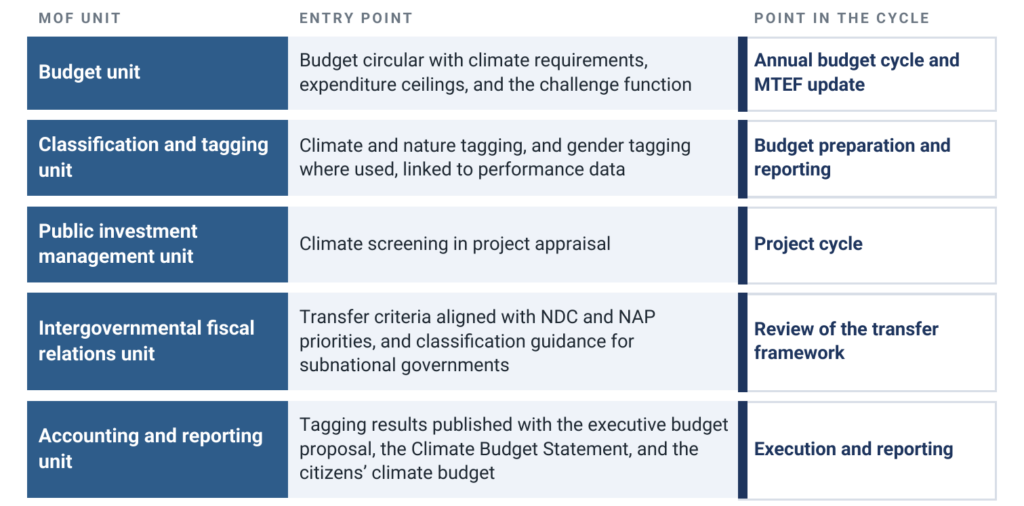
Within an MoF, these functions fall across a defined set of units, although final responsibility varies by jurisdiction. Figure 2 maps each entry point to the unit or division that typically manages it.
Figure 2. Where the budget entry points sit within an MoF
Source: Prepared by the authors, drawing on Allen et al. (2015).
Barriers and ways to overcome them
The main challenge in green PFM is no longer identifying possible tools but integrating them into existing systems and decision processes (Eguino and Delgado, 2023; IMF, 2021).
Each issue below pairs a typical barrier with actions an MoF could consider. A wider range of Opportunities for action is given in the next section.
National climate commitments translate weakly into annual budget processes
Spending reviews assess the stock of existing and inherited expenditure rather than the flow of new proposals alone. Climate Public Expenditure and Institutional Reviews (CPEIRs) assess how well public spending and institutions align with climate objectives. They often precede CBT and map climate-relevant spending and institutional responsibilities. Their main value lies in highlighting gaps between commitments and current resource allocations and in assessing readiness for reform. They may be particularly useful for countries at an early stage of climate-related PFM reform (World Bank, 2021c; UNDP, 2025). However, these reviews are retrospective and resource-intensive, and their findings may have limited influence on subsequent budget decisions.
Approach
Link findings from spending reviews and CPEIRs to fiscal strategy reviews, budget circulars, expenditure ceilings, and PFM reform plans. This allows them to inform future budget decisions rather than remain standalone analytical exercises (World Bank, 2021c; UNDP, 2025).
Reform ambitions can exceed available implementation capacity
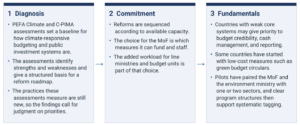
The Public Expenditure and Financial Accountability (PEFA) Climate Framework and IMF Climate-Public Investment Management Assessment (C-PIMA) are diagnostics tools that baseline how climate-responsive a country’s budgeting and public investment systems are (see Figure 3).
PEFA Climate Framework assessments identify strengths and weaknesses in climate-responsive PFM systems and provide a structured basis for reform roadmaps. The framework’s 14 indicators cover the full budget cycle, and assessments have been conducted at national and subnational levels since piloting began in 2020 (PEFA, 2024). The findings require judgement rather than mechanical compliance. The framework codifies practices that remain relatively new, and treating their indicators as a scorecard to try gain maximum scores can produce reform lists that are difficult to implement. The workload shared with line ministries and budget units also needs to be considered.
Approach
Prioritize and sequence reforms according to available capacity rather than attempt to implement every recommendation from a diagnostic. Where the diagnostic identifies more reforms than the MoF can staff, the choice is which measures to fund and sustain. Embedding reform responsibilities in existing performance management systems can help make them part of core functions rather than temporary additional tasks. Formal governance arrangements, designated responsibilities, and agreed timelines can support cross-government implementation and reporting.
Countries have started with relatively low-cost measures or introduced qualitative reforms, such as green budget circulars, while quantitative capabilities develop. Where core systems remain weak, budget credibility, cash management, and reporting fundamentals may warrant priority. Pilots have typically paired the MoF and the environment ministry with one or two highly relevant sectors. Clear program and subprogram structures can then support systematic CBT.
Figure 3. Sequencing PFM reform through diagnosis, commitment, and strong fundamentals
Source: Based on PEFA (2024) and IMF C-PIMA practice.
Climate risks are not included in the fiscal forecast
Climate and disaster risks remain only partly integrated into forecasting, fiscal strategy, debt management, and medium-term frameworks. Some MoFs continue to treat climate mainly as an environmental matter rather than a fiscal risk. Limited capacity and data as well as projection uncertainty present further constraints. Much of the relevant information is held outside the MoF, making working relationships with other institutions part of the reform. Moving ahead of trading partners on decarbonization may also create first-mover costs, including higher energy prices for industry and carbon-leakage risks. The pace and competitiveness implications of transition spending therefore form part of fiscal strategy.
Approach
Build working relationships with planning ministries, meteorological services, and disaster agencies that hold relevant data. Progressively incorporate climate and disaster risks into fiscal forecasts, strategies, and medium-term frameworks. Where the available data do not support a modeled estimate, recent guidance points to qualitative assessment of climate-related fiscal risks. Such an assessment carries less weight than a robust quantitative estimate but may be more defensible than a number based on weak evidence (UNDP, 2021; OECD, 2025).
Line ministries may lack clarity about submission requirements
Guidance for line ministries on how to reflect climate considerations in spending proposals is often limited, leaving climate priorities disconnected from resource allocation decisions. Where the budget circular contains no climate-related requirement, submissions cannot be assessed against one. The issue then enters budget negotiations, where it competes with other priorities.
Approach
Incorporate clear climate-related requirements into routine budget circulars and submission processes. Kenya has used budget circulars to require ministries to identify and tag climate-related expenditure and demonstrate alignment with climate priorities in routine submissions (Kenya National Treasury, 2025).
The annual budget creates enduring assets and legacies
Annual budgets are constitutionally anchored in most countries, so multi-year certainty often needs to be built within them rather than around them. Decarbonization infrastructure, adaptation measures, and ecosystem restoration require commitments extending beyond a single year. However, frameworks may concentrate climate allocations in the first year, leave forward estimates non-binding, or rely on weak costing of national climate plans.
Approach
Consider an MTEF to provide greater predictability for multi-year climate investments (World Bank, 2013). Pakistan has incorporated climate-related information requirements into its budget call circulars, bringing climate considerations into existing budget preparation procedures (UNDP, 2021). Where the broader framework cannot be reformed, commitment appropriations, carryover authority, and multi-year contracts may provide ways to commit future finance within annual budget rules. However, these arrangements bind later years less firmly than a medium-term ceiling and remain vulnerable to a future government declining to honor them. They may nevertheless offer a practical option where broader reform is not immediately feasible.
Disaster risk reduction spending faces the same classification gap as adaptation
Responsibility is dispersed across ministries and levels of government, and the expenditure is often not identifiable in standard classifications. Combined disaster and adaptation spending may therefore be undercounted, leaving ministries without a consolidated view. Spending on prevention, preparedness, early warning, and anticipatory action is particularly likely to be undercounted or reported inconsistently. Without a consolidated classification, an MoF may struggle to determine whether prevention is underfunded relative to response or whether expenditure aligns with the exposure recorded in the fiscal risk statement.
Many budget systems also lack instruments that would allow governments to respond to shocks without disrupting other spending and capital investment. Limited stress testing further constrains the translation of risk information into budget decisions.
Approach
Integrate disaster and adaptation codes to make prevention, preparedness, early warning, and anticipatory action visible alongside adaptation spending. Depending on the fiscal framework, these classifications may be complemented by disaster reserves, contingency funds, or ring-fenced allocations intended to create space for shocks without displacing planned capital investment. Stress testing can help estimate potential financing needs and inform the size and design of these provisions.
Accountability and reporting systems remain relatively underdeveloped
Many governments disclose climate-positive expenditure but provide limited information on environmentally harmful spending, fossil fuel subsidies, climate-related contingent liabilities, or climate-related financial risks. Reporting only positive expenditure can therefore provide an incomplete picture of the fiscal implications of climate policy and spending.
Approach
Governments can build on existing budget reports and fiscal risk statements, starting with the most material gaps in coverage. Agreed definitions, clear reporting responsibilities, and guidance for line ministries can support consistent disclosure, with coverage expanding as data and capacity improve. Linking reported expenditure to performance indicators and incorporating audit findings into subsequent budget reviews can strengthen accountability for both spending and results.
International organizations are developing further guidance on climate-related reporting and disclosure (see Capability 1, Communicating on climate, the economy, and public finances). The OECD’s work on green budgeting and public-sector sustainability reporting also supports governments in integrating climate considerations into budgeting, performance monitoring, and public reporting (OECD, 2025).
Further resources for MoFs
- OECD Paris Collaborative on Green Budgeting, which includes methods, country practice, and peer exchange (OECD, 2024).
- Green Budgeting: Towards Common Principles (EC, IMF, and OECD, 2021).
- PEFA Climate and IMF C-PIMA, which provide diagnostics baselining climate-responsive PFM and PIM (PEFA, 2024; IMF, n.d).
- Budgeting for Climate Change: A Guidance Note for Governments to Integrate Climate Change into Budgeting and Making a difference: Good practice in climate change performance and compliance audits (UNDP, 2021; UNDP, 2026).
- Inclusive Budgeting and Financing for Climate Change in Africa, a CABRI, UNDP, and IIED partnership which provides practitioner support for African MoFs.
- The Coalition of Finance Ministers for Climate Action’s own Helsinki Principle 4 workstream, which integrates climate change into macroeconomic policy, fiscal planning, budgeting, public investment management, and procurement practicesthrough member peer exchange (CFMCA, 2019).
- The Sustainable Budgeting Approach, which provides decision support for comparing budget measures under constrained fiscal space (O’Callaghan et al., 2023).
Opportunities for action
MoFs can use the budget cycle and PFM processes to support transformation and investment while protecting fiscal resilience. An MoF may pursue more advanced measures in areas where it has capacity while strengthening foundations elsewhere.
A PEFA Climate Framework or C-PIMA assessment can help identify binding constraints. An MoF can then focus on reforms that it can staff and sustain. Where core systems remain weak, budget credibility, cash management, and reporting fundamentals may warrant priority. Countries have also started with relatively low-cost qualitative measures, such as green budget circulars, while quantitative capabilities develop.
This can cover expenditure classification and analytical requirements for climate-sensitive sectors. OECD Paris Collaborative on Green Budgeting materials provide one possible reference.
Strategic and detailed line ministry submissions can be assessed against national climate strategies and identified investment needs, including resilience and contingency provisions where rising disaster risks make them material.
Publishing CBT results with the executive budget proposal, including in machine-readable form, can inform legislative deliberation. One option is a Climate Budget Statement to the legislature, accompanied by a plain-language citizens’ climate budget (IBP, 2023; see Capability 1, Communicating on climate, the economy, and public finances).
Adaptation and mitigation objectives can be incorporated into the MTEF, budget circulars, and expenditure reporting rather than treated only as a standalone exercise.
CBT, spending reviews, and appraisal are most useful both when they inform budget negotiations, government discussion, and allocation and when the resulting information feeds into subsequent circulars. Where institutional mandates and data systems allow, aligning tagging, performance indicators, and sustainability reporting can give oversight bodies more usable information and reduce duplication.
Common guidance can help budget departments identify synergies and trade-offs across these objectives during appraisal and prioritization. The depth of assessment can reflect materiality and available capacity.
Assigning responsibilities, timelines, and accountability through established performance-management systems can help make reform part of core functions rather than a temporary additional task.
Where risks are material and data allow it, fiscal risk statements and medium-term projections can present physical and transition exposures, assumptions, and uncertainty. Possible financing arrangements include general fiscal buffers, disaster reserves, contingent credit, and risk transfer. If classifications are extended, unified disaster and adaptation codes can make prevention, preparedness, and early warning visible and allow expenditure to be assessed against the risks recorded in fiscal risk statements.
Within annual budget rules, options may include climate-related ceilings, multi-year commitments for major capital works, and contingent allocations triggered by defined climate events. Their use depends on the legal framework, fiscal position, and strength of commitment controls.
Aligning CBT, performance indicators, and sustainability reporting can give oversight bodies more usable information and reduce parallel reporting. The feasible degree of integration depends on data systems and institutional mandates.
Real-world examples
Tonga
Climate-related budgeting was introduced through its annual Budget Guidance for line ministries rather than through a separate instrument (Tonga Ministry of Finance, 2024). Anchoring CBT in this process is intended to strengthen domestic reporting, improve climate finance management, and increase development partners’ use of national systems while allowing a small administration to avoid staffing two parallel processes.
Brazil
Brazil’s National Treasury used AI-assisted classification to reduce the time needed to classify expenditure from around 1,000 hours to eight (OECD, 2025). The example illustrates how automation can reduce the administrative burden of classification, while clear criteria and expert quality assurance remain important.
Rwanda
The Ministry of Finance and Economic Planning incorporated CBT into the core budget process from the outset. CBT was included in the budget call circular and their Integrated Financial Management Information System, and extended to every budget agency from central government to regional districts. Green and brown tags are applied at the activity level across recurrent and development spending and published in an annual Climate Budget Statement to government (MINECOFIN, 2023). A central quality-assurance process is intended to connect the tagged data to allocation decisions rather than leave tagging as a reporting exercise.
Canada
The 2024 Cabinet Directive requires federal departments to apply a climate, nature, and economy lens to all budget proposals. This incorporates climate appraisal into routine budget preparation through an administrative directive rather than a new institutional structure (Government of Canada, 2024).
Ireland
The Department of Public Expenditure, National Development Plan Delivery and Reform worked with the OECD to strengthen the consideration of climate and environmental impacts in public investment appraisal (OECD, 2023).
Togo
The first green budget for 2024 was prepared with IMF technical support, piloting the approach across a subset of ministries before extending and codifying the methodology. The example illustrates how a resource-constrained administration can build on existing capacities rather than establish parallel systems.
Bangladesh
Climate budgeting dates from its 2012 Climate Public Expenditure and Institutional Review, one of the earliest such exercises. The Finance Division has published Climate Budget Statements since the 2017/18 budget, linking medium-term expenditure planning to climate objectives, with a dedicated cell coordinating external finance. The system has been refined progressively since its introduction.
Korea
The Greenhouse Gas Reduction Cognitive Budgeting System requires ministries to assess the emissions implications of budget proposals and demonstrate alignment with national targets (OECD, 2024; IMF, 2021).
France
The annual Green Budget identified around EUR41.7bn in environmentally favorable or mixed spending in its 2024 edition. The MoF and Ministry for the Ecological Transition and Territorial Cohesion jointly rate each budget line within the standard cycle. The exercise carries a material administrative cost that needs to be reflected in staffing and work planning (Government of France, 2023).
Croatia
The MoF introduced green budget tagging as part of its program of work for 2021–2024 without a legal requirement. Expenditure is tagged against the six environmental objectives of the EU taxonomy through a working group within the environment ministry and a methodology adopted by ministerial decision in 2024. The example shows that a taxonomy-aligned system can be introduced through administrative arrangements before legislation is adopted. (see full Croatia case study)
Nepal
The MoF incorporates climate expenditure coding into the Consolidated Financial Statements, Economic Survey, and annual budget annex. It was among the first low-income countries to place CBT in core budget documents rather than parallel reports(UNDP, 2019).
Indonesia
CBT has been extended from central government to the subnational level, piloting across provinces and districts. The AKSARA platform links planning, tagged expenditure, and performance monitoring against national climate targets (Indonesia Ministry of Finance, 2025).
Philippines
The People’s Survival Fund provides dedicated domestic financing for adaptation projects linked to local needs and priorities. It illustrates how a defined adaptation framework can guide funding decisions alongside broader CBT (Republic of the Philippines, 2012; Philippine Climate Change Commission, 2024).
Namibia
Namibia’s Environmental Investment Fund, a Green Climate Fund-accredited Direct Access Entity, drew on integrated gender and climate evidence to secure US$39m for adaptation projects benefiting smallholder farmers. This example illustrates how gender-responsive project design can support access to climate finance and consider who benefits from investment (Environmental Investment Fund of Namibia, 2023; Mungunda et al., 2021).
Guatemala and Madagascar
Each country illustrates different entry points for incorporating disaster risk reduction into budget systems.
Guatemala used a disaster risk reduction budget review to establish what the budget already covered before developing CBT and risk-informed financing from that baseline (UNDRR, 2025).
The Madagascar MoF, working with UNDRR as well as the IMF, validated a methodology for identifying disaster risk reduction expenditure in its budget systems (IMF, 2025b).
In both cases, classification answers a financing question rather than only satisfying a reporting requirement.
CABRI (Kay Brown); IMF (Aurélien Billot, Diego Mesa Puyo, Alpa Shah); UNDRR (Erick Ariel Gonzales Rocha, Mathieu Verougstraete); IBP (Sally Torbert; UNDP (Shanaz Broermann, Vivek Misra, Asad Maken, Mamta Kohli, Biplab Das, Nahid Sharmin, Owais Parray); C40 (Luis H. Sáenz, Andrea Fernández); Andy King; Murray Petrie.
Allen R, Hurcan Y, Murphy P, Queyranne M, Yläoutinen S (2015) The evolving functions and organization of finance ministries. IMF Working Paper 15/232. Washington, DC: International Monetary Fund.
Bangladesh Ministry of Finance (2020) Bangladesh Climate Fiscal Framework 2020. Dhaka: Finance Division, Ministry of Finance.
Bhattacharya A, Songwe V, Soubeyran E, Stern N (2024) Raising ambition and accelerating delivery of climate finance. Third report of the Independent High-Level Expert Group on Climate Finance. London: Grantham Research Institute on Climate Change and the Environment, London School of Economics and Political Science.
Brandon C, William R, Meisner C, Lan V (2025) Strengthening the investment case for climate adaptation. Washington, DC: World Resources Institute.
Brihanmumbai Municipal Corporation [BMC] (2024) Climate budget report FY 2024–25. Mumbai: Environment and Climate Change Department, Brihanmumbai Municipal Corporation.
C40 Cities Climate Leadership Group [C40 Cities] (2025) Climate budgeting framework.
Calleja R (2021) How do development agencies support climate action? CGD Policy Paper 207. Washington, DC: Center for Global Development.
City of Oslo (2026) Oslo climate budget 2026. Oslo: Climate Agency (Klimaetaten), City of Oslo.
Climate Policy Initiative (2026) Global landscape of climate finance 2026. San Francisco: Climate Policy Initiative.
Coalition of Finance Ministers for Climate Action [CFMCA] (2019) The Helsinki Principles.
Collaborative Africa Budget Reform Initiative [CABRI] (2022) Dual climate and gender budget tagging. Pretoria: Collaborative Africa Budget Reform Initiative.
Collaborative Africa Budget Reform Initiative [CABRI], United Nations Development Programme [UNDP], International Institute for Environment and Development [IIED] (2022) Inclusive budgeting and financing for climate change in Africa.
Curristine TR, Adenauer I, Alonso-Albarran V, Grinyer J, Tee KH, Wendling CP et al. (2024) How to develop and implement a medium-term fiscal framework. IMF How-To Note 2024/005. Washington, DC: International Monetary Fund.
Eguino H, Delgado R (2023) Climate expenditure classification in Latin America and the Caribbean. Washington, DC: Inter-American Development Bank.
Environmental Investment Fund of Namibia (2023) Green Viewpoint 9. Windhoek: Environmental Investment Fund of Namibia.
European Commission [EC], International Monetary Fund [IMF], Organisation for Economic Co-operation and Development [OECD] (2021) Green budgeting: Towards common principles. Brussels: European Commission.
French Ministry for the Economy, Finance and Industrial and Digital Sovereignty, French Ministry for the Ecological Transition and Territorial Cohesion (2023) Report on the environmental impact of the central government budget in France 2024. Paris: Government of France.
Government of Canada (2024) Cabinet Directive on Strategic Environmental and Economic Assessment. Ottawa: Government of Canada.
ICLEI Africa (2024), How can gender be integrated into local climate projects? BRIDGE training session no. 4.
Independent High-Level Expert Group on Climate Finance [IHLEG] (2025) Raising ambition and accelerating delivery of climate finance. Fourth report of the Independent High-Level Expert Group on Climate Finance. London: Grantham Research Institute on Climate Change and the Environment, London School of Economics and Political Science.
Indonesia Ministry of Finance (2025) AKSARA climate performance platform documentation.
International Budget Partnership [IBP] (2023) Open Budget Survey 2023. Washington, DC: International Budget Partnership.
International Monetary Fund [IMF] (n.d.) Climate-Public Investment Management Assessment (C-PIMA). Web page. https://infrastructuregovern.imf.org/content/PIMA/Home/PimaTool/C-PIMA.html
International Monetary Fund [IMF] (2025a) Kosovo: Green budgeting methodology technical note. Washington, DC: International Monetary Fund.
International Monetary Fund [IMF] (2025b) Republic of Madagascar: Country report. Washington, DC: International Monetary Fund. https://www.imf.org/-/media/files/publications/cr/2025/english/1mdgea2025003-source-pdf.pdf
International Monetary Fund [IMF] (2021) Green public financial management: Functions and implementation. IMF Staff Climate Note 2021/002. Washington, DC: International Monetary Fund.
International Public Sector Accounting Standards Board [IPSASB] (2026) IPSASB SRS 1, Climate-related Disclosures. New York: International Public Sector Accounting Standards Board.
Kenya National Treasury (2025) Budget circular for the FY2025/26 budget process. Nairobi: National Treasury.
Mungunda RB et al. (2021) Strengthening gender responsiveness of the Green Climate Fund ecosystem-based adaptation programme in Namibia. Sustainability 13(18): 10162. https://doi.org/10.3390/su131810162
NDC Partnership (2025), ‘From Budget Codes to Gender-Responsive Forest Management: Climate Action in Zambia’, 11 November.
New York City Mayor’s Office of Management and Budget [NYC OMB] (2025) New York City climate budgeting: Climate alignment assessment and capital climate investments. New York: New York City Mayor’s Office of Management and Budget.
New York City Mayor’s Office of Management and Budget [NYC OMB] (2024) New York City climate budgeting: Climate alignment assessment and capital climate investments. FY2025 Executive Budget technical appendix. New York: New York City Mayor’s Office of Management and Budget.
O’Callaghan B et al. (2023) The sustainable budgeting approach. Oxford: Oxford University Economic Recovery Project.
O’Callaghan B et al. (2022) Global Recovery Observatory: Final report. Oxford: Oxford University Economic Recovery Project.
Organisation for Economic Co-operation and Development [OECD] (2025) Governing with artificial intelligence. Paris: OECD Publishing.
Organisation for Economic Co-operation and Development [OECD] (2024) Green budgeting in OECD countries 2024. Paris: OECD Publishing.
Organisation for Economic Co-operation and Development [OECD] (2023) Strengthening environmental considerations in public investment in Ireland: Assessment and recommendations. OECD Public Governance Policy Papers 35. Paris: OECD Publishing.
Organisation for Economic Co-operation and Development [OECD] (2021) Green budgeting in OECD countries. Paris: OECD Publishing.
Petrie M (2021) Environmental governance and greening fiscal policy. Cham: Palgrave Macmillan.
Philippine Climate Change Commission (2024) The Philippines’ National Adaptation Plan 2023–2050. Manila: Climate Change Commission.
Public Expenditure and Financial Accountability [PEFA] (2024) Supplementary framework for assessing climate-responsive public financial management. Washington, DC: PEFA Secretariat.
Republic of the Philippines (2012) Republic Act No. 10174: An act establishing the People’s Survival Fund to provide long-term finance streams to enable the government to effectively address the problem of climate change, amending for the purpose Republic Act No. 9729, otherwise known as the “Climate Change Act of 2009,” and for other purposes. Manila: Official Gazette of the Republic of the Philippines.
Rwanda Ministry of Finance and Economic Planning [MINECOFIN] (2023) Rwanda’s Guidelines on Climate Budget Tagging (CBT). Kigali: Ministry of Finance and Economic Planning.
Schuknecht L, Tanzi V (1995) The growth of government and the reform of the state in industrial countries. IMF Working Paper 95/130. Washington, DC: International Monetary Fund.
Shin J, Kustar A (2024) Oslo’s “climate budget” is building a cleaner city. Blog post, 15 July. World Resources Institute.
Tonga Ministry of Finance (2024) Budget statement 2024–2025. Nuku’alofa: Ministry of Finance.
United Nations Capital Development Fund [UNCDF] (2023) Enabling locally led adaptation in Uganda through the establishment of the LoCAL Performance-Based Climate Resilience Grant Facility. New York: United Nations Capital Development Fund.
United Nations Development Programme [UNDP] (2025) Using public financial management to implement NDCs and NAPs. New York: United Nations Development Programme. https://www.undp.org/asia-pacific/publications/using-public-financial-management-implement-ndcs-and-naps
United Nations Development Programme [UNDP] (2021) Budgeting for climate change: A guidance note for governments to integrate climate change into budgeting. Bangkok: United Nations Development Programme.
United Nations Development Programme [UNDP] (2019) Climate budget tagging: A guidance note for governments in Asia and the Pacific. Bangkok: United Nations Development Programme.
United Nations Office for Disaster Risk Reduction [UNDRR] (2025) Guatemala: Budget tagging turns data into investment in resilience. Web page. https://www.undrr.org/news/guatemala-budget-tagging-turns-data-investment-resilience
World Bank (2021a) Kenya: Financing Locally Led Climate Action Program. Washington, DC: World Bank.
World Bank (2021b) Subnational climate budgeting: International experience. Washington, DC: World Bank.
World Bank (2021c) Climate change budget tagging: A review of international experience. Washington, DC: World Bank.
World Bank (2013) Beyond the annual budget: Global experience with medium-term expenditure frameworks. Washington, DC: World Bank.