Providing disaster risk finance and insurance for all
It covers:
• Fiscal risk assessment.
• Risk layering and pre-arranged financing, including reserve funds, contingent credit, regional risk pools, and sovereign risk transfer.
• Anticipatory action and inclusive insurance.
“Disaster risk financing” includes reserves, contingency funds, contingent credit, and insurance; this Action Area uses “disaster risk financing and insurance” to make the role of insurance explicit.
Context and role of Ministries of Finance
Disasters and climate-related shocks can pose significant risks to macroeconomic stability, with impacts transmitted to public finances through a range of financial and economic channels. These shocks can:
- Increase sovereign borrowing costs.
- Widen risk premia.
- Put pressure on exchange rates.
- Disrupt economic activity.
- Damage productive assets and infrastructure.
- Reduce government revenues.
- Increase demands for public expenditure (CFMCA, 2025c; World Bank, 2025a; Rising et al., 2026).
The resulting fiscal pressures can widen deficits, increase debt burdens, and constrain investment in long-term development priorities. For example, Hurricane Melissa, which struck Jamaica as a Category 5 storm in October 2025, caused physical damage estimated at US$8.8bn—equivalent to around 41% of the country’s 2024 gross domestic product—making it the costliest disaster in the country’s recorded history (World Bank, 2025b). Pakistan’s 2022 floods caused an estimated US$30bn in damages and losses, close to 9% of GDP (World Bank, 2022). Nepal’s August 2026 floods, triggered by a glacier collapse, could cost US$4–5bn to rebuild from—nearly a tenth of GDP—according to a preliminary estimate provided by the Minister of Finance (Reuters, 2026).
These risks also extend to high-income economies: Storm Kristin, which affected the Iberian Peninsula in early 2026, caused around US$7.7bn in losses, of which only around US$1.8bn was insured (Munich Re, 2026). Globally, it is estimated that the occurrence of at least one major climate event per year is associated with an increase in that year’s fiscal deficit of 0.8% of GDP for lower- to middle-income countries and 0.9% of GDP for the low-income group (Alejos, 2018).
Climate-related hazards and disasters are expected to further increase fiscal exposure in many countries
Disasters can also trigger macroeconomic and financial shocks that cascade and compound across economies through several transmission channels. They can disrupt supply chains, reduce productivity, negatively affect trade and investment, and create secondary fiscal pressures that extend well beyond the immediate area or duration of the shock (CFMCA, 2025c). Beyond the direct costs of emergency response and reconstruction, governments often face implicit contingent liabilities arising from pressure to support affected households, businesses, and communities. In many countries, low levels of insurance coverage mean that governments increasingly act as “insurers of last resort,” amplifying fiscal risks associated with disasters.
Disasters simultaneously weaken revenues and increase expenditure pressures through emergency response, reconstruction, social protection, and other fiscal stabilization measures. Pre-arranged financing can help governments meet these pressures more quickly and predictably. However, it does not cover all financing needs, particularly following severe shocks, and may need to be complemented by budget reallocations, borrowing, or other sources of finance.
Disaster risk financing and insurance (DRFI) refers to the financial strategies, instruments, and institutional arrangements used to manage the economic and fiscal consequences of disasters (World Bank, 2014). These include:
- Budgetary instruments, such as contingency appropriations and reserve funds.
- Contingent financing instruments, such as contingent credit lines and climate-resilient debt clauses.
- Risk transfer instruments, such as insurance, reinsurance, catastrophe bonds, and regional risk pools.
These instruments are often combined within a broader risk-layering strategy to ensure that financing is available for different types and scales of disaster losses (World Bank, 2014). By arranging financing before disasters occur, DRFI helps ensure that resources are available when they are most needed, enabling faster response, recovery, and reconstruction while reducing disruption to public finances and development objectives (GFDRR, 2018). Pre-arranged financing can also support anticipatory action, enabling resources to be released in advance of forecast shocks when predefined triggers are met.
Effective DRFI strategies are often anchored in Ministries of Finance
This is particularly true where they affect fiscal risk, budgeting, and public financing, even if financing cuts across different agendas and is often seen as belonging to specialized agencies (World Bank, 2014). In a growing number of developing countries, the Ministry of Finance (MoF) has established fiscal risk management divisions tasked with the identification, quantification, disclosure, and management of fiscal risks associated with natural disasters. These teams often lead and coordinate the fiscal and financing components of the DRFI agenda, working closely with disaster management agencies and line ministries responsible for sectors such as agriculture, health, and social protection. This ensures that financing arrangements are aligned with contingency plans, delivery systems, and the needs of vulnerable populations.
Anchoring DRFI within the MoF supports comprehensive approaches to fiscal and debt risk management, builds on existing capacity to manage contingent liabilities, and strengthens broader public financial management frameworks to improve fiscal resilience. Recent evidence suggests that disaster risk financing (DRF) instruments deliver the greatest benefits when embedded within broader fiscal risk management frameworks, supported by strong MoF engagement, cross-government coordination, and integration into fiscal planning, budgeting, and debt management processes (World Bank IEG, 2026; see Box F3d.1).
Box F3d.1. Integrating DRF across the budget cycle
Integrating DRF into public financial management systems is not a single action; each stage of the budget cycle offers a distinct entry point. Figure 1 maps seven of them, from strategic planning and budget preparation through to audit and policy review. Some principles hold across stages. Disaster contingent liabilities are most useful when quantified and distinguished by type (explicit, such as the cost of repairing public assets; or implicit, such as support for uninsured households), with both feeding medium-term expenditure forecasts. Budget circulars can provide guidance to spending units on disaster risk management priorities, and allocations can cover specific DRF instruments including reserve funds, contingent credit, and sovereign insurance.
Preparedness matters most at execution: reallocation procedures, emergency procurement, and disbursement authorization chains work best when designed before a disaster rather than during one. At the accounting stage, climate budget tagging lets governments track and report spending by function across risk reduction, preparedness, response, and recovery. Across every stage, the agenda sits naturally with central finance agencies, working through formal coordination arrangements with disaster management agencies, sectoral ministries, and social protection institutions.
Figure 1: Entry points for DRF across the budget cycle
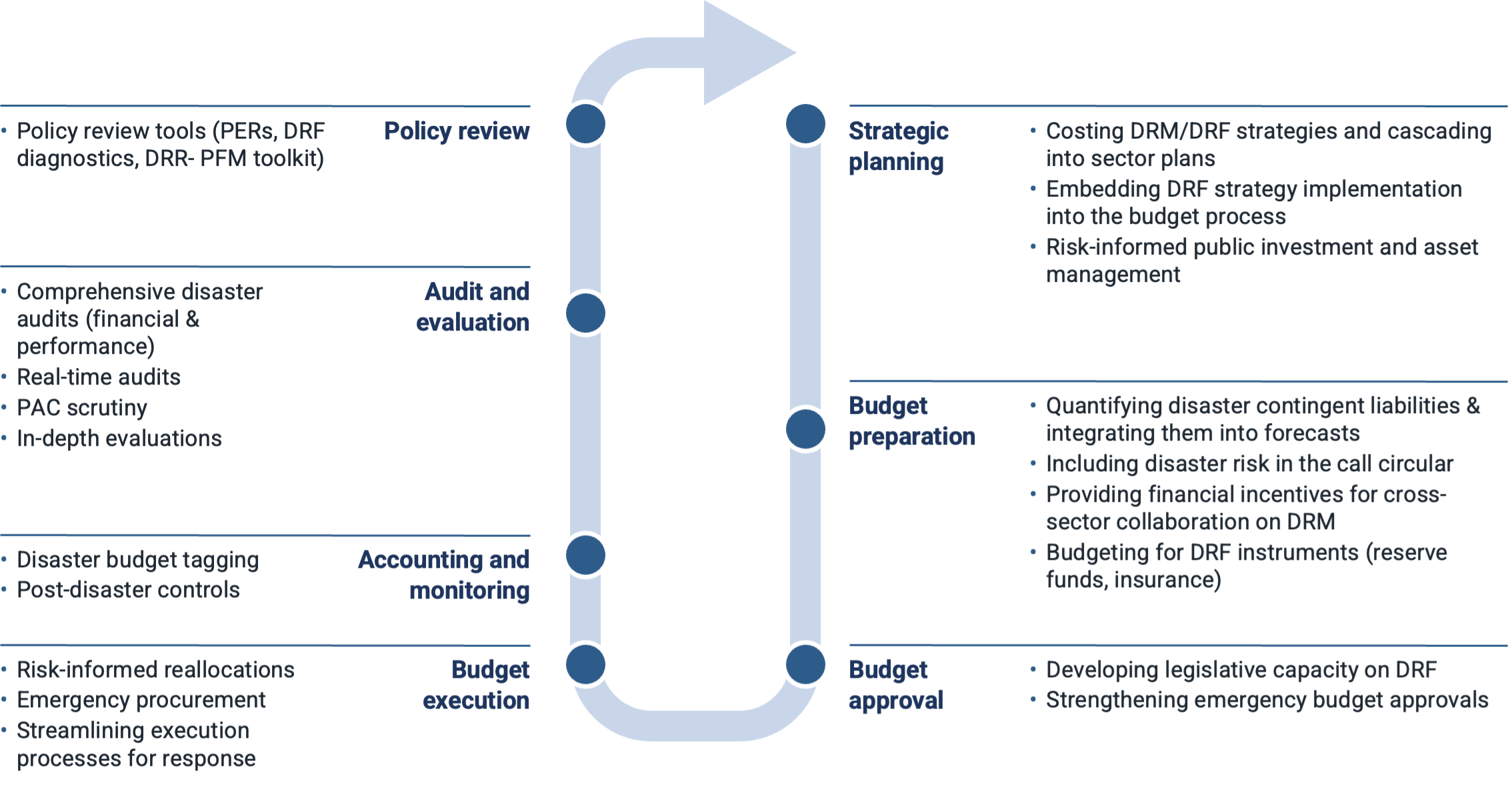
Source: World Bank (2024).
Notes: 1. DRM = disaster risk management. 2. PAC = public accounts committee. 3. PER= Public Expenditure Review. 4. DRR-PFM = Disaster Resilient and Responsive Public Financial Management.
International guidance and country experience increasingly recognize DRFI as a core MoF function
This reflects the MoF’s central role in managing fiscal risks and contingent liabilities within public financial management (World Bank, 2014; World Bank IEG, 2026). While institutional arrangements differ across countries, responsibility for DRFI commonly sits within fiscal risk management, budget, treasury, debt management or economic policy functions, depending on the structure and capacity of the MoF.
Historically, governments have mostly addressed the financial effects of disasters on an ad hoc basis
In line with the Sendai Framework for Disaster Risk Reduction and evolving work under the UNFCCC and Paris Agreement on averting, minimizing, and addressing loss and damage, there is an increasing emphasis on proactive planning before a disaster strikes.
A key principle of effective DRF is the matching of financial instruments to different layers of risk (World Bank, 2010). Frequent but lower-cost events may be financed through budget contingencies, reserve funds, or scalable social protection mechanisms, while less frequent but more severe events may require contingent credit, insurance, or other risk transfer instruments.
2By combining budgetary instruments, contingent financing, and risk transfer to address different frequencies and severities of disaster losses, MoFs can improve cost-effectiveness and reduce financing gaps (World Bank and IAIS, 2025). Pre-arranged finance can make resources available when needed, enabling faster and more predictable response and recovery compared with relying solely on budget reallocations, borrowing, or external assistance after a disaster.
Complementary investment in prevention and preparedness can also strengthen fiscal resilience. Between 2019 and 2023, only around 1% of total official development assistance was categorized as disaster risk reduction, prevention, and preparedness, rising to around 2% when broader sectoral projects contributing to DRR are included. Yet evidence cited in the UNDRR Global Assessment Report 2025 indicates that every US$1 invested in DRR can save, on average, around US$15 in future recovery and reconstruction costs. For MoFs, this strengthens the case for incorporating DRR investment into fiscal planning alongside arrangements to finance residual disaster losses (UNDRR, 2025a).
Addressing insurance protection gaps can form an important component of effective, multilayered DRF strategies
Insurance-based mechanisms can complement budgetary and contingent financing instruments by transferring or sharing risks that governments, households, and businesses may otherwise retain. They include:
- Public-private insurance programs
- Parametric insurance
- Regional risk pools
- Catastrophe bonds.
However, their effectiveness depends on appropriate risk data, institutional and technical capacity, affordable and sustainable coverage, and coordination between governments, insurers, and other stakeholders. Recent international initiatives have increasingly focused on these challenges. The Global Shield against Climate Risks, launched by the G7 and V20 in 2022, supports climate-vulnerable countries through pre-arranged climate and DRFI, alongside technical and capacity support (G7 and V20, 2022; Global Shield against Climate Risks, 2025). In 2024, the G7 Finance Track, drawing on contributions from the OECD and IAIS, developed a High-Level Framework for Public-Private Insurance Programmes against Natural Hazards, providing guidance on public-private approaches to addressing natural-hazard insurance protection gaps (G7 Finance Ministers and Central Bank Governors, 2024).
The G20 Sustainable Finance Working Group, under the 2025 South African Presidency, subsequently developed recommendations on addressing natural catastrophe insurance protection gaps. This included insurance-based mechanisms and solutions, with particular attention to emerging and developing market economies (World Bank and IAIS, 2025). Building on this, the G7 Finance Track under the 2026 French Presidency has continued work on the economic and financial risks associated with extreme weather events, including the role of insurance in mitigating their impacts and strengthening insurability against natural disasters (G7 Finance Ministers and Central Bank Governors, 2026). These issues also provide an important area for continued exchange between MoFs and financial authorities, including through the Network for Greening the Financial System-Coalition of Finance Ministers for Climate Action joint dialogue platform (NGFS-CFMCA).
Budgetary and contingent financing instruments provide governments with access to resources for more frequent or moderate disaster events and can help reduce reliance on emergency borrowing or disruptive budget reallocations. Examples include:
- Budget contingencies and emergency appropriations.
- Disaster reserve funds.
- Contingent credit arrangements.
- Disaster-linked social protection mechanisms that can scale up rapidly following shocks.
Risk transfer instruments transfer a portion of financial risk to third parties and are often used to manage less frequent but higher-severity events. Examples include:
- Sovereign insurance programs and regional risk pools.
- Property catastrophe insurance for homeowners and small and medium-sized enterprises.
- Agricultural insurance for farmers, herders, and fishers.
- Reinsurance arrangements and catastrophe bonds.
The range of pre-arranged financing instruments continues to evolve
In addition to contingency funds, contingent credit, and insurance, recent innovations create additional fiscal space for response and recovery. These include climate-resilient debt clauses, which allow debt service payments to be temporarily deferred following eligible disasters. Development finance institutions have also introduced mechanisms that enable existing project resources to be rapidly reallocated following disasters or emergencies.
The appropriate mix of pre-arranged instruments will depend on the nature and scale of risks, fiscal circumstances, institutional capacity, and the costs and availability of different financing options. Pre-arranged finance is therefore one component of a broader DRF strategy and is unlikely to meet all financing needs following a major disaster. Governments need to retain the capacity to mobilize additional resources where losses exceed pre-arranged financing.
DRFI instruments differ in how they are funded and managed
Some instruments are established and managed directly by the MoF, such as contingency funds and reserve funds, while others involve partnerships with development banks, insurers, reinsurers, or capital markets to transfer or share risk. Risk transfer instruments may also be structured as traditional indemnity insurance, which pays for assessed losses; or parametric insurance, which provides payouts when predefined triggers are exceeded (such as rainfall volume, wind speed or drought conditions), enabling more rapid disbursement.
Pre-arranged financing allows for faster, more predictable post-disaster liquidity
Instruments such as contingent credit lines, regional risk pools, sovereign insurance, and catastrophe bonds can provide rapid financing following shocks. They are often more cost-effective than relying solely on emergency borrowing or post-disaster budget reallocations. However, these instruments can be technically complex, require significant preparation and institutional capacity, and may involve upfront fees or insurance premiums. MoFs play a central role in establishing financing frameworks, accessing available instruments, and strengthening the capacity needed to assess risks and manage financial protection strategies effectively.
Beyond managing fiscal risks, DRFI can also help mobilize private capital for resilience and recovery
Pre-arranged financing mechanisms can also expand the range of financial resources available to manage disaster risks by attracting reinsurance, capital market, and institutional investors. By improving risk information, creating larger and more diversified risk pools, and establishing predictable financing frameworks, MoFs can help reduce transaction costs and support the development of DRFI markets.
This can be particularly important in countries with constrained fiscal space, where mobilizing private capital can complement public resources and strengthen overall financial resilience. By improving financial preparedness and reducing the fiscal and economic disruption associated with disasters, these mechanisms can help create a more predictable investment environment and crowd in private capital (CFMCA, 2025d).
DRFI is one component of a broader approach to managing disaster and climate-related risks
Effective disaster risk management, combining investments in disaster risk reduction (DRR), resilience, and climate adaptation with DRFI instruments, helps MoFs manage the financial consequences of shocks (UNDRR, 2025a). DRR encompass ex-ante investments in prevention, preparedness, resilient infrastructure, early warning systems, risk-informed land use, and other measures that reduce losses before they materialize. Resilience-building measures therefore reduce the scale of potential losses and future fiscal exposure. DRFI focuses on ensuring timely access to liquidity and financial protection when disasters occur, helping MoFs manage the residual risks that remain.
Risk layering complements this approach by matching financial instruments to different levels of residual risk and potential loss. Operationally, effective integration means aligning adaptation planning, public investment, and financial protection through core public finance systems including public investment appraisal, medium-term expenditure frameworks, budget tagging, expenditure reviews, and fiscal risk analysis. This assesses risk-reduction investments and financing for residual shocks together rather than through separate policy processes. Together, these approaches can reduce disaster-related losses, limit budgetary disruption, and strengthen fiscal resilience over time (UNDP, 2025; World Bank and IAIS, 2025; CFMCA, 2025d).
Nature-based solutions can reduce disaster risks while also providing climate and biodiversity benefits
Increasingly, nature-based solutions are being implemented as infrastructure and resilience investments. Often in combination with conventional grey infrastructure, they are becoming part of mainstream development and resilience portfolios rather than stand-alone environmental projects (World Bank, 2023). Ecosystems such as mangroves, wetlands, forests, and watersheds can reduce the impacts of floods, storm surges, erosion, and landslides, helping to protect infrastructure, livelihoods, and economic activity (UNDRR, 2022). A recent review of economic evaluations found that compared to conventional DRR engineering approaches, nature-based solutions were more cost-effective in over 80% of cases, highlighting their potential contribution to reducing future disaster losses and financing needs (Vicarelli et al., 2024).
Despite growing evidence of their effectiveness, nature-based solutions continue to be overlooked in many public policy frameworks
When assessing options for managing disaster risks, nature-based solutions are not always considered alongside DRFI strategies (World Bank, 2023). While evidence on their risk-reduction benefits is expanding, these benefits are not yet routinely reflected in public investment decisions, insurance underwriting, pricing models, or broader risk management frameworks (Kousky and Burley, 2025). However, a growing number of DRFI solutions are beginning to recognize the role of nature-based solutions in reducing disaster risks and, in some cases, helping to de-risk investment in ecosystem restoration and resilience (Clavey et al., 2026). MoFs can support more comprehensive disaster risk management by considering nature-based solutions alongside conventional and hybrid infrastructure investments, both when assessing options for reducing future losses and when planning financing needs.
Adaptive social protection links pre-arranged financing with existing social protection delivery systems
Adaptive social protection means support can be scaled up in response to shocks (UNICEF, 2023; ILO, 2024). By combining financing arrangements with established delivery mechanisms, MoFs can provide support to affected households through existing programs rather than relying solely on ad hoc emergency assistance, unplanned budget reallocations, or emergency borrowing. Financing instruments such as contingency budgets, reserve funds, contingent credit, insurance-linked payouts,and regional risk pools can be linked to cash transfers, unemployment support, public employment programs, or temporary benefit top-ups through predefined triggers and eligibility rules. This creates a direct connection between financing arrangements and delivery systems, enabling support to be scaled up following climate-related shocks while making disaster-related social protection liabilities more visible within fiscal planning and budgeting processes.
Box F3d.2 Enhancing social protection systems for climate and disaster resilience
Social protection—including cash transfers, public works, and economic inclusion programs—is one of the most effective tools available to governments for addressing the impacts of climate change and climate policies on people. It supports households during climate shocks, strengthens long-term resilience and adaptation, and enables equitable climate transitions while advancing broader objectives such as poverty reduction and gender equality. This growing role is increasingly reflected in national climate policy. Around 64% of Nationally Determined Contributions now reference social protection or public works programs, including cash transfers, social safety nets, in-kind services, and compensation measures to protect vulnerable households and workers during the climate and energy transition. References to compensation or subsidy measures alone appear in 37% of them, highlighting the growing recognition of social protection as a core component of climate policy (ILO, 2025).
Pillar I. Shock response: Protecting fiscal space and reducing climate shock costs
Social protection systems enable governments to respond rapidly to climate shocks through social registries, payment systems, and pre-arranged financing that allow support to be scaled up quickly and transparently. Timely cash transfers help households avoid harmful coping strategies such as selling productive assets, reducing food consumption, or withdrawing children from school that have lasting impacts on productivity and human capital (Botea et al., forthcoming).
Early action also reduces fiscal costs: humanitarian responses delivered late can cost around seven times more than early interventions, while pre-established delivery systems can reduce humanitarian spending by up to 30% (Cabot Venton, 2018). Ethiopia’s Productive Safety Net Program illustrates how established systems enable faster drought response, reduce reliance on humanitarian assistance, and avoid disruptive budget reallocations (World Bank, 2013, 2020).
Pillar II. Climate adaptation: Building long-term resilience
Social protection also strengthens households’ capacity to adapt to both extreme weather events and gradual climate change. Cash transfers provide an income floor that enables households to invest and adapt without depleting productive assets. Public works programs create climate-resilient infrastructure such as water harvesting and soil conservation, while economic inclusion programs combine transfers with skills and financial services to diversify livelihoods and strengthen resilience, including for women (Botea et al., forthcoming).
Where social protection systems are less developed, MoFs can expand coverage through household-level support. This includes grants, stipends, training vouchers, and mobile payments delivered via trusted intermediaries including worker associations and cooperatives to reach informal workers and vulnerable groups outside formal systems. Evidence shows these interventions reduce food insecurity, protect productive assets, and improve long-term welfare, lowering reconstruction costs and future fiscal liabilities.
Pillar III.Climate mitigation: ELinking disaster risk financing with adaptive social protectionLinking pre-arranged disaster finance to targeted social protection can help support low-income households and informal workers who lack insurance or savings. Clear eligibility rules and accessible payment channels can make assistance more predictable and reduce reliance on ad hoc relief.
Across these three pillars, social protection connects disaster financing with household support, helping protect livelihoods and strengthen fiscal resilience.
Source: Author’s compilation with input from WB, WRI and ILO.
Barriers to action and ways to overcome them
Implementing proactive, multilayered DRFI strategies requires institutional capacity, technical expertise, and long-term planning, all of which remain limited in many countries. Effective financial protection depends on strong public financial management systems, trained officials capable of assessing fiscal risks, and the ability to incorporate disaster scenarios into fiscal forecasts, budget planning, and debt management strategies (World Bank and IAIS, 2025). In many countries, disaster-related fiscal risks remain poorly understood or are not systematically integrated into fiscal decision-making (CFMCA, 2025a).
Each issue below pairs a typical barrier with actions an MoF could consider. A wider range of Opportunities for action is given in the next section.
Limited data, modeling, and analytical capacity
Data availability and modeling capability are often major challenges (Eguino and Delgado, 2023; CFMCA, 2025a). The design and implementation of DRFI instruments can be technically complex, requiring expertise in areas such as risk assessment, financial modeling, actuarial analysis, and capital markets. Existing international datasets recording loss data from climate-related events are frequently not publicly available, not available in full, or provide only a partial picture of impacts.
In addition, economic losses are not always reported using common standards, making it difficult to distinguish losses borne by the public and private sectors and then estimate the resulting fiscal impacts. Limited access to high-quality, granular data also constrains the assessment of insurance protection gaps and the development of reliable models for setting forward-looking risk-based premiums.
Approach
For capabilities that do not yet exist in-house, MoFs may need to draw on external expertise from the private sector, academia, or development partners (CFMCA, 2025b). Disaster-related budget stress testing can help translate hazard and loss information into fiscal variables such as revenues, expenditures, deficits, debt, and financing needs. A practical approach is to test a small number of scenarios: a recent or plausible historical event; average annual loss as a benchmark for annual provisioning; or one or more severe but plausible tail events. The results can then inform contingency fund sizing, reserve policies, contingent credit, insurance, and risk transfer within a risk-layered financing strategy.
Capacity development can be phased to reflect country circumstances, with sustained technical assistance and government engagement helping strengthen the fiscal systems and institutions needed to make disaster financing effective (World Bank IEG, 2026).
Early warnings do not always lead to early action
Significant progress has been made in disaster forecasting, early warning systems and climate risk analytics. However, risk information does not always translate into timely action: early warning systems often remain disconnected from the financing and decision-making processes needed to act before a disaster (REAP, 2024). Governments continue to rely heavily on ad hoc financing mobilised after disasters, once losses have occurred (Centre for Disaster Protection, 2024). Even where financing is available, disbursement bottlenecks can delay support to affected communities and implementing agencies (REAP, 2024).
Approach
Forecast-based financing and other anticipatory financing approaches seek to address this challenge by linking pre-arranged funding to predefined triggers, such as weather forecasts or other risk indicators (Centre for Disaster Protection and ODI, 2019; IFRC, 2025). When trigger thresholds are met, financing can be released before a disaster occurs, enabling the MoF, humanitarian agencies, and communities to take early action to reduce losses and protect lives and livelihoods.
Examples include the early distribution of cash assistance, the protection of productive assets, evacuation support, and the strengthening of preparedness measures ahead of an anticipated shock (Anticipation Hub, 2025; FAO, 2025). Strengthening the links between risk information, financing, delivery systems, and response mechanisms can help ensure that early warnings lead to early action, reducing both the human and fiscal costs of disasters (REAP, 2024; UNDRR, 2025b).
Fragmented institutional responsibilities
Many of these challenges require effective coordination across ministries and agencies responsible for finance, planning, disaster management, social protection, and sectoral investments (UNDRR, 2025a). Adopting a proactive disaster risk financing approach has important multi-year budget implications, requiring the assessment of fiscal risks and the development of revenue, expenditure, and financing forecasts across government, aligned with broader fiscal planning processes.
Weak coordination can undermine the effectiveness of DRFI strategies, delay decision-making, hinder timely disbursement, and make it more difficult to align financial protection arrangements with broader development, adaptation, and resilience objectives. Disaster management authorities, line ministries, planning agencies, and MoFs often operate with different mandates, financing streams, and data systems, reducing preparedness and slowing financing decisions during crises.
Approach
Coordination mechanisms can clarify leadership and responsibilities across government, including the MoF’s active role on fiscal and financing matters.
Practical approaches include:
- Establishing formal coordination mechanisms across institutions.
- Integrating disaster and climate risks into budget processes, public investment management, and macrofiscal planning.
- Aligning DRFI strategies with adaptation and development plans.
- Improving data-sharing arrangements to support risk-informed decision-making.
Effective coordination can also extend to the insurance sector. Collaboration between MoFs, insurers, reinsurers, and development partners can support public-private partnerships, strengthen domestic insurance markets, and facilitate access to sovereign risk transfer instruments that complement public financing arrangements.
Disconnection from social protection systems
Crisis financing continues to rely heavily on ex–post budget reallocations and emergency financing, while social protection, disaster risk management, and public financial management operate through separate institutions, financing channels, and information systems.
Approach
Better integration can improve the speed, predictability, and cost-effectiveness of responses by linking pre-arranged financing with scalable social protection programs and embedding disaster risks within fiscal planning, program design, and financing strategies.
Limited market access in climate-vulnerable countries
Market and access constraints can also limit the effectiveness of DRFI strategies. It remains particularly challenging to secure comprehensive and affordable financial protection against disaster risks in countries with limited insurance market development, high levels of vulnerability, or constrained fiscal space.
Small Island Developing States, many low-income countries, and other climate-vulnerable economies often face the highest levels of disaster risk while also encountering the greatest barriers to accessing DRIF. Affordability constraints, limited technical and institutional capacity, concentrated risk exposures, and relatively small insurance markets can increase the cost of coverage and reduce access to financial protection.
Approach
Expanding concessional support for DRFI, strengthening regional risk pooling arrangements, and developing simpler and more accessible financial protection products can help lower costs, increase scale, and improve access in lower-capacity contexts.
For MoFs, the policy challenge is not only to increase insurance uptake but also develop integrated fiscal resilience frameworks that connect risk diagnostics, budget planning, investment prioritization, DRR, pre-arranged finance, and risk transfer. This can help identify where scarce public resources achieve the greatest risk reduction value, improve the credibility of requests for concessional finance, and make risk transfer more affordable over time by reducing expected losses through prevention and resilience investment.
MoFs can play an important role in advocating for greater concessionality of loan terms, stronger regional cooperation, and more tailored international disaster risk financing instruments to help ensure that financial protection reaches the most vulnerable countries and communities (UNDRR, 2025a; World Bank and IAIS, 2025; OECD, 2026; see Capability 2, Coordination and collaboration for whole-of-economy climate action).
Rising costs and widening insurance protection gaps
Expensive premiums, high transaction costs, and limited market depth can restrict access to risk transfer instruments, while low levels of insurance penetration leave many losses uninsured or underinsured (OECD, 2026). In 2025, just over half of global economic losses from natural disasters were uninsured, highlighting the continuing insurance protection gap (Aon, 2026).
In some regions, rising climate risks are further increasing costs and reducing the availability of coverage, contributing to growing protection gaps. In extreme cases, insurers may withdraw from markets altogether, creating challenges for households, businesses, and governments seeking financial protection (WWF, 2026; Geneva Association, 2026).
Approach
Addressing these constraints often requires a combination of public and private solutions, including targeted subsidies, concessional finance, public-private partnerships, domestic insurance market development, and innovative risk-sharing arrangements (WRI, 2019; Geneva Association, 2026). Private-sector partners can contribute capital, technical expertise, and product innovation, helping deepen domestic insurance markets and expand financial protection.
Scaling these approaches will also require supportive policy and regulatory frameworks, improved risk data and technical capacity, as well as continued collaboration between MoFs and the insurance industry to address challenges such as product complexity and basis risk (IDF, 2025; Geneva Association, 2026).
Growing risks in high-income economies
While high-income countries generally benefit from larger economies, deeper financial markets, and greater access to risk transfer instruments, the increasing frequency and severity of disasters are testing the limits of existing approaches to financial protection. As disaster-related losses grow, many advanced economies may need to adopt more comprehensive DRFI strategies that combine risk reduction, risk retention, and risk transfer measures.
Approach
High-income economies may have lessons to learn from developing countries that have pioneered innovative approaches to DRFI, regional risk pooling, and pre-arranged finance. This includes parametric insurance, regional risk pools, public-private partnerships, and the strategic use of sovereign insurance and reinsurance. They demonstrate how MoFs can work with insurers and reinsurers to expand access to financial protection and strengthen fiscal resilience (IDF, 2025; Geneva Association, 2026).
In this respect, these innovations may offer valuable insights for strengthening financial resilience in a wider range of contexts, particularly given the growing emphasis within the G7 and G20 Finance Tracks on closing protection gaps, strengthening public-private partnerships, and expanding pre-arranged financial protection (G20 Disaster Risk Reduction Wokring Group, 2025; World Bank and IAIS, 2025; G7 Finance Ministers and Central Bank Governors, 2026).
Compounding debt and climate risks
The interaction between debt and climate risk is a growing source of fiscal vulnerability, especially for low-income and climate-vulnerable countries. They often face a double bind in which high exposure to disasters coincides with elevated borrowing costs and constrained fiscal space: each shock deepens debt distress, while servicing it crowds out investment in resilience.
Approach
Innovative instruments are beginning to address this nexus. Barbados completed the world’s first debt-for-climate-resilience conversion in 2024, restructuring existing debt at a lower fixed rate to generate around US$125m in fiscal savings. They are being channeled into the climate-resilient South Coast Water Reclamation Project, including a solar-powered upgrade to its wastewater treatment system (IDB, 2024).
Risks that cannot be insured or transferred
While DRFI can help MoFs manage many disaster-related fiscal risks, not all climate impacts are readily insurable or suitable for risk transfer. Advances in extreme event attribution are increasingly linking specific disasters to climate change, influencing risk assessments and insurance pricing as climate-related hazards become more frequent and severe.
At the same time, rising physical risks are contributing to growing protection gaps and, in some contexts, challenging the commercial viability of insurance, particularly in highly exposed and low-income countries. Slow-onset processes—such as sealevel rise, desertification, and ecosystem degradation, as well as severe residual losses that exceed available financial protection—may require alternative forms of financing and international support.
Approach
For MoFs, the practical distinction is between risks that can be managed through DRFI instruments and those that may require broader loss and damage financing approaches and access to dedicated international support mechanisms.
Opportunities for action
The growing frequency and severity of disasters and climate-related shocks strengthen the case for an earlier and more substantive MoF engagement in managing the fiscal implications of disaster risk. Developing comprehensive DRFI strategies, integrated within broader fiscal, development, and climate resilience frameworks, can help strengthen financial preparedness and reduce the economic and fiscal impacts of disasters. In doing so, MoFs may wish to consider the following actions.
This includes between MoFs, disaster management agencies, social protection institutions, climate authorities, and other relevant stakeholders.
Pre-arranged finance for residual shocks should be complemented by investment in prevention, preparedness, resilient infrastructure, early warning systems, and risk-informed public investment.
Actions like disaster-related budget stress testing can help to better understand fiscal exposures, quantify contingent liabilities, assess financing needs, and calibrate contingency funds, reserve policies, contingent credit, and risk transfer instruments.
This includes fiscal risk assessments, budget planning, debt management, and medium-term fiscal frameworks (see Box F3d.1).
Options include regional risk pooling arrangements, development finance institutions, and peer learning platforms while using international support to strengthen data systems, institutional capacity, and broader financial protection frameworks.
This includes through early warning systems, anticipatory action mechanisms, and scalable social protection programs that can be expanded in response to shocks.
Combinations of risk reduction, risk retention, and risk transfer instruments can be supported by pre-arranged financing mechanisms to provide timely resources following disasters.
Actions include integrating climate and disaster risks into actuarial assessments, stress testing, and reserve policies; strengthening the availability of robust, granular risk data; maintaining appropriate risk-based regulation and supervision; and investing in risk prevention to reduce the impacts of extreme weather events.
This can include enhancing financial literacy and awareness of risks and available insurance products; fostering inclusive, multistakeholder approaches and public-private cooperation; supporting private market capacity to provide affordable protection and expand insurance coverage; and establishing appropriate financing arrangements for extraordinary crisis measures.
Enabling policy, legal, and regulatory frameworks can strengthen insurance markets, encourage public-private partnerships, facilitate regional risk pooling, and support the responsible adoption of innovative financial protection instruments.
Real-world examples
Fiscal risk management and stress testing
The Lao People’s Democratic Republic and Indonesia
With UNDRR support, their MoFs assessed how severe disaster scenarios could affect GDP, tax revenues, expenditures, deficits, debt, and inflation over the medium term. In Lao People’s Democratic Republic, the exercise used flood scenarios of different severity, including frequent and more severe return-period events, and helped inform discussions on trigger-based fiscal expenditure measures. Indonesia has explored the use of budget stress testing and disaster risk data to integrate national and subnational disaster risks into fiscal planning (ESCAP, 2025).
Uganda
The Ministry of Finance, Planning and Economic Development, working with the Office of the Prime Minister and development partners, is developing a Disaster Risk Financing Strategy (FY2026/27–FY2031/32) to shift from reactive response toward proactive financial preparedness. The strategy addresses estimated annual disaster response costs of US$30.7m, rising to more than US$55m under compound climate shock scenarios, and an annual financing gap of around US$14m. It combines contingency funds, social protection scale-ups, agricultural and parametric sovereign insurance, and contingent credit.
A flagship initiative links pre-arranged financing and parametric insurance to the Northern Uganda Social Action Fund, enabling support to vulnerable households to scale up automatically following droughts and floods. Uganda is also integrating disaster risk analytics into fiscal risk statements, medium-term expenditure frameworks, budget processes, and debt sustainability analysis.
Budget integration and resilience planning
Guatemala
A DRR budget review and financing framework helped identify public, private, and international financing flows for climate adaptation, multi-hazard early warning systems, and anticipatory action. The analysis found that, excluding extraordinary COVID-19-related expenditure, an average of 2.47% of the national budget was allocated to DRR between 2013 and 2024. It also revealed that official assigned budget for the Executive Secretariat of the National Coordinator for Disaster Reductionincreased from approximately 115m quetzales (US$14.7m) in 2024 to 272.2m quetzales (US$34.9m) in 2025.
Madagascar
A national climate budget tagging methodology, developed with support from UNDRR and the IMF, explicitly includes DRR-related expenditure classifications and is being integrated into the 2026 green budget process.
Risk transfer and insurance markets
Mexico
The MoF has developed comprehensive disaster risk management structures and programs, with initiatives including disaster risk financing and insurance strategies to manage the financial risk posed by disasters through the Fund for Natural Disasters. During its operation, the Fund supported disaster relief and reconstruction through a budgetary program designed to ensure a prompt and efficient response to emergencies. It used a catastrophe risk financing strategy that combined budgetary resources, insurance, and catastrophe bonds to support disaster response and reconstruction.
In 2006, Mexico became the first country to issue a sovereign catastrophe bond and, in 2011, insurance against catastrophic risks was contracted for the first time. The Fund was dissolved as a dedicated trust fund in 2020 and formally wound down by mid-2021, after which disaster spending shifted to direct budget appropriations (Wilson Center, 2021). To ensure correct implementation of the disaster risk finance strategy, the MoF works closely with the National Center for Disaster Prevention and the National Civil Protection System.
Morocco
Morocco has developed an integrated DRF system that combines public solidarity mechanisms with market-based insurance to protect households against climate-related and other disasters. Following a series of major disasters and growing recognition of the government’s contingent liabilities, Morocco established the Solidarity Fund against Catastrophic Events, a public initiative that provides compensation to uninsured households affected by catastrophic events. The system operates through a layered financing approach in which public resources absorb smaller losses while private insurance and reinsurance markets provide protection against more severe events.
Financed through a dedicated levy on non-life insurance contracts, the Solidarity Fund raised more than US$90m between 2020 and 2023. Following the 2023 Al-Haouz earthquake, the fund mobilized approximately US$300m in financing for affected uninsured households, including US$275m from pre-arranged sovereign reinsurance. Morocco continues to expand its DRF toolkit through reserve funds, risk transfer instruments, and enhanced risk modeling. The experience demonstrates how governments can combine public and private financing mechanisms to reduce contingent liabilities, improve financial protection, and strengthen resilience to increasingly severe disasters.
Italy
The Government introduced a national public-private catastrophe insurance scheme to address a disaster insurance protection gap estimated at 78% of potential losses from natural hazards. Under the 2024 Budget Law reforms, all registered companies operating in Italy (excluding agricultural businesses but including foreign entities with a permanent establishment) are required to insure their assets against earthquakes, floods, and landslides. Likewise, insurers are required to offer such disaster coverage for land, buildings, plant and machinery, and industrial and commercial equipment based on their reconstruction, restoration, and replacement costs.
The scheme combines mandatory private insurance with a public reinsurance backstop that can absorb up to 50% of insurers’ catastrophe exposure, helping to maintain the availability of coverage for high-risk events. The law has been implemented gradually, beginning with large enterprises and extending to small and medium-sized firms. Insurance premia are updated periodically to reflect economic conditions and a company’s specific risks.
The Ministry of Economy and Finance collaborated with its wholly owned IT company and the insurance sector to develop detailed risk assessments, historical loss data, and catastrophe modeling to inform the scheme. By combining regulatory requirements, private insurance markets, and public risk sharing, the scheme aims to increase insurance penetration, reduce reliance on post-disaster government assistance, and strengthen resilience to growing climate and disaster risks.
Spain
The Insurance Compensation Consortium, created in 1941 and operating in its current form since 1954, is one of the world’s longest-running public catastrophe insurance schemes. It provides coverage for “extraordinary risks” including major floods, storms, earthquakes, volcanic eruptions, and civil disturbances through a compulsory surcharge applied to eligible private insurance policies. Acting as a public insurer and a last resort reinsurer, the scheme pools risk nationally and maintains dedicated reserves, financed through premiums and surcharges, that can be drawn upon following major disasters. This structure enables rapid claims payments without relying on ad hoc budgetary allocations.
Following the October 2024 floods in Valencia, the Consortium received more than 250,000 claims and had paid over EUR4bn (US$4.64bn) in compensation by late 2025, with total final insured cost expected to reach approximately EUR4.8bn (US$5.56bn). Despite the scale of the event, it was able to absorb the obligations from its accumulated resources, illustrating the value of long-term pre-arranged financial protection and risk pooling in strengthening fiscal and economic resilience to catastrophic events.
Anticipatory action and social protection
The Philippines
The MoF has supported a layered approach to disaster risk financing that combines risk retention instruments for frequent, lower-severity events; risk pooling arrangements for medium-severity risks; and risk transfer instruments such as sovereign insurance and catastrophe bonds for rare, high-impact disasters. It also played a central role in establishing the Local Disaster Risk Reduction and Management Fund, which requires local governments to allocate at least 5% of estimated revenues to DRR, preparedness, response, and recovery.
The Philippines has further strengthened anticipatory action by linking forecast-based triggers to pre-arranged financing and delivery systems, including through its flagship social protection program, 4Ps. Evidence suggests that these approaches can generate significant benefits. Anticipatory interventions begun approximately two months before peak impacts of the 2024 agricultural drought generated an estimated return of around US$4 for every US$1 invested. Ahead of Typhoon Man-Yi, anticipatory interventions activated before landfall generated benefits of approximately US$11 for every US$1 invested, compared with around US$7 for conventional post-disaster assistance delivered after the event.
Together, these experiences demonstrate how MoFs can use pre-arranged financing and forecast-based action to reduce losses, protect vulnerable populations, and strengthen fiscal resilience.
Malawi
Malawi’s disaster risk financing strategy combines contingency budget allocations; contingent financing; scalable cash transfer programs; sovereign drought insurance through African Risk Capacity; and regional pre-arranged financing mechanisms under the Regional Climate Resilience Program. The government is also exploring insurance solutions for public infrastructure and integrating disaster risk considerations into broader fiscal planning.
Despite these efforts, significant financing gaps remain: Government estimates suggest that responding to a drought expected to occur once every five years would require approximately US$210m, while a one-in-ten-year drought would require around US$315m. Existing financing instruments provide only around US$80m in available resources, leaving a substantial funding gap that would often require external assistance or post-disaster borrowing.
Malawi’s experience highlights both the value of developing layered DRF strategies and the challenges many climate-vulnerable countries face in securing sufficient financial protection given limited fiscal space and constrained access to risk financing instruments.
Regional and international financing mechanisms
The Caribbean Catastrophe Risk Insurance Facility
The Caribbean Catastrophe Risk Insurance Facility was established in 2007 to limit the impacts of disasters on Caribbean and Central American governments by providing liquidity when policies are activated. It offers parametric insurance policies for tropical cyclones, earthquakes, rainfall, and fishery activities. Since its inception, the mechanism has made more than 80 payouts to its member governments, amounting to approximately US$483m (CCRIF SPC, 2025).
Following Hurricane Melissa in October 2025, the Facility made record payouts of US$91.9m to Jamaica within weeks, illustrating how parametric coverage converts pre-arranged premiums into rapid post-disaster liquidity. These payouts are determined based on the coverage and parametric triggers defined in each policy.
The African Risk Capacity
The African Risk Capacity was established by the African Union in 2012 and is a leading example of a regional DRFI mechanism. It combines risk modeling, contingency planning, and parametric insurance to provide participating countries with rapid access to finance following droughts, tropical cyclones, and other climate-related shocks. By pooling risks across multiple countries, the African Risk Capacity helps reduce the cost of coverage while improving access to financial protection.
Participating governments are required to develop contingency plans, helping to ensure that payouts can be deployed quickly and effectively when disasters occur. By linking pre-arranged finance with preparedness and early action, the Capacity has helped strengthen financial resilience and reduce reliance on ad hoc post-disaster assistance across Africa (ARC Ltd., 2025).
The European Union Solidarity Fund
The European Union Solidarity Fund, established in 2002, provides post-disaster financial assistance to EU Member States and candidate and accession countries following major natural disasters and public health emergencies. Unlike insurance-based mechanisms, the Fund operates as a fiscal solidarity instrument, providing grants from the EU budget to support emergency operations and recovery efforts.
Since its establishment, the Fund has mobilized more than EUR9.6bn (US$11.13 billion) to support 136 disaster responses across more than 20 European countries. This has helped governments manage the fiscal consequences of large-scale shocks and demonstrates the role that regional solidarity mechanisms can play in strengthening financial resilience (European Parliament, 2025).
Multilateral contingent credit
Countries have also made use of contingent credit arrangements, which provide rapid access to financing following eligible disasters or other crises. Similar to a line of credit, these instruments provide governments with immediate liquidity while reducing the need for emergency borrowing or disruptive budget reallocations. The World Bank’s Catastrophe Deferred Drawdown Option, for example, is a pre-arranged contingent credit line that enables governments to rapidly draw down financing following an eligible disaster or public health emergency, provided agreed policy and institutional conditions have been met (World Bank IEG, 2026).
Other multilateral development banks, including the IDB and the ADB, have established similar contingent financing instruments. The IDB’s Contingent Credit Facility for Natural Disaster Emergencies, established in 2009, has provided US$1.9bn in contingent financing, helping to strengthen countries’ emergency response capacity and financial resilience (Eguino and Delgado, 2023).
UNDRR (Erick Ariel Gonzales Rocha, Mathieu Verougstraete); WWF (Karen Ellis); REAP (Catalina Jaime); ILO (Jana Bischler, Pranav Prashad, Ekaterina Chubarova); UNEP FI (Seth Eshun, Katy Baker, Verena Kraus, Beata Bienkowska); E3G (Kate Levick, Salvatore Serravalle, Claire Peraldi Decitre); World Bank (Sarah Coll-Black, Alexander Jaeger)
African Risk Capacity Limited [ARC Ltd.] (2025) ARC Ltd. 2024 annual report. Johannesburg: African Risk Capacity Limited.
Alejos LA (2018) Three essays in public finance in developing countries. Doctoral dissertation. Ann Arbor: University of Michigan.
Anticipation Hub (2025) An approach that works: How anticipatory action delivers impacts. Berlin: Anticipation Hub.
Aon (2026) 2026 climate and catastrophe insight. https://www.aon.com/en/insights/reports/climate-and-catastrophe-report
Botea, Iona et al. 2026. Reducing the Human Costs of Climate Change: Evidence on the Role of Social Safety Nets (forthcoming)
Cabot Venton C (2018) The economics of resilience to drought in Ethiopia, Kenya and Somalia. Washington, DC: United States Agency for International Development, Center for Resilience.
CCRIF SPC (2025) CCRIF SPC support for disaster risk management in the Caribbean region. Grand Cayman: Caribbean Catastrophe Risk Insurance Facility Segregated Portfolio Company.
Centre for Disaster Protection (2024) Demystifying pre-arranged financing for governments: A stocktake of financial instruments from international financial institutions. London: Centre for Disaster Protection.
Centre for Disaster Protection, ODI (2019) Anticipatory crisis financing and action: Concepts, initiatives and evidence. London: Centre for Disaster Protection and Overseas Development Institute.
Clavey L, Surminski S, Johannes-Gold J, Kaundinya PS, Glauda A, Bellezza B (2026) Compendium of nature-related insurance products and guidance for insurers and policymakers. Zenodo. https://doi.org/10.5281/zenodo.20118895
Coalition of Finance Ministers for Climate Action [CFMCA] (2025a) A global survey of Ministries of Finance: The pressing policy questions Ministries of Finance face in driving green and resilient transitions. Report for the Helsinki Principle 4 (HP4) initiative.
Coalition of Finance Ministers for Climate Action [CFMCA] (2025b) How Ministries of Finance can build capabilities for economic analysis and modeling to drive green and resilient transitions. Report for the Helsinki Principle 4 (HP4) initiative.
Coalition of Finance Ministers for Climate Action [CFMCA] (2025c) How Ministries of Finance can assess and manage physical climate risks and adaptation: Available analytical tools and emerging good practice.
Coalition of Finance Ministers for Climate Action [CFMCA] (2025d) Economic analysis and modeling tools to assist Ministries of Finance in driving green and resilient transitions. Summary report from a global compendium of practice.
Eguino H, Delgado R (eds) (2023) Fiscal policy for resilience and decarbonization: Contributions to the policy dialogue. IDB Technical Note IDB-TN-2652. Washington, DC: Inter-American Development Bank.
European Parliament (2025) EU aid for Spain and France to help with recent natural disasters. Press release, 13 November. Brussels: European Parliament. https://www.europarl.europa.eu/pdfs/news/expert/2025/11/press_release/20251106IPR31292/20251106IPR31292_en.pdf
Food and Agriculture Organization of the United Nations [FAO] (2025) Addressing land degradation across landholding scales. Rome: Food and Agriculture Organization of the United Nations.
G7, Vulnerable Twenty Group [V20] (2022) G7 and V20 officially launch the Global Shield against Climate Risks. Joint press release, 14 November. Sharm El-Sheikh: Global Shield against Climate Risks. https://www.v-20.org/wp-content/uploads/2022/11/Joint-press-release-V20-G7-Global-Shield-COP27.pdf
G7 Finance Ministers and Central Bank Governors (2026) Communiqué of the G7 Finance Ministers and Central Bank Governors meeting, Paris, 18–19 May 2026. Paris: G7 French Presidency.
G7 Finance Ministers and Central Bank Governors (2024) High-level framework for public-private insurance programmes against natural hazards. Annex II to the G7 Finance Ministers and Central Bank Governors’ communiqué, Stresa, 23–25 May 2024. G7 Italian Presidency.
G20 Disaster Risk Reduction Working Group [G20 DRRWG] (2025) G20 Disaster Risk Reduction Ministerial Declaration: Resilience for all—strengthening disaster risk reduction through solidarity, equality and sustainability. Pretoria: G20 South African Presidency.
Geneva Association (2026) Addressing growing protection gaps through better public-private insurance programmes. Zurich: Geneva Association.
Global Facility for Disaster Reduction and Recovery [GFDRR] (2018) Disaster risk finance: A primer. Core principles and operational framework. Washington, DC: World Bank.
Global Shield against Climate Risks (2025) Vision and mission. Web page. https://www.globalshield.org/about/vision-mission/
Insurance Development Forum [IDF] (2025) Increasing insurability to close protection gaps. London: Insurance Development Forum.
Inter-American Development Bank [IDB] (2024) Barbados launched the world’s first debt-for-climate-resilience operation. Press release, 2 December. Washington, DC: Inter-American Development Bank. https://www.iadb.org/en/news/barbados-launched-worlds-first-debt-climate-resilience-operation
International Federation of Red Cross and Red Crescent Societies [IFRC] (2025) Strengthening national disaster risk management systems through integration of anticipatory action. Geneva: International Federation of Red Cross and Red Crescent Societies.
International Labour Organization [ILO] (2025) Mapping just transition in NDCs: An overview. Geneva: International Labour Organization.
International Labour Organization [ILO] (2024) World social protection report 2024–26: Universal social protection for climate action and a just transition. Geneva: International Labour Organization.
Kousky C, Burley K (2025) Nature for insurance and insurance for nature. New York: Environmental Defense Fund.
Munich Re (2026) Natural disaster figures for 2025. Press release, 13 January. Munich: Munich Re.
Organisation for Economic Co-operation and Development [OECD] (2026) Financial protection against catastrophic risks: Floods, fires and other major risks. Paris: OECD Publishing.
Reuters (2026), ‘Nepal’s flood damage may cost up to a tenth of economy to rebuild’, 29 August https://www.reuters.com/world/china/nepal-needs-least-4-billion-rebuilding-finance-minister-says-2026-08-29/
Rising J, Godfrey N, Watkiss P, Surminski S, Baeza Breinbauer D, Gutiérrez-Hurtado MP et al. (2026) The macroeconomic case for investing in climate adaptation. London: Grantham Research Institute on Climate Change and the Environment, London School of Economics and Political Science.
Risk-informed Early Action Partnership [REAP] (2024) What does successful implementation of the “Getting Ahead of Disasters” Charter look like? London: Risk-informed Early Action Partnership.
United Nations Children’s Fund [UNICEF] (2023) Disaster risk financing and social protection: An assessment of the evidence on pre-arranged finance for government support in disasters. Bangkok: UNICEF East Asia and Pacific Regional Office.
United Nations Development Programme [UNDP] (2025) Integrating climate and disaster risk finance and insurance into National Adaptation Plans and Nationally Determined Contributions. New York: United Nations Development Programme.
United Nations Economic and Social Commission for Asia and the Pacific [ESCAP] (2025), Committee on Macroeconomic Policy, Poverty Reduction and Financing for Development, fifth session.
United Nations Office for Disaster Risk Reduction [UNDRR] (2025a) Global assessment report on disaster risk reduction 2025. Geneva: United Nations Office for Disaster Risk Reduction.
United Nations Office for Disaster Risk Reduction [UNDRR] (2025b) Global status of multi-hazard early warning systems 2025: Target G. Geneva: United Nations Office for Disaster Risk Reduction.
United Nations Office for Disaster Risk Reduction [UNDRR] (2022) Global assessment report on disaster risk reduction 2022: Our world at risk. Transforming governance for a resilient future. Geneva: United Nations Office for Disaster Risk Reduction.
Vicarelli M, Mullan M, Laurans Y, Bisaro A, Markandya A, Swart R (2024) On the cost-effectiveness of nature-based solutions for reducing disaster risk. Science of the Total Environment 954: 176822.
Wilson Center (2021) FONDEN: Mexico’s approach to natural disaster financing for risk reduction and reconstruction. Washington, DC: Woodrow Wilson International Center for Scholars.
World Bank (2025a) Bridging the gap in disaster risk financing through integrating physical and financial resilience: Disaster and climate adaptation financing framework. Washington, DC: World Bank.
World Bank (2025b) World Bank, IDB, estimate Hurricane Melissa damage to Jamaica totals all-time high of US$8.8 billion. Press release, 19 November. Washington, DC: World Bank. https://www.worldbank.org/en/news/press-release/2025/11/19/world-bank-idb-estimate-hurricane-melissa-damage-to-jamaica-totals-all-time-high-of-us-8-8-billion
World Bank (2024) Conceptualizing disaster risk-based budgeting and exploring practical applications. Prosperity Insight Series. Washington, DC: World Bank.
World Bank (2023) Nature-based solutions for climate resilience in the World Bank portfolio. Washington, DC: World Bank.
World Bank (2022) Pakistan: Flood damages and economic losses over USD 30 billion and reconstruction needs over USD 16 billion—new assessment. Press release, 28 October. Washington, DC: World Bank. https://www.worldbank.org/en/news/press-release/2022/10/28/pakistan-flood-damages-and-economic-losses-over-usd-30-billion-and-reconstruction-needs-over-usd-16-billion-new-assessme
World Bank (2020) Emerging lessons in financing adaptive social protection. Washington, DC: World Bank.
World Bank (2014) Financial protection against natural disasters: An operational framework for disaster risk financing and insurance. Washington, DC: World Bank.
World Bank (2013) Ethiopia’s Productive Safety Net Program (PSNP): Integrating disaster and climate risk management. Washington, DC: World Bank.
World Bank (2010) Financial protection of the state against natural disasters: A primer. Washington, DC: World Bank.
World Bank, International Association of Insurance Supervisors [IAIS] (2025) G20 Sustainable Finance Working Group input paper: Identify and address insurance protection gaps. Washington, DC: World Bank and International Association of Insurance Supervisors.
World Bank Independent Evaluation Group [IEG] (2026) Managing disaster-related fiscal risks in a shock-prone world: Insights from the Catastrophe Deferred Drawdown Option (Cat DDO) experience. Washington, DC: World Bank.
World Resources Institute [WRI] (2019) The future of disaster risk pooling for developing countries: Where do we go from here? Washington, DC: World Resources Institute.
WWF (2026) Tackling the insurance protection gap. Gland: WWF International.