Coordinating climate action across government
It covers:
• How the MoF’s coordination role can reflect its mandate and capacity.
• How coordination mechanisms connect to budget, planning and investment decisions.
• How competing priorities and policy tensions across ministries can be managed.
• How collaboration with subnational governments, central banks and other public institutions supports coherent action.
• How shared data, analysis and planning can strengthen coordination across climate, nature and just-transition priorities
Context and role of Ministries of Finance
Coordination links climate commitments to fiscally credible investment pathways. The issues span infrastructure, energy, agriculture, health, labor, transport, financial regulation, and social protection. Ministries of Finance (MoFs) can contribute to this through expenditure, tax, financing, and public investment decisions through their authority at the center of government, legislative appropriation, and existing spending commitments. Siloed decisions may duplicate spending, create conflicting incentives, and weaken fiscal control (OECD, 2025a). Because institutional roles differ, alignment does not require identical mandates. The center of government, an economic affairs ministry, or a planning ministry may hold the wider coordination mandate, while the MoF supplies fiscal analysis and determines decision points.
Budget and planning processes provide recurring coordination points
MoFs often lead, oversee, or co-govern the annual budget, the medium-term fiscal framework, public investment appraisal, and intergovernmental transfers (Petrie, 2021 and 2024; see Function 2, Using public financial management and the budget to drive transformation). Budget circulars, project gates, allocation decisions, and implementation reports connect sector proposals to fiscal limits. Embedding climate and resilience priorities in these tools gives line ministries a reason to engage. It also links sector strategies to medium-term spending and investment pipelines, especially when the budget is executed as approved. In cash-constrained contexts, coordination may need to extend beyond budget formulation to cash releases and commitment controls, which determine whether approved priorities are implemented. Where coordination mechanisms sit outside the fiscal cycle, governments can instead anchor them in national planning processes or decisions taken at the center of government.
Budget coordination is consequential and often contested
Legislative approval, bilateral sector negotiations, and in-year cash decisions limit the MoF’s control. Some governments begin with less contested areas such as financial regulation. Others use contingent-liability analysis, climate scenarios, public investment governance, and implementation reporting to coordinate beyond the budget.
High-level bodies set direction, working groups connect direction to decisions
Singapore, Denmark, and Uganda use different combinations of interministerial committees, secretariats, and thematic groups. Leadership of coordination processes may sit with another ministry or the center of government, with the MoF retaining authority over fiscal matters. Smaller administrations often focus on one group linked to a budget, planning, or investment decision. Operational work may also run through sector groups, shared data platforms, and joint planning. The architecture can develop as capacity and decision needs change. Climate councils provide complementary advice, and country platforms can coordinate policy reforms, investment pipelines, and external finance around shared national priorities (see Function 3, Setting up country platforms).
MoF influence depends on the decision route rather than the chair
Early substantive participation in policy design may matter more than formal membership of a high-level body or working group alone. Depending on the institutional framework, influence may be applied through the budget, government committees, public investment governance, or a co-chair role (CFMCA, 2025a).
Denmark connects fiscal analysis, sector budgets, and committee support inside the MoF through its Green Policy Center. It covers climate, energy, environment, food, and agriculture; manages four ministry budgets; applies the GreenREFORM model;and serves as secretariat to the Green Committee (Danish Ministry of Finance, n.d.). To drive horizontal implementation across the wider administration, this internal setup is complemented by Denmark’s Climate Task Force. Chaired by the MoF at a senior official level, this group coordinates cross-cutting analysis, prepares government submissions, and has supported the delivery of major climate policy packages (ibid.). Some governments use this type of arrangement to make climate part of core economic strategy, while others retain dedicated structures that fit their administrative arrangements.
Working groups are most durable when their mandate, outputs, and route to a decision are explicit
Country experience suggests that effective working groups share several features: political backing, clear terms of reference, technically equipped leads, continuous membership, designated focal points, and a cadence aligned with the fiscal or planning calendar (NDC Partnership, 2024). Advisory bodies may require greater independence over topics and findings.
Box C2a.1 The role of climate councils in guiding fiscal decision-making
Climate councils can add independent, science-based evidence to fiscal decisions. Their contributions include physical-risk valuation, taxonomy advice, and analysis of revenue measures.
- United Kingdom. The Climate Change Committee monetizes physical-risk damages, while the Office for Budget Responsibility reports climate-related public-finance costs (CCC, 2021; OBR, 2025).
- Canada. The Canadian Climate Institute supplies technical research to the Taxonomy and Transition Planning Council, connecting scientific credibility with market practicality and the broad support required for adoption (Canadian Climate Institute, 2026).
- Denmark. The Council on Climate Change recommended taxation as a cost-effective approach to agricultural emissions. An expert group then presented three levy models, with effective rates from 125 krone to 750 krone (US$19–116) per ton, and a 2024 tripartite agreement scheduled an agricultural emissions levy from 2030 (Klimarådet, 2024; Expert Group for a Green Tax Reform, 2024; Ernst and Young, 2024).
- Ireland. Joint climate and fiscal council analysis estimated EUR 8 bn to EUR 26 bn in compliance costs if binding European Union climate and energy obligations are missed or EUR 3 bn to EUR 12 bn with planned measures. The range reflects uncertainty in the emissions path and compliance costs. The Government’s stated objective remains reducing emissions rather than paying for non-compliance (Irish Fiscal Advisory Council and Climate Change Advisory Council, 2025).
The coordination agenda is widening
Adaptation, nature, disaster risk, just transition, industrial policy, the circular economy, and strategic value chains such as critical minerals each involve different mandates and instruments. An MoF may prioritize issues by fiscal exposure and analytical capacity, while sector ministries retain policy-delivery roles. The wider coordinating function may sit with the center of government, economic affairs or planning, or be shared. Without alignment, governments may risk conflicting targets, duplicated financing requests, and inconsistent signals to investors.
Table 1 maps the coordination themes with the strongest fiscal links. The coordination mechanism still depends on national responsibilities.
Table 1. Coordination themes by fiscal weight, key partners, and related Action Areas
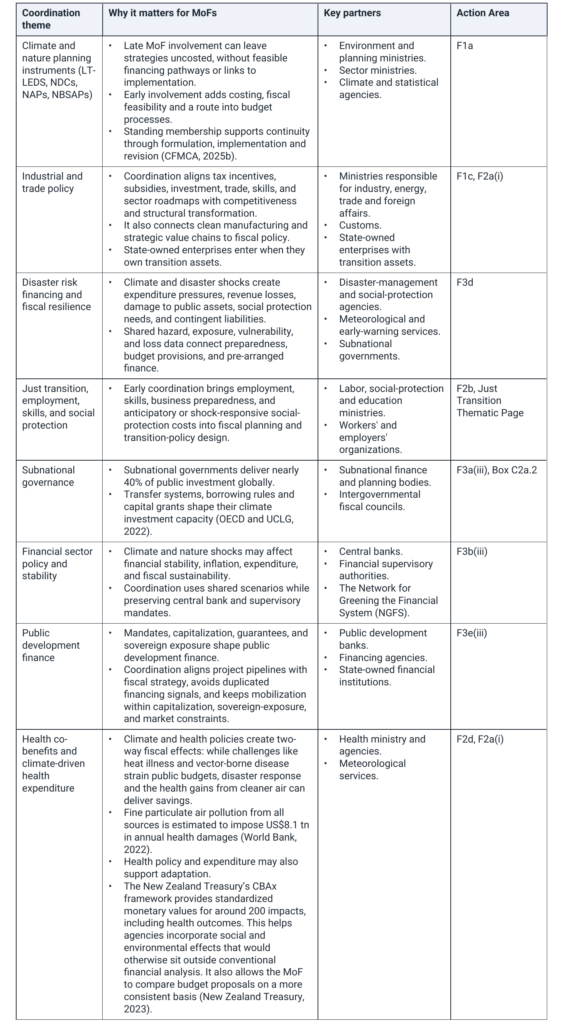
Source: Authors’ compilation, drawing on OECD (2025a) and CFMCA (2025b).
Digital systems support coordination when institutions agree on data, responsibilities, and cost
Climate modules in financial management systems, shared expenditure dashboards, and data-exchange platforms may connect planning, budgeting, and reporting. Indonesia’s CONNECT Climate Finance Dashboard provides one example. The institutional work of agreeing data-sharing protocols and technical costs may be harder than building the platform itself. Interoperability, governance, and staff capability remain prior conditions (GIZ, 2025; see Function 2, Greening public investment management).
Barriers and ways to overcome them
Each issue below pairs a typical barriers with actions an MoF could consider. A wider range of Opportunities for action is given in the next section.
The MoF is not meaningfully engaged in coordination
In some countries the MoF might not be an active member of the interministerial coordination mechanism on climate change. In others it might sign off on budget and financial matters without shaping the strategy those decisions fund. Where no active participation happens, the only route in is the budget approval point, after the design choices are made.
Approach.
Where membership of an interministerial coordination mechanism exists without defined responsibilities, some countries have tied participation to specific budget and investment decision points. Others give the MoF a chair or co-chair role where the fiscal stakes are high. The appropriate choice depends on the domestic governance framework.
Agencies do not know who leads on a particular climate issue
Leadership on climate change is often unclear because domestic climate governance arrangements are unstated. The overlap between line ministries and the climate change team inside the MoF can also be a recurrent point of contention.
Approach.
Conflict resolution of this kind (see Box C2a.3) presumes clarity on mandates; where they are not clearly defined, escalation routes may resolve the immediate issue without addressing the wider question. Some countries have written the division of responsibility into the mandate itself (see Capability 1, Strengthening the mandate of Ministries of Finance).
Interministerial tensions around climate policy are not necessarily failures of coordination; they often reflect competing institutional priorities. The World Bank’s 4i Framework helps explain these tensions through four dimensions of political economy institutions, interests, ideas, and influence (Hallegatte et al., 2023). These dimensions overlap in three recurring forms of inter-ministerial tension:
- Fiscal sustainability and policy ambition. MoFs coordinate primarily to secure the fiscal sustainability of climate measures, while environment ministries carry the ambition mandate (OECD, 2025a). One route to resolution is impact analysis that separates short-term fiscal costs from long-term benefits, paired with phasing that matches ambition to fiscal capacity.
- Competitiveness and regulatory compliance. Industry ministries weigh carbon leakage, competitiveness, and job displacement. Environment ministries carry a mandate for regulatory stringency. Packages that combine pricing, subsidies, public investment, and regulation can hold both mandates together (CFMCA, 2026, see Function 2, Combining instruments into coherent policy packages).
- Production and conservation. Agriculture ministries focus on productivity, food security, and rural livelihoods. Environment ministries focus on ecosystem protection. One route to resolution is integrated landscape planning that combines conservation with sustainable production, supported by reform of environmentally harmful subsidies and targeted assistance for affected producers and communities (IPBES and IPCC, 2021).
The MoF may arbitrate when its mandate covers the issue. Budget sequencing remains subject to government approval and legislative appropriation. Disputes involving the MoF may go to the center of government while other systems assign sequencing to a planning ministry. Shared cost–benefit, impact, and macroeconomic analysis can minimize disputes rooted in different data.
Escalation follows the nature of the dispute. Fiscal questions may move through MoF channels, technical points through the relevant sector hierarchy, and high-stakes issues to the head of government. Denmark’s Cabinet Economic Committee, chaired by the finance minister and including the climate minister, provides one formal route.
Source: Authors’ compilation.
Proposals arrive in a form that require “translation” by MoFs
Ministries of finance and environment work with different analytical frameworks, vocabularies, and timelines. Climate proposals can therefore reach the MoF without the fiscal case attached, and the response might read as obstruction rather than engagement. Competition for authority compounds this where mandates overlap or dedicated climate finance creates rivalry for resources (CFMCA, 2025b).
Approach
Countries have narrowed this gap through focal points on each side of a proposal, joint analytical work on shared assumptions, seminars and secondments, and recruiting environmental economists into the MoF (see Capability 1, Formalizing governance structures and organizational set-up and Capability 3, Enhancing economic decision-making tools and data-driven analysis).
Small MoF teams are asked to sit on too many coordination bodies
Governments can create so many bodies and working groups that the load can become self-defeating, and MoF teams stretched across them may engage less deeply in each (ODI, 2025). A climate finance unit set up to attract international investmentbut cut off from core fiscal processes could also add load without changing the budget/allocation.
Approach
Where the coordination architecture cannot be rationalized, a small team can choose which mechanisms to staff by fiscal exposure, and a unit tied to core fiscal processes can anchor the work.
Line agencies approach funds and markets separately
In many countries the MoF screens requests for international finance before approval. Where line agencies pursue their own climate priorities, it might be harder to issue green bonds, reach climate funds, or put a coherent investment case to international partners.
Approach
Where screening sits at approval rather than at pipeline formation, the MoF sees a request after the partner has been approached and can then only decline or reprofile it. Some countries have moved the screen upstream to pipeline formation (see Function 3, Setting up country platforms).
Labor and education ministries enter after the budget is set
Engagement with these ministries is often constrained by institutional silos, with labor, skills, and social protection treated as secondary rather than integral to climate and economic policy. Assessing the social and distributional implications of climate policies and estimating their cost is analytically demanding, and most MoFs are still sourcing the data and tools to do this (CFMCA, 2025a).
Approach.
Where the costing tools are not yet in place, asking about measures to manage employment and social protection consequences at the design stage might be appropriate. Capability 3, Enhancing economic decision-making tools and data-driven analysis sets out measurement tools, and the Just Transition thematic page includes a more detailed breakdown.
No single body manages the fiscal aspects of disaster risk
Disaster risk information is dispersed across disaster management agencies, hydrological and meteorological services, line ministries, and subnational governments; financing responsibilities may be split along the same lines. Where the information sits with agencies that do not report to the MoF, the consolidated picture is assembled from what they choose to share.
Approach.
Fiscal risk statements can give ranges rather than specific figures. Countries have addressed this by establishing data-sharing protocols anchored in the budget calendar (see Function 2, Future-proofing the public finances by redesigning the tax system for net zero and climate resilience and Function 3, Providing disaster risk finance and insurance for all).
Subnational governments can be absent from fiscal policy design
Cities and subnational governments are often not part of fiscal policy design. This can result in domestic climate commitments and strategies that are based on inaccurate assumptions of local investment capacity or fiscal strength, if not completely disconnected from them.
Approach.
Instruments to improve this are already available to MoFs in most contexts, among them intergovernmental fiscal frameworks, transfer systems, and borrowing rules. Box C2a.2 sets out those instruments and the channels countries have used.
Multilevel coordination connects national commitments to local delivery. Subnational governments deliver public investment, regulation, and services yet may be absent from the fiscal and policy design that shapes their capacity. Urban areas account for more than 80% of global GDP and subnational governments account for nearly 40% of public investment (OECD and UCLG, 2022). Responsibilities for transfers, borrowing, and capital grants differ across fiscal systems.
Kenya gives dialogue a fiscal instrument. County Climate Change Funds, anchored in county legislation, direct 1–2% of development budgets to locally prioritized climate investments (Crick et al., 2019). Intergovernmental fiscal frameworks and borrowing rules may be constitutionally assigned or shared with independent commissions and subnational legislatures. Four out of five NDCs refer to subnational governments as implementation partners, while about one quarter explicitly integrate urban priorities and solutions (WRI, 2024; UNFCCC, 2025).
Early dialogue can bring local authorities into the design of strategies, project pipelines, transfers, and co-financing rules. National systems may pair finance with technical support for project preparation and reporting, while that support remains outside the MoF’s delivery role. Institutionalized fiscal and technical channels also avoid repeating an ad hoc consultation each cycle (see Function 3, Enhancing sub-sovereign finance to support fast growing cities and towns).
The Coalition for High Ambition Multilevel Partnerships for Climate Action (CHAMP) was launched at COP28. As of 2025, its 78 endorsers (77 countries plus the EU) represent 69% of global GDP (CHAMP, 2025). It an example framework through which central governments have committed to embedding subnational governments in domestic climate strategies.
Source: Authors compilation with input from C40
Opportunities for action
MoFs can participate in inter-agency climate coordination and, in some contexts, lead it. The appropriate role depends on mandate, capacity, market conditions, and the coordination burden described above. The options below draw together approaches used by different countries and are not intended as a common model.
Budget circulars, common assumptions for resilience proposals, climate budget tagging, medium-term expenditure frameworks, and implementation reviews create recurring points for coordination. Integrating climate risk and investment into existing planning and reporting keeps the work within established fiscal processes. In donor-financed settings, aid modality also shapes MoF oversight (see Function 2, Using public financial management and the budget to drive transformation).
Working groups and shared platforms are most useful when terms of reference, outputs, and reporting lines connect to budget, planning, or investment decisions. Shared platforms may align climate data, strategic plans, and departmental budgets. Participation may include labor, education, and social protection institutions so employment and distributional effects inform the relevant decisions.
Shared data protocols, a common resilience and climate-investment pipeline, joint appraisal criteria, and contingency planning connect risk reduction, reserves, contingent credit, and insurance to fiscal decisions and assigned responsibilities during crises (see Function 3, Providing disaster risk finance and insurance for all).
Intergovernmental forums, transfer negotiations, budget circulars, and borrowing frameworks bring local conditions into national investment planning and may align fiscal transfers with local delivery capacity. Additional bodies carry staffing and secretariat costs. CHAMP provides one voluntary framework for dialogue (see Box C2a.2 and Function 3, Enhancing sub-sovereign finance to support fast growing cities and towns).
Joint planning may cover NDCs, NAPs, NBSAPs, and biodiversity finance plans. Coordination across finance, industry, energy, environment, and labor may connect industrial and transition policy, while fiscal analysis identifies conflicting incentives, financing claims, and public flows that work against environmental objectives. The same process may identify a role for blended finance. MoFs select scope according to exposure and capacity (see Function 1, Participating in the development and implementation of climate strategies, Function 1, Shaping 21st century industrial and innovation strategies, Function 2, Carbon pricing, subsidy reform and fiscal policy measures, Function 3, Driving innovations in financing models, including blended finance and Function 3, Setting up country platforms ).
The NGFS-CFMCA Joint Dialogue Platform is an informal forum that brings together MoFs, central banks, and financial supervisors. They share analysis and experience on the macroeconomic and financial implications of climate change while respecting their individual mandates and central bank independence. Shared stress-test results link financial stability analysis to sovereign risk, budget planning, and debt management (see Function 3, Greening central banks and fiscal and monetary policy coordination).
Distributional analysis, transition costing, and economic scenarios and models give finance, planning, environment, central bank, and public development bank teams common assumptions. The same work may bring social implications and transition-support measures into budgeting, public investment planning, and medium-term expenditure frameworks. Secondments, regional technical bodies, and embedded advisers with handover plans can supplement limited staff (AFD, 2026; see Function 2,Using public financial management and the budget to drive transformation and Capability 3, Enhancing economic decision-making tools and data-driven analysis).
Shared tools add value after data governance, interoperability, and role allocation are in place. Some ministries also test AI-assisted fiscal analysis and build digital skills where capacity allows.
Real word examples
Spain
The Capability Assessment Framework helps Ministries of Finance assess their institutional, analytical and coordination capabilities for integrating climate action into their core functions, and identify priorities for strengthening them. As a result of Spain’s application of the Framework, the Ministry of Economy, Trade and Business established a cross-departmental working group, bringing together representatives from units where climate issues are most operationally relevant. The group serves as the Ministry’s primary internal coordination mechanism, within its existing general competences and ahead of any dedicated legal mandate. It meets regularly to share progress, address challenges, and maintain alignment across departments, while also serving as an internal channel for disseminating Coalition work.
Germany
The Sustainable Finance Advisory Council links the Federal Government to business, academic, and civil society sustainable finance expertise, with membership reset each legislative period.
Indonesia
The CONNECT Climate Finance Dashboard links national and subnational climate planning, budgets, and performance data. Memorandums of understanding among finance, planning, and environment ministries provide the basis for data interoperability and a shared evidence base (see Function 2, Using the budget to drive transformation in all sectors of the economy).
Singapore
A committee at the center of government sets direction, with permanent-secretary and working-level groups coordinating the finance, transport, environment, and national development portfolios.
Seychelles
A Commonwealth-funded climate finance adviser worked across the climate and finance ministries, supporting a technical working group jointly chaired by their principal secretaries. The arrangement helped connect climate priorities to fiscal planning and supported climate budget tagging, a Climate Budget Statement, and reforms under the IMF Resilience and Sustainability Facility. Climate finance functions were subsequently transferred into the MoF (see full case study).
Sri Lanka
The MoF led a three-stage process that selected 12 instruments for the National Climate Finance Strategy for 2025 to 2030, launched in October 2025. Through collaboration between the Ministry of Environment, UNDP, and the UK Government, the strategy links domestic and international resource mobilization, governance and transparency, and stakeholder engagement (Government of Sri Lanka, 2025).
Madagascar
The MoF and technical ministries developed a climate budget tagging method that includes disaster risk reduction and stakeholder validation. It received support from UNDRR and financing linked to the IMF Resilience and Sustainability Facility. Integration into the 2026 green budget process enables expenditure on prevention, early warning, and preparedness to be identified, tracked, and reported (UNDRR, 2024).
South Africa
The Just Energy Transition Partnership coordinates transition finance across the Presidency, sector ministries, the National Treasury, and the Presidential Climate Commission. A Presidential Climate Finance Task Team engaged partners, advised the Government through an interministerial committee, and prepared the investment plan. The Government endorsed the plan in October 2022. It identified 1.48 tn rand (US$87 bn) for 2023 to 2027 covering electricity generation, new energy vehicles,and green hydrogen. The National Treasury connects priorities to budgeting, infrastructure planning, and public finance systems and helps coordinate public, concessional, and multilateral development bank finance alongside risk-sharing structures.
The Presidential Climate Commission is a multi-stakeholder statutory body that oversees and facilitates a just and equitable transition toward a low-emissions and climate-resilient economy. It brings together government, business, labor, civil society, youth, and academia into the process, providing one route for worker representation and published an appraisal in 2023 (Republic of South Africa, 2022; Presidential Climate Commission, 2023).
Fiji
For the 2021–2022 budget, the Ministry of Economy—then responsible for fiscal policy—used a VAT exemption and targeted premium subsidies for parametric climate and disaster insurance. Delivered through the social welfare system, it supportedfarmers, fishers, market vendors, and other vulnerable groups. Coordination connected fiscal authorities, insurance regulators, social-protection systems, and the Pacific Catastrophe Risk Insurance Company to support faster post-disaster response (Fiji Climate Change Portal, 2022; see Function 3, Providing disaster risk finance and insurance for all and Function 3, Enhancing sub-sovereign finance to support fast growing cities and towns).
Uzbekistan
A tripartite institution brings the MoF, the Ministry of Employment and Poverty Reduction, and social partners together on just transition questions (see Capability 2, Coordination and collaboration for whole-of-economy climate action).
Malaysia
The MoF aligns fiscal policy and sustainable finance strategy, while Bank Negara Malaysia leads supervisory implementation on climate and emerging nature-related risks. This division brings climate scenarios into prudential work—the assessment of their safety and resilience—without overstepping the central bank’s mandate (JC3, 2022).
Brazil
The National Monetary Council, chaired by the finance minister, sets rural credit policy. The central bank implements and supervises environmental eligibility checks linked to illegal deforestation within a broader social, environmental, and climate-risk framework, exercising distinct policy and supervisory responsibilities (CPI and WWF, 2024).
Uganda
The Ministry of Finance, Planning and Economic Development sits on the three strategic policy committees dealing with climate policy: the Policy Committee on Environment, a government subcommittee, and the National Climate Change Advisory Committee. Building on the National Climate Change Policy (2015), it also coordinates across ministries, departments, and agencies and works with the National Planning Authority and the Ministry of Water and Environment. This architecture informed the Fourth National Development Plan for 2025/26 to 2029/30, which mainstreams climate resilience across sector mandates and links the Green Growth Strategy and updated NDCs to budgeting and implementation.
Public financial management provides the delivery links. A statutory contingencies fund under the Public Finance Management Act 2015 supports disaster response and adaptation. Green public procurement reforms integrate environmental and social sustainability into government expenditure, and a Climate Finance Unit coordinates mobilization, budget tracking, and engagement across ministries.
E3G (Ben Rhodes, Raisa Cole, Kate Levick); UNDRR (Erick Ariel Gonzales Rocha, Mathieu Verougstraete); C40 (Luis H Sáenz, Andrea Fernández); UNDP (Shanaz Broermann, Vivek Misra, Asad Maken, Mamta Kohli, Biplab Das, Nahid Sharmin, Owais Parray, Nila Murti, Garnadipa Gilang, Cristina Gregorio); Commonwealth (Aurelius Nkonde, Nwamarah Uzoamaka); 2050 Pathways (Marcela Jaramillo); Ministry of Finance of Spain (Francisco Morales Tamayo, Ana San Basilio Berenguer); WWF (Karen Ellis, Maud Abdelli, Andrew Deutz); CEP (Patrick Lenain); ILO (Jana Bishler; Alice Vozza; Verena Schmidt; UNCTAD (Rachid Amui, Chantal Line Carpentier, Claudia Contreras, Clovis Freire, Lorena Jaramillo Castro, Malick Kane, Jingyuan Wu); AFD (Etienne Espagne, Antoine Godin, Jean-Baptiste Jacouton); NDC Partnership (Joaquim Leite, Adrian Flores Aguilar)
AFD (2026) Climate and Nature Economic Policy Scenarios (CNEPS) for Ministries of Finance, Public Development Banks, and Financial Authorities. What is at stake for the post-COP30 implementation agenda. Policy Paper No. 21, June 2026. Paris: Agence Française de Développement. https://www.afd.fr/en/resources/climate-and-nature-economic-policy-scenarios-cneps-ministries-finance-public-development
Canadian Climate Institute (2026) Canada’s new taxonomy council has a big job ahead. Here’s why it matters. https://climateinstitute.ca/canadas-new-taxonomy-council-why-it-matters/
CCC (2021) Independent Assessment of UK Climate Risk. Advice to Government for the UK’s third Climate Change Risk Assessment. London: Climate Change Committee. https://www.theccc.org.uk/publication/independent-assessment-of-uk-climate-risk/
CFMCA (2025a) A Global Survey of Ministries of Finance: The pressing policy questions Ministries of Finance face in driving green and resilient transitions and their use of analytical tools to address them. Report for the ‘Economic Analysis for Green and Resilient Transitions’ initiative.
CFMCA (2025b) How Ministries of Finance Can Build Capabilities for Economic Analysis and Modeling to Drive Green and Resilient Transitions: Taking stock of challenges, strategies, and lessons learned. Report for the ‘Economic Analysis for Green and Resilient Transitions’ initiative
CFMCA (2026) How Ministries of Finance Can Support Coherent Climate Policy Packages: Available Analytical Tools and Emerging Good Practice. Report for the ‘Economic Analysis for Green and Resilient Transitions’ initiative
CHAMP (2025) Summary of Activities 2025. Coalition for High Ambition Multilevel Partnerships for ClimateAction.
CPI and WWF (2024) Regulatory Mapping: Central Bank of Brazil. Climate Policy Initiative and WWF. https://wwfint.awsassets.panda.org/downloads/regulatory-mapping-bcb.pdf
Crick F, Hesse C, Orindi V, Bonaya M, Kiiru J (2019) Delivering climate finance at the local level to support adaptation. Experiences of County Climate Change Funds in Kenya. Working Paper. Nairobi: Ada Consortium. https://www.iied.org/g04415
Danish Ministry of Finance (undated) Green Policy Center. Copenhagen: Ministry of Finance. https://en.fm.dk/about-us/organization/green-policy-center/
Ekspertgruppen for en grøn skattereform (2024) Green Tax Reform. Final Report. February 2024. Copenhagen: Expert Group for a Green Tax Reform.
Ernst and Young (2024) Danish Government plans to introduce a new agriculture CO₂ tax. https://www.ey.com/en_gl/technical/tax-alerts/danish-government-plans-to-introduce-a-new-agriculture-co2-tax
Fiji Climate Change Portal (2022) Fiji’s parametric climate and disaster risk insurance product. Suva: Government of Fiji. https://fijiclimatechangeportal.gov.fj/fijis-parametric-climate-and-disaster-risk-insurance-product/
GIZ (2025) Navigating Green Public Financial Management: A Reference Guide for Ministry of Finance Officials. https://www.greenfinanceplatform.org/guidance/navigating-green-public-financial-management-reference-guide-ministry-finance-officials
Government of Sri Lanka (2025) National Climate Finance Strategy of Sri Lanka (2025 to 2030). Colombo: Ministry of Finance. https://www.treasury.gov.lk/news/article/361
Hallegatte S, Godinho C, Rentschler J, Avner P, Dorband II, Knudsen C, Lemke J, Mealy P (2023) Within Reach: Navigating the Political Economy of Decarbonization. Washington D.C.: World Bank. https://openknowledge.worldbank.org/handle/10986/40601
IPBES and IPCC (2021) Biodiversity and Climate Change Workshop Report. https://www.ipbes.net/events/launch-ipbes-ipcc-co-sponsored-workshop-report-biodiversity-and-climate-change
Irish Fiscal Advisory Council and Climate Change Advisory Council (2025) A Colossal Missed Opportunity. Ireland’s Climate Action and the Potential Costs of Missing Targets. March 2025. Dublin.
Joint Committee on Climate Change [JC3] (2022) Reference Guide on Climate Risk Management and Scenario Analysis. Kuala Lumpur: Bank Negara Malaysia and Securities Commission Malaysia. https://www.sc.com.my/api/documentms/download.ashx?id=692e67c4-8800-4b04-a6e2-f19c7afd8023
Klimarådet (2024) Status Outlook 2024. Denmark’s national climate targets. Copenhagen: Danish Council on Climate Change. https://klimaraadet.dk/
NDC Partnership (2024) Country Coordination Mechanisms. Best Practice Brief, July 2024. https://ndcpartnership.org/sites/default/files/2024-07/country-coordination-mechanisms-best-practice-brief.pdf
NDC Partnership (2025) A Practical Guide to Establishing Climate Finance Units. Policy Brief, February 2025. Center for Access to Climate Finance. https://ndcpartnership.org/sites/default/files/2025-02/climate-finance-units-policy-brief.pdf
New Zealand Treasury (2023) CBAx Tool User Guidance. Guide for departments and agencies using Treasury’s CBAx tool. Wellington: The Treasury. https://www.treasury.govt.nz/sites/default/files/2023-12/cbax-tool-user-guidance-dec23.pdf
OBR (2025) Fiscal risks and sustainability. July 2025. London: Office for Budget Responsibility. https://obr.uk/frs/fiscal-risks-and-sustainability-july-2025/
ODI (2025) Inside research and policy units: how four African Ministries of Finance structure evidence use. https://odi.org/en/publications/inside-research-and-policy-units-how-four-african-ministries-of-finance-structure-evidence-use
OECD (2025a) Breaking Down Silos: Strengthening Interministerial Coordination to Mobilize Finance and Investment for Climate Mitigation. Paris: OECD
OECD/UCLG (2022) 2022 Synthesis Report of the World Observatory on Subnational Government Finance and Investment. Paris/Barcelona: OECD Publishing.
PCC (2023) PCC analysis and recommendations on the Just Energy Transition Investment Plan. May 2023. Pretoria: Presidential Climate Commission.
Petrie M (2021) Environmental Governance and Greening Fiscal Policy: Government Accountability for Environmental Stewardship. First edition. Palgrave Macmillan.
Petrie M (2024) Environmental Governance and Greening Fiscal Policy: Government Accountability for Environmental Stewardship. Second edition. Palgrave Macmillan.
Republic of South Africa (2022) South Africa’s Just Energy Transition Investment Plan (JET IP) 2023 to 2027. Pretoria: The Presidency.
UNDRR (2024) Annual Report 2024. Geneva: United Nations Office for Disaster Risk Reduction. https://www.undrr.org/annual-report/2024
UNFCCC (2025) NDC Synthesis Report. Bonn: UNFCCC Secretariat.
World Bank (2022) The Global Health Cost of PM2.5 Air Pollution. Washington D.C.: World Bank. https://openknowledge.worldbank.org/handle/10986/36501
WRI (2024) Stronger NDCs With Cities, States, and Regions: Recommendations for National Governments. Washington D.C.: World Resources Institute.