Using blended finance and risk-sharing instruments
This Action Area covers how Ministries of Finance can use public finance to mobilize private investment while managing fiscal exposure. It covers:
- Matching public interventions to the constraints preventing investment, including the wider policy and enabling environment.
- Financial, risk-sharing, and demand-side instruments.
- Delivery channels.
- Additionality and fiscal risks.
- How approaches vary with fiscal space, market depth, project pipelines, and institutional capacity.
Context and role of Ministries of Finance
How public finance can unlock private investment
The scale and nature of the investment required for the transition to a low-carbon, climate-resilient, and nature-positive economy create a challenge for Ministries of Finance (MoFs) across developed and emerging economies. Delivering countries’ Nationally Determined Contributions, and where applicable their National Adaptation Plans, National Biodiversity Strategies and Action Plans, and wider development and resilience objectives, requires investment across energy, transport, buildings, industry, agriculture, infrastructure, and resilience. This investment will need to come from a combination of public and private sources, with the appropriate balance varying across sectors, countries, and stages of market development.
The challenge is particularly acute in emerging markets and developing economies (EMDEs). Investment needs are often compounded by constrained fiscal space, higher perceived or assessed risk (country, credit, and currency), higher financing costs, and more limited access to private and international capital (Ameli et al., 2021; IEA, 2024). Climate finance to EMDEs surpassed US$1tn in 2023 but was highly concentrated, with China accounting for 64% of the total. CPI estimates that EMDEs require almost US$4tn in annual climate finance through 2030 to meet their climate goals (CPI, 2025).
Sovereign credit risk can also constrain borrowers’ access to international capital. Many potentially viable projects, companies, and financial institutions in EMDEs remain unable to access international institutional capital, reflecting a combination of risk–return considerations, financing conditions and, in some cases, regulatory, prudential, and fiduciary constraints.
Public finance can fund investment directly, improve investment conditions, and, where appropriate, share risks that prevent private participation. The choice of intervention depends on what prevents investment, and these constraints often originate beyond the financing transaction itself. Policy and regulatory frameworks, sector incentives, credible transition pathways, public investment, and project development capacity shape the underlying profitability and risk of different investments, and therefore where capital flows.
Consider wider government action before financial support
Where a residual financing constraint remains, public finance can improve investment conditions, share specific risks with private investors, or create demand for new products and technologies. Where these interventions make an investment sufficiently viable, they can mobilize private capital that would otherwise not be available. Where no viable private revenue model exists, public funding or direct provision may be more appropriate.
This approach also means recognizing that mobilizing private investment for EMDEs can be more effective at the portfolio level than at the level of individual projects. Pooling and aggregating investments can diversify risks and, when combined with appropriate public-sector risk absorption or subordination, help bring investments within the mandates of institutional investors in advanced economies. At the individual investment level, public support may instead be needed to address a specific risk, financing constraint, or demand gap. Domestic banks and local-currency financing are also relevant channels, particularly for borrowers with local-currency revenues. Their contribution depends on domestic savings, lending capacity, and financial-market depth.
The objective is to use scarce public finance where it makes a clear difference: addressing constraints that limit private investment or supporting investments for which private finance is not suitable. In practice, this means improving investment conditions or the risk–return profile of a project or portfolio while weighing the private capital mobilized against the fiscal resources and risks the government assumes.
Blended finance is one means of addressing these constraints. Combining public and private finance can improve the risk–return profile enough to mobilize additional private investment. However, it is not an objective in and of itself, and cannot substitute for broader policy reform, public investment, or financial-market development where these are needed. For MoFs, the key questions are whether:
- Public support addresses a specific constraint at an acceptable fiscal cost, considering the private capital mobilized and the public resources and risks committed.
- The investment would have occurred without public support.
- Support remains justified as market conditions evolve.
Addressing the constraint
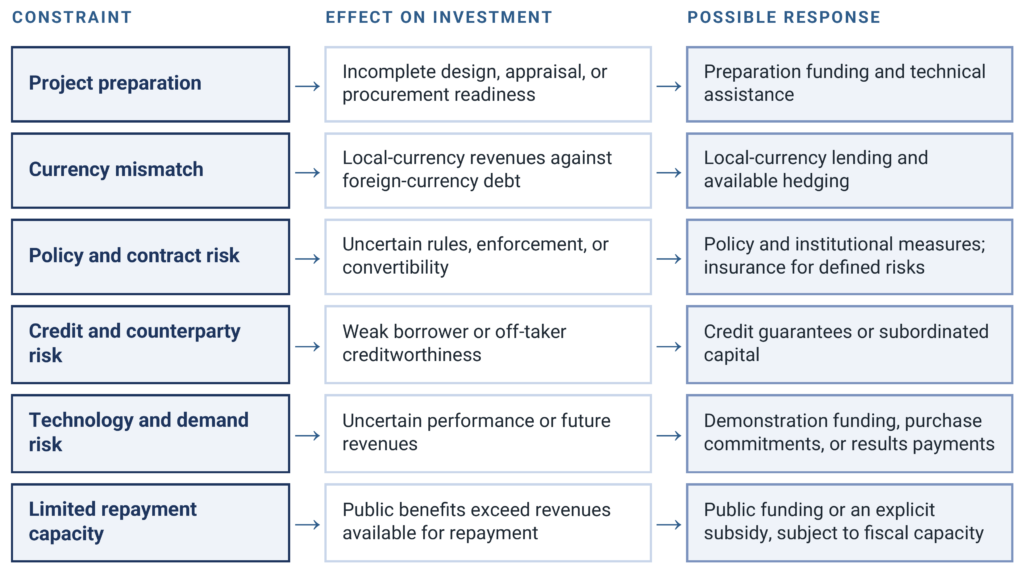
Public finance and wider government action can address different constraints to private investment, but the appropriate intervention depends on what is preventing investment. Governments can influence investment not only through public finance but also by shaping incentives and market conditions. For example, they can design policies that support clean energy, transport, and infrastructure, establish credible transition pathways, or use public procurement and other forms of government support to create markets. Figure 1 sets out the main constraints that can deter private investment, alongside the public interventions and instruments that can address them.
Figure 1. Constraints to private investment and instruments to address them
Source: Authors’ compilation drawing on Waissbein et al. (2013) and OECD (2021).
Note: Risk transfer does not remove the underlying risk. Public exposure depends on the contract and its implementation.
Public responses to these constraints fall into four broad categories: improving investability, sharing specific risks, creating demand, and providing public funding where private finance is not suitable.
Improve investability
Policy and regulatory reforms, reliable institutions, enabling infrastructure, project preparation, and technical assistance can make projects more investable and reduce the risk premium investors require. These measures can address constraints that affect multiple activities, rather than subsidizing individual transactions, and create a pipeline of projects that later use commercial or blended finance.
Share risks
Where a project is commercially viable but risks prevent private financing, public institutions can share or transfer those risks. Guarantees, concessional loans, first-loss capital, and other risk-sharing instruments can improve the risk–return profile for private investors. The design needs to identify the specific risk being addressed, the party best placed to bear it, the maximum public exposure, the expected fiscal cost, and the conditions under which support ends. Risk-sharing is most useful where it addresses a defined market or financing constraint.
Create demand
Some emerging technologies or markets face a different constraint: investors may be unwilling to build capacity because future demand is uncertain. Public procurement, advance market commitments, and other offtake arrangements can provide greater revenue certainty and allow private investment to scale.
Use public funding where private finance is not suitable
Some investments generate substantial public benefits but have no reliable revenue stream. De-risking cannot make these investments commercially viable. Grants, public investment, or direct provision may therefore be more appropriate, particularly for some adaptation, resilience, nature, and basic infrastructure investments.
Mobilize private capital where it adds value
Not every investment needs to be structured as a private finance transaction. Pooling and aggregating investments into portfolios can be an effective way to mobilize institutional capital from advanced economies to EMDEs (NZAOA, 2021). By diversifying risks across multiple investments and countries, such structures can improve risk-adjusted returns and, where appropriate, use public junior capital to enhance the credit profile of instruments offered to private investors. Aggregation can also reduce transaction costs and project-level execution risks, while providing access to local origination, due diligence, and project delivery capabilities that many institutional investors lack. Mobilization ratios and returns on public capital depend on portfolio performance, risk allocation, and the terms of the public contribution.
Box F3c(ii).1. Public finance can support wider resilience and competitiveness objectives
Using public finance to mobilize private investment can have benefits beyond the individual project. Investment in domestic renewable generation, grids, and energy efficiency can reduce exposure to imported fossil fuels and energy price shocks. Investment in resilient infrastructure can reduce the economic and fiscal costs of climate-related disruptions. Investment in strategic sectors can also support broader competitiveness objectives. This link is developed further under development bank governance in the Opportunities for action below (see Function 1, Shaping 21st-century industrial and innovation strategies).
These wider benefits do not remove the need to assess fiscal costs. Guarantees and other risk-sharing instruments create direct or contingent public liabilities, while concessional resources have alternative uses. Fiscal appraisal therefore considers both the wider economic and resilience benefits of an investment and the risks retained by government. Private finance can support investment beyond direct budget financing, while leaving repayment obligations and any public liabilities to be met. It does not itself create additional budget resources. Public provision remains relevant where markets cannot generate a viable revenue model.
Choosing the right instrument
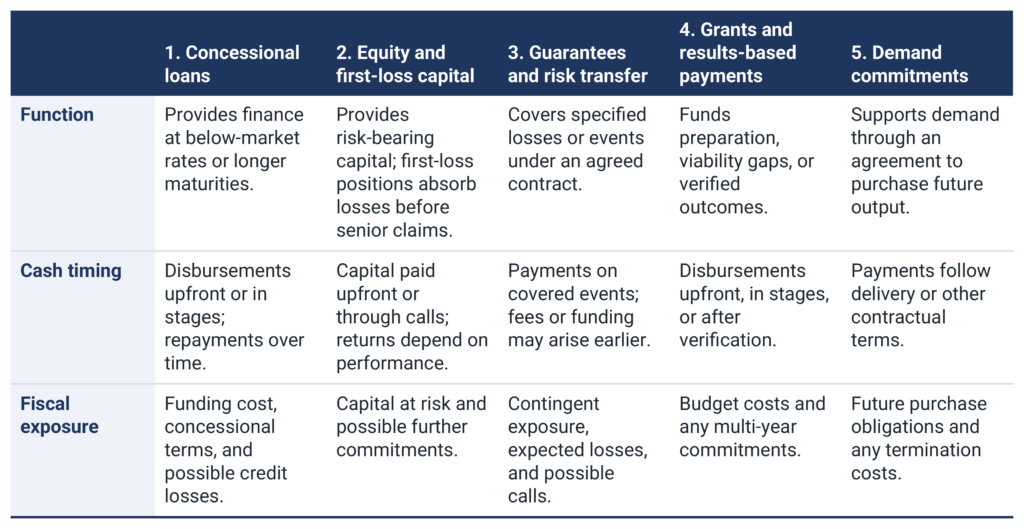
Once the constraint is clear, instrument choice determines how public and private capital, risk, and payment are allocated. Financial and risk-sharing instruments recur across blended-finance structures, including concessional finance, first-loss capital, guarantees, and grants and results-based payments. Demand-side instruments, such as procurement, advance market commitments, and offtake arrangements, address a different constraint by creating greater certainty about future revenues.
The instruments differ in what the public contribution pays for, the timing of cash flows, and the fiscal exposure retained by government. Figure 2 summarizes these features. Accounting recognition and provisioning depend on the instrument and the applicable rules.
Financial and risk-sharing instruments
- Concessional loans reduce financing costs through below-market interest rates, longer maturities, or grace periods. They are appropriate where a project can generate revenues but cannot attract commercial capital on market terms. The Indonesia case study below describes a public development finance platform that provides concessional and risk-sharing support alongside commercial sources (see also OECD, 2021; DFI Working Group, 2023).
- Equity and first-loss capital absorb losses before private investors bear any. They can reduce the expected losses of senior investors and make a financing vehicle sufficiently attractive to institutional capital. The public sector therefore accepts greater downside risk in exchange for mobilizing additional private capital. This approach can be taken either at the project or portfolio level, depending on the scope for diversification. The Finland and Tropical Forest Forever Facility case studies below describe public first-loss positions (see also Convergence, 2025; IDB Invest, 2023; NZAOA, 2021; 2022).
- Guarantees and other risk-transfer instruments protect investors or lenders against defined risks, such as credit, political, currency, construction, or demand risk. Governments generally pay only if the defined risk materializes, but the commitment creates a contingent fiscal liability. For example, South Africa’s National Treasury funded the loss reserve for its Energy Bounce Back guarantee scheme through a vehicle at the Reserve Bank, so that losses accrued outside the annual budget (South Africa National Treasury and SARB, 2023). The South Africa case study below describes the scheme in more detail (see also Saxena, 2017; Razlog et al., 2020; Bellesi et al., 2025).
- Grants and results-based payments fund activities where there is no sufficient commercial return. Grants can support project preparation, technical assistance, or viability gaps. Results-based payments release funding when agreed outcomes have been independently verified. For example, Kenya’s Financing Locally Led Climate Action program channels donor-supported climate finance through the National Treasury to county governments for adaptation and resilience investments (World Bank, 2017; OECD, 2021).
Demand-side instruments
- Demand commitments provide greater certainty about future revenues and market conditions. Public procurement, advance market commitments, and other offtake arrangements can help create predictable demand for emerging technologies, giving investors greater confidence to invest at scale. Equally important are clear and credible policy commitments on the future trajectory of polluting technologies and activities—including phase-out or progressive tightening of standards—which can shift relative incentives and strengthen the investment case for cleaner alternatives.
Figure 2. Public financing instruments: Their functions, cash timing, and fiscal exposure
Source: Authors’ compilation based on OECD (2021); DFI Working Group (2023); Saxena (2017); Razlog et al. (2020).
Note: Fiscal exposure depends on the terms of the instrument and the risks retained by government.
The appropriate instrument depends on the constraint, the level of public support required, and the public sector’s risk tolerance, fiscal capacity, and policy objectives. More public support is not necessarily better: the aim is to provide what is needed to make the investment viable while limiting public exposure.
Box F3c(ii).2. Mobilization and additionality
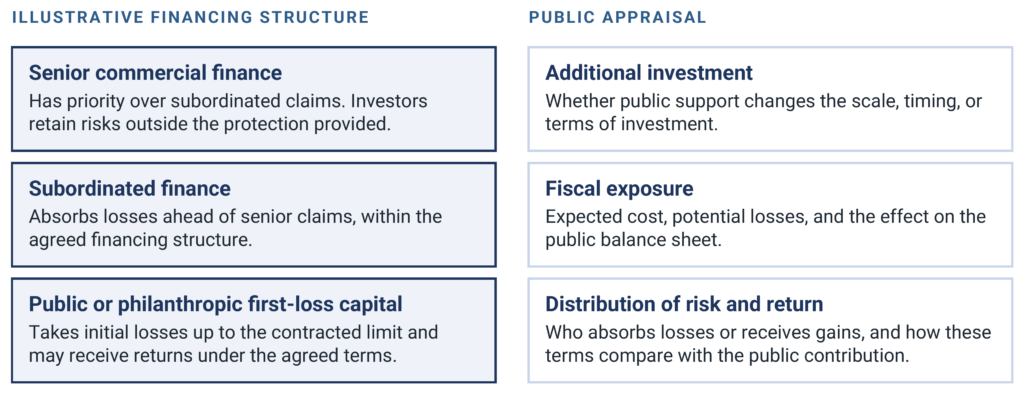
Mobilizing private finance is one way in which public finance can contribute to investment, but the amount of private capital mobilized does not by itself capture the full contribution of public support. Public interventions can influence the terms, scale, timing, or risk allocation of an investment, including by enabling investment that may otherwise have been delayed, undertaken at a smaller scale, or financed on less favorable terms.
Public risk absorption can leave losses with government while gains accrue to private investors. This risk is greater when support subsidizes investment that would have proceeded anyway or provides protection without corresponding public compensation. Evidence from different instruments and markets shows that the effects of public intervention vary with country circumstances, market conditions, and instrument design. Development finance participation can, for example, improve financing terms and help address specific market or financing constraints, while the extent of its contribution will depend on the circumstances of each investment (Broccolini et al., 2021; Mazzucato, 2013; Mazzucato and Penna, 2016).
For MoFs, relevant considerations include:
- How much private capital was mobilized.
- What constraint public support was intended to address.
- How public support affected the terms, scale, or timing of investment.
- What public resources and risks the intervention involves.
- Whether the level and form of support remain appropriate as market conditions evolve.
Practical approaches include:
- Setting clear eligibility and pricing conditions.
- Monitoring realized mobilization and the contribution of public support.
- Considering fiscal exposure.
- Reviewing whether the structure remains appropriate over time.
The appropriate approach depends on the instrument, market, and country circumstances, as well as the alternative uses of public funds (OECD, 2021; see Figure 3).
Figure 3. Illustrative risk allocation and public appraisal
Source: Authors’ compilation drawing on OECD (2021); Saxena (2017); Mazzucato (2013).
Notes: 1. Guarantees cover specified risks by contract and can sit alongside the capital structure. 2. Public loss protection can leave gains with private investors. Pricing, disclosure, review, and provisions for sharing returns affect this distribution.
Development banks and climate funds provide established delivery channels
While instruments define how public resources and risks are allocated, delivery channels determine which institutions provide, administer, or combine those instruments.
Development banks and climate funds can provide established channels for deploying public finance and mobilizing private capital. They can offer concessional finance, guarantees, equity, grants, and technical assistance, and can combine these instruments with commercial finance.
Development banks can help where private investors lack the information, risk appetite, maturity, or scale needed to finance a project. Their participation can improve financing terms and help develop project pipelines, particularly in sectors and markets where private investment is limited. Expanding finance into higher-risk and lower-income markets can therefore benefit from a systemic response, with development banks, governments, private investors, financial institutions, and other market participants working together to address these constraints.
Development banks can also create fiscal exposures. Public-private partnerships may involve availability payments, minimum-revenue guarantees, or termination payments, while guarantees create contingent liabilities (UNCTAD, 2026a). Project appraisal, fiscal risk management, and guarantee registers provide means of recording and assessing these exposures.
Climate funds provide another channel, particularly for grants, concessional finance, and project preparation. The main multilateral climate funds include the Green Climate Fund, the Global Environment Facility, Climate Investment Funds, and the Adaptation Fund. Their preparation and readiness programs can help countries develop the institutional capacity and project pipelines needed to attract further finance. Multilateral development banks (MDBs) can bring mature, operational projects to institutional investors by aggregating and securitizing existing assets that have passed the initial project execution phase and creating investment-grade instruments suited to institutional investment. As MDB shareholders, MoFs can encourage greater use of such approaches, including through initiatives such as the CIF Capital Markets Mechanism and IDB Invest’s ReInvest+ (G20 IHLEG, 2024; UNEP FI, 2025).
Access can nevertheless require significant preparation and coordination, reflecting the requirements of different funding windows, institutional mandates, and project structures. MoFs can therefore consider which access and delivery arrangements are best suited to country circumstances, including whether funds are accessed directly or through development banks or other accredited institutions (GCF IEU, 2020).
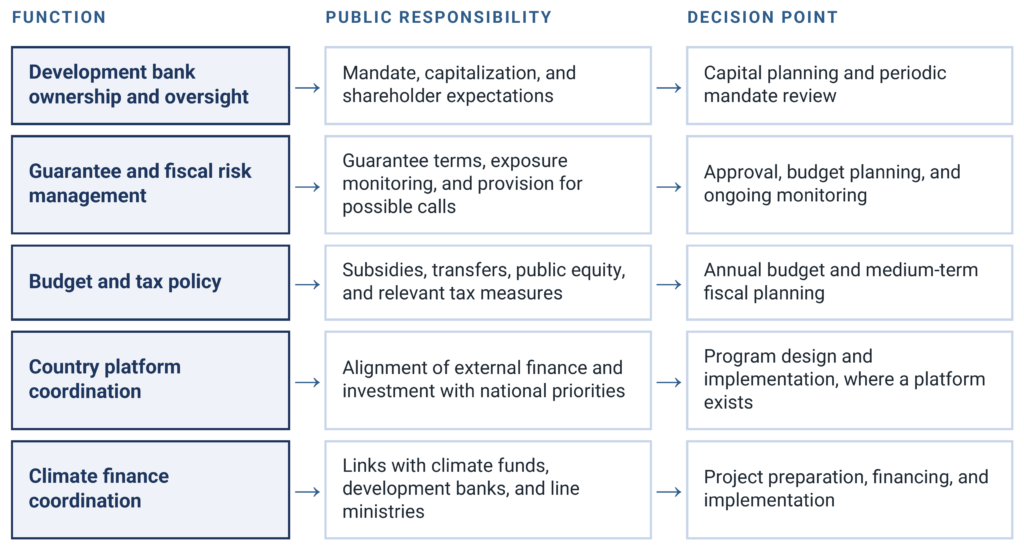
The delivery model depends on country institutions and mandates. Depending on their responsibilities, MoFs may set mandates and incentives, allocate public risk-bearing capacity, oversee fiscal exposure, or exercise shareholder and funder functions. Other ministries and public institutions may hold some of these responsibilities and execute individual transactions. Figure 4 illustrates possible responsibilities, instruments, and decision points.
Figure 4. Illustrative responsibilities and levers
Source: Authors’ compilation.
Note: Institutional ownership varies by country. MoFs may lead, coordinate, or support these functions.
While the tools and delivery channels are established, countries differ substantially in their fiscal space, institutional capacity, project pipelines, domestic financial markets, and ability to access external finance. These differences affect whether and how MoFs can use public finance to mobilize private capital.
Barriers to action and ways to overcome them
Each issue below pairs a typical barrier with actions a MoF could consider. A wider range of Opportunities for action is given in the next section.
Transaction costs can weigh disproportionately on smaller investments
Blended finance transactions can involve lengthy preparation and negotiation, particularly when several institutions participate or risks require tailored contractual arrangements. Structuring, legal, and due diligence costs do not fall proportionately with transaction size, which can make smaller investments more difficult to finance. For a MoF financing preparation or administering a facility, these costs absorb budget resources and staff time as well as affecting the terms available to private investors (OECD, 2026).
Approach
Options include pooling smaller transactions, standardizing documentation, and funding project preparation. Aggregation and securitization of existing MDB and development finance institution portfolios can recycle capital and enable further lending and investment, subject to market demand and the institutions’ mandates. MoFs can also assess which structural risks the public balance sheet can cover at acceptable cost. Where a public development bank exists, the treasury and shareholder unit may make that allocation together; MoFs without one have used guarantee facilities arranged by MDBs or development finance institutions (World Bank, 2025).
Uncertain demand can deter finance for new climate technologies
For technologies that lack maturity, private finance faces uncertainty about future demand on top of construction and credit risk. This can delay investment in production capacity and slow deployment, particularly in markets where demand is less predictable.
Approach
Weak project pipelines contribute to concentration in a few markets and sectors
A lack of projects that are sufficiently prepared, structured, and investable can limit private investment even where capital is available. The distribution of prepared projects across countries and sectors affects which markets can attract private finance.
Approach
Adaptation value does not always create a private repayment stream
Adaptation investment can avoid losses, stimulate economic activity by reducing background risk, and produce development co-benefits even in years when no disaster occurs. Some assets also generate direct revenue. The financing constraint arises when these benefits accrue broadly and neither payer nor cash flow exists, as with some flood defenses and early warning systems (Tanner et al., 2015).
Approach
Additionality is difficult to demonstrate and maintain
As discussed in Box F3c(ii).2., mobilization alone does not show that public support creates additional investment. In practice, however, it can be difficult for MoFs to establish what would have happened without public support, particularly where market conditions and investor behavior are changing. A transaction may attract private capital but still support an investment that would have proceeded without public intervention. Conversely, support that is too small, costly, or narrowly structured may fail to change the investment decision (NZAOA, 2021).
Approach
Institutional and fiscal capacity can constrain implementation
Mobilization results depend on the political economy, the institutions available to operate a structure, the project pipeline, and the regulatory environment. A structure that has performed well in one market often produces different results in another when these conditions differ (OECD, 2023; Convergence, 2025). Limited staff and expertise can also make it difficult for MoFs to prepare transactions, assess contingent liabilities, or access external climate funds directly.
Approach
Box F3c(ii).3. Private finance perspective: What blended finance needs to scale
Private investors emphasize investable pipelines, standardized documentation, clear risk allocation, and confidence that a market can outlast individual transactions. These conditions lower transaction costs and support scale, while the public share of risk remains subject to fiscal appraisal (UNEP FI, 2025; NZAOA, 2021).
Investors’ priorities include:
- Risk-absorbing capital. Development banks and vertical climate and environmental funds can take risks that private investors cannot efficiently bear.
- Project preparation. Technical assistance, grant-funded preparation, and early engagement among governments, public development banks, and private financiers can build predictable pipelines and turn sector priorities into transactions at scale.
-
Standardization. Simpler application and reporting requirements, together with standardized vehicles, guarantee structures, and contractual documentation, reduce fixed transaction costs.
- Mandates and incentives. Development bank performance frameworks can record private capital mobilization as well as lending volumes.
Source: UNEP FI (2025) and NZAOA (2021).
Opportunities for action
Identify the sectors and areas where investment is needed, drawing on Nationally Determined Contributions, National Adaptation Plans, other national priorities and, where relevant, National Biodiversity Strategies and Action Plans. Then identify the specific constraint preventing investment before selecting an instrument or delivery channel. Assess whether it is policy and regulatory, project-related, financial, demand-related, or linked to the absence of a viable private revenue stream. Determine whether public intervention can address the constraint at an acceptable fiscal cost. Where no viable private revenue model exists, assess public funding or direct provision rather than forcing the investment into a private-finance structure. Where capacity is limited, an existing national, regional, or multilateral institution may provide the delivery channel.
Use loans for revenue-earning adaptation and nature assets. Combine these assets with public-good components in portfolios where appropriate. Use insurance and guarantees to transfer defined risks and grants or results-based payments to create a payer where benefits accrue broadly and no private repayment stream exists. Where an investment combines revenue-generating and public-good components, finance these components through different instruments or combine them in one structure. Recognize avoided losses, economic activity generated by lower risk, and social or environmental co-benefits without assuming each benefit creates a private repayment stream (Tanner et al., 2015; FfB, 2025; CBI, 2024; see Function 3, Providing disaster risk finance and insurance for all).
Where suitable institutions already exist, combine grants, concessional loans, equity, and guarantees in existing facilities, including those operated by national, regional, or multilateral development banks. Draw on their appraisal and structuring capacity. Compare the public contribution with direct provision and other uses of fiscal space, and limit support to the amount needed to change the financing outcome (DFI Working Group, 2023; OECD, 2021; Griffith-Jones et al., 2020; see Function 3, Greening national development banks and green investment banks).
Advance market commitments or public offtake guarantees can give suppliers revenue certainty and reduce demand risk for new technologies (Kremer et al., 2020). Multi-year commitment authority and competitive allocation can limit fiscal exposure and avoid locking in support for technologies that may become commercially viable without it. Where demand is not the binding constraint, focus can be instead on the policy, information, or project-readiness conditions preventing investment.
Record exposure through registers, approval limits, risk-based fees, and claim procedures, and assess provisioning and expected losses before commitments are approved. Match each residual risk to the least-cost covering instrument. Use external facilities where guarantee-pricing capacity is not held in-house (see Box F3c(ii).4; Saxena, 2017; Razlog et al., 2020; World Bank, 2025).
Box F3c(ii).4 How a guarantee call reaches the budget
A guarantee creates exposure when issued and a cash payment when called. A central register records the beneficiary, trigger, ceiling, fee policy, costed subsidy element, and expected loss while the exposure remains contingent. Expected calls may then be provisioned in advance, commonly through a reserve funded by fees and budget appropriations. Claim procedures established in regulation define who verifies the claim, which appropriation authorizes payment, which account releases cash, and how the government pursues recovery. A ring-fenced reserve protects liquidity. A reserve within routine cash allocation may be used for other purposes, leaving the call to the budget in the year it arrives (Saxena, 2017; Razlog et al., 2020).
Pool smaller projects into larger portfolios. Standardize blended-finance structures. Use standardized contracts, documentation, and financing structures when this can reduce transaction costs and make opportunities more accessible to institutional investors. Use common eligibility and reporting requirements when appropriate, while allowing terms to reflect material differences in risk and country context (NZAOA, 2021; UNEP FI, 2025).
Experience shows that mobilization at scale depends on how public funds are governed and deployed to address investment risks and barriers. MDBs, development finance institutions, and development agencies can face mandate, balance sheet, and risk appetite constraints, highlighting the role of MoFs as shareholders and funders in shaping governance and incentives. Standardization, aggregation, and scale require deliberate coordination across public institutions and markets.
Define, where possible, the investment and financing expected without public support and identify the constraint the intervention is intended to address. Track realized mobilization alongside public resources and risks. Review whether the level and form of support remain appropriate as market conditions evolve, adjusting them where the underlying constraint or financing conditions change. Compare the expected fiscal cost and wider benefits with direct public provision and other uses of public funds. Consider mechanisms for sharing upside when public capital takes first loss (OECD, 2021; IDB Invest, 2023).
Ensure that policy, regulatory, and sector frameworks create credible investment signals and support a pipeline of bankable opportunities. Sustainable finance roadmaps, taxonomies, financial-sector regulation, and disclosure frameworks can improve market signals, while sector policies, project development, and public investment can strengthen project pipelines. MoFs can help align these wider conditions with capital reallocation objectives and reduce reliance on transaction-level public support.
Real-world examples
Using public capital to de-risk and mobilize private investment
South Africa
South Africa’s Energy Bounce Back Loan Guarantee Scheme illustrates how a public guarantee can address financing constraints and mobilize commercial lending to distributed renewable energy. Launched in 2023 by the National Treasury with commercial banks, the scheme guaranteed loans to households, micro, small, and medium enterprises, and energy service companies, with the public sector covering up to 20% of first losses. The scheme increased banks’ willingness to lend to the solar market, although uptake was below expectations as electricity supply improved and some potential borrowers had already invested in alternative solutions (OECD, forthcoming). The experience also highlights the importance of timing, prudential treatment, loan size, and additionality in the design of guarantees.
European Union
The EU’s External Action Guarantee provides a large-scale example of public risk-sharing to mobilize investment in partner countries. It shares risks with development banks and private investors while retaining a contingent claim on the EU budget. Under the 2021–2027 framework, the guarantee capacity is provisioned against expected losses, while additional calls remain a contingent budget exposure. The model illustrates how public guarantees can support investment at scale without providing the full financing directly from the public balance sheet (Council of the European Union, 2026).
Indonesia
Indonesia capitalized SDG Indonesia One through PT Sarana Multi Infrastruktur, a state-owned infrastructure finance company under the MoF, to aggregate concessional and commercial capital across multiple transactions. Its Green Finance Facility combines donor and concessional resources with commercial investment, with public capital absorbing early-stage risk. The platform approach allows smaller projects to be pooled and supported through a common financing structure rather than requiring each transaction to be structured independently.
Finland
The Ministry for Foreign Affairs of Finland channels concessional capital through the International Finance Corporation to absorb first losses in climate-focused blended-finance structures. This enables the International Finance Corporation and private investors to participate at risk levels compatible with their investment requirements, while Finland retains the concessional exposure.
Luxembourg
Luxembourg provided cornerstone capital alongside Schroders and BlueOrchard to attract private institutional investors to a climate-impact fund focused on EMDEs. The public investment helped establish the fund and provided an anchor for subsequent private participation.
Singapore
Singapore’s Financing Asia’s Transition Partnership pools concessional and commercial capital to support early coal retirement and clean-energy investment across Southeast Asia. The regional platform uses concessional capital to address transition risks that may otherwise prevent commercial investors from participating.
Using aggregation and financial innovation to mobilize institutional capital
Brazil
Brazil’s Living Amazon Financing Mechanism combines a receivables-based instrument with non-reimbursable funding to support sociobiodiversity value chains, with participation from Natura, VERT, and FUNBIO and support from the Global Environment Facility. The structure combines commercial financing with concessional support and uses receivables to create a financing mechanism for activities that can be difficult to finance through conventional lending. Broader Brazilian platforms, including the Amazon Fund and Tropical Forest Forever Facility, provide additional channels for public and private finance for forest-related investment.
Tropical Forest Forever Facility
The Tropical Forest Forever Facility was launched at COP30, with Brazil and Indonesia among its leading sponsors. It is designed to use public first-loss capital to attract private investment into a diversified portfolio of sovereign and corporate bonds and generate payments to countries maintaining tropical forests. The facility targets substantial private mobilization through portfolio diversification and public risk absorption, with returns on the public capital linked to portfolio performance. The model also illustrates the role of MoFs and debt management authorities in determining public capital commitments and their fiscal and accounting treatment.
Creating demand and market certainty
Frontier
Frontier uses advance purchase commitments from major corporate buyers to provide revenue certainty for emerging carbon-removal technologies before a mature market exists. The model demonstrates how credible, multi-year purchase commitments can help developers secure investment by reducing uncertainty over future demand. Governments can use similar approaches through public procurement, advance market commitments, or other offtake arrangements where appropriate.
Using public risk-sharing beyond project-level blended finance
Ecuador
Ecuador’s Galápagos transaction refinanced approximately US$1.6bn of sovereign debt through a US$656m bond supported by development finance guarantees. It reduced the face value of public debt and created long-term financing for marine conservation through annual conservation funding and an endowment. The transaction illustrates how development finance guarantees can improve the economics of sovereign debt refinancing while generating environmental benefits.
Climate Policy Initiative (Tini Thomas, Chavi Meattle, Nicole Pinko, Morgan Richmond, Pallavi Sherikar, Barbara Buchner, Bella Tonkonogy, Karla Esquinca); UNCTAD Division on Investment and Enterprise (Amelia Santos-Paulino, Stephania Mageste, Claudia Trentini); Finance for Biodiversity Foundation (Jasmine Khatri); WWF (Karen Ellis, Maud Abdelli, Andrew Deutz); OECD (Robert Youngman, Emily Berger, Yuji Nakahama, Valentina Bellesi, Julia Wanjiru); UNEP FI (Jessica Smith, Sem Houben, Katy Baker); UNDRR (Erick Ariel Gonzales Rocha, Mathieu Verougstraete)
Ameli N, Dessens O, Winning M, Cronin J, Chenet H, Drummond P et al. (2021) Higher cost of finance exacerbates a climate investment trap in developing economies. Nature Communications 12: 4046. https://doi.org/10.1038/s41467-021-24305-3
Bellesi V, Denis B, Schenk C (2025) Guarantees and other risk mitigation instruments for clean energy: Harnessing blended finance to scale investments in emerging markets and developing economies. OECD Environment Working Paper 266. Paris: OECD Publishing. https://doi.org/10.1787/93a6e05c-en
Broccolini C, Lotti G, Maffioli A, Presbitero AF, Stucchi R (2021) Mobilization effects of multilateral development banks. The World Bank Economic Review 35(2): 521–543.
Climate Bonds Initiative [CBI] (2024) Climate Bonds Resilience Taxonomy, Version 1. London: Climate Bonds Initiative.
Climate Policy Initiative [CPI] (2025) Global landscape of climate finance 2025. San Francisco: Climate Policy Initiative.
Convergence (2025) State of blended finance 2025. Toronto: Convergence.
Council of the European Union (2026) NDICI-Global Europe: Council and Parliament strike a deal to strengthen the External Action Guarantee. Press release, 26 January. Brussels: Council of the European Union.
DFI Working Group on Blended Concessional Finance for Private Sector Projects (2023) Joint report, 2023 update. Washington, DC: International Finance Corporation.
Finance for Biodiversity Foundation [FfB] (2025) Towards a sovereign debt nature assessment model. Consultation draft.
G20 Independent High-Level Expert Group [G20 IHLEG] (2024) Report of the G20 Independent High-Level Expert Group Review of Vertical Climate and Environmental Funds. Brasília: G20 Brazilian Presidency.
Green Climate Fund Independent Evaluation Unit [GCF IEU] (2020) Independent synthesis of the GCF’s accreditation function. Songdo: Green Climate Fund.
Griffith-Jones S, Attridge S, Gouett M (2020) Securing climate finance through national development banks. London: ODI.
IDB Invest (2023) Additionality framework for blended finance operations. Washington, DC: IDB Invest.
International Energy Agency [IEA] (2024) World energy investment special report: Reducing the cost of capital. Paris: International Energy Agency.
Kremer M, Levin J, Snyder CM (2020) Advance market commitments: Insights from theory and experience. AEA Papers and Proceedings 110: 269–273.
Mazzucato M (2013) The entrepreneurial state: Debunking public vs. private sector myths. London: Anthem Press.
Mazzucato M, Penna CCR (2016) Beyond market failures: The market creating and shaping roles of state investment banks. Journal of Economic Policy Reform 19(4):305–326.
Net-Zero Asset Owner Alliance [NZAOA] (2022) Renewed call to action to asset managers for climate-focused blended finance vehicles. Geneva: UNEP Finance Initiative.
Net-Zero Asset Owner Alliance [NZAOA] (2021) Scaling blended finance: Position paper. Geneva: UNEP Finance Initiative.
Organisation for Economic Co-operation and Development [OECD] (2026) Private finance mobilisation report 2026. Paris: OECD Publishing.
Organisation for Economic Co-operation and Development [OECD] (2023) Private finance mobilised by official development finance interventions. Paris: OECD Publishing.
Organisation for Economic Co-operation and Development [OECD] (2021) The OECD DAC Blended Finance Guidance. Paris: OECD Publishing.
Organisation for Economic Co-operation and Development [OECD] (forthcoming) Towards a just energy transition in South Africa: Overcoming financial and capacity barriers to empower green small-scale enterprises in Mpumalanga and the Western Cape. Paris: OECD Publishing.
Razlog L, Irwin T, Marrison C (2020) A framework for managing government guarantees. MTI Discussion Paper 20. Washington, DC: World Bank.
Saxena S (2017) How to strengthen the management of government guarantees. IMF How-To Note 17/06. Washington, DC: International Monetary Fund.
South Africa National Treasury, South African Reserve Bank [SARB] (2023) Answering your questions about the Energy Bounce-Back Loan Guarantee Scheme. Pretoria: National Treasury. https://www.treasury.gov.za/comm_media/press/2023/2023080801%20Energy%20Bounce%20Back%20Scheme%20FAQs.pdf
Tanner TM, Surminski S, Wilkinson E, Reid R, Rentschler JE, Rajput S (2015) The triple dividend of resilience: Realising development goals through the multiple benefits of disaster risk management. Washington, DC, and London: Global Facility for Disaster Reduction and Recovery, World Bank, and ODI.
United Nations Conference on Trade and Development [UNCTAD] (2026a) International investment in sustainable infrastructure: The role of public-private partnerships. UNCTAD/DIAE/2025/6. Geneva: United Nations Conference on Trade and Development.
United Nations Conference on Trade and Development [UNCTAD] (2026b) World investment report 2026. Geneva: United Nations Conference on Trade and Development.
United Nations Environment Programme Finance Initiative [UNEP FI] (2025) Transformational finance for climate: Unlocking systemic effects. A systemic approach to deliver Paris-aligned finance at scale. Geneva: UNEP Finance Initiative.
Waissbein O, Glemarec Y, Bayraktar H, Schmidt TS (2013) Derisking Renewable Energy Investment (DREI): A framework to support policymakers in selecting public instruments to promote renewable energy investment. New York: United Nations Development Programme.
World Bank (2025) Accelerating investment: Country pipelines and the cost of risk. Washington, DC: World Bank.
World Bank (2017) Results-based climate finance in practice: Delivering climate finance for low-carbon development. Washington, DC: World Bank.