Using financial sector policy to mobilize private capital for the transition
Ministries of Finance manage parts of the policy framework that determine how much private capital the transition to a low-carbon, climate-resilient, and nature-positive economy can attract, on what terms, and at what cost. They shape rules through which climate and nature information is produced and priced, issue in their own name, and influence conditions that affect the depth of domestic capital markets and the cost of capital. Through these channels, financial sector policy can help private capital find, price, and finance eligible activities, working most effectively alongside a viable investment pipeline and supportive market conditions.
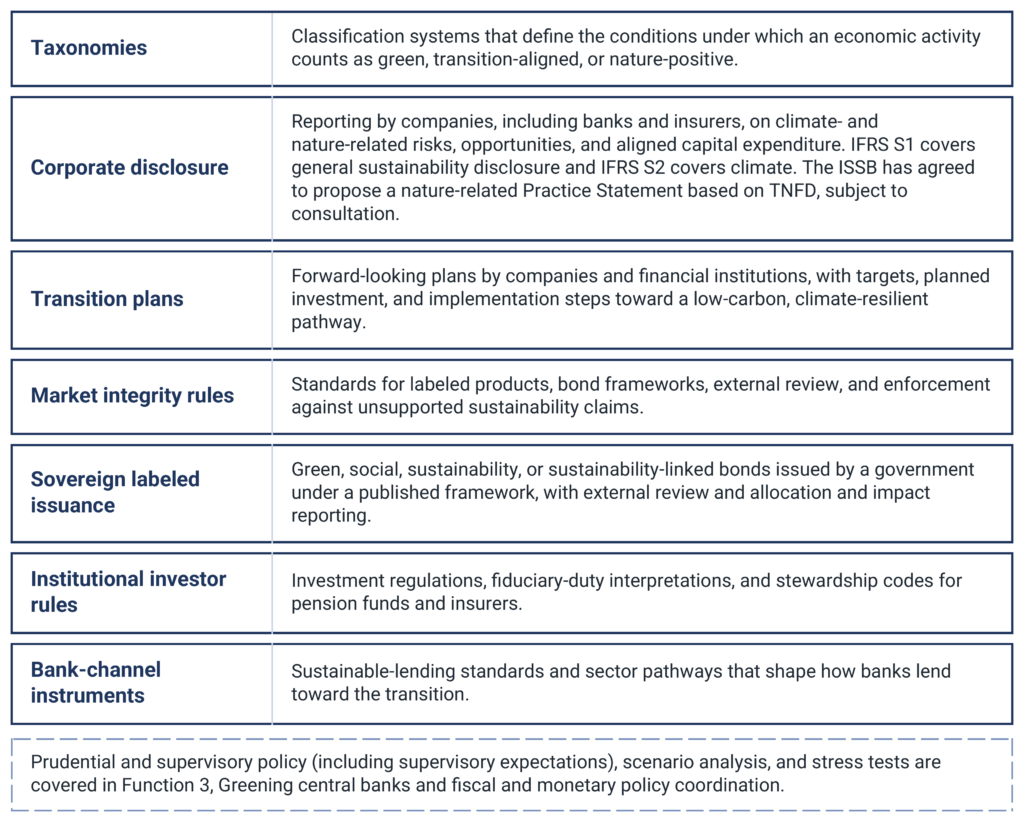
This Action Area covers the policy instruments most relevant to private-finance mobilization:
- Taxonomies
- Corporate disclosure
- Transition plans
- Market integrity rules
- Sovereign labeled issuance
- Institutional investor rules
- Bank-channel instruments
Context and role of Ministries of Finance
Mobilizing private capital is the underlying challenge
Domestic public balance sheets rarely cover transition investment needs on their own, so the practical question for most Ministries of Finance (MoFs) is how to bring private capital in at scale and at an acceptable cost. The Independent High-Level Expert Group on Climate Finance estimates global annual needs of US$6.3tn to US$6.7tn by 2030. Its estimate for external finance in emerging markets and developing economies other than China is about US$1tn a year, including US$450bn to US$500bn from private sources (Bhattacharya et al., 2024). On the nature side, UNEP estimates that annual investment in nature-based solutions needs to reach US$571bn by 2030 (UNEP, 2026).
These global estimates do not set a national financing mix. What they do establish is that private finance must provide a large share, and that the terms on which capital can be raised determine how much of the need is met.
Tracked climate finance surpassed US$2tn for the first time in 2024, but most of it went to mitigation (around US$1.9tn), with only US$64bn going to adaptation. Private finance concentrates where returns are clearest: private sources provided around 62% of all climate finance (more than US$1.2tn) but less than US$4bn of the US$64bn for adaptation(CPI, 2026). With harder-to-capture returns, adaptation and resilience rely more heavily on public and blended finance (see Function 3, Using blended finance and risk-sharing instruments and Providing disaster risk finance and insurance for all).
Private capital is generally allocated against risk-adjusted returns, and two factors tend to weigh on how readily it finances the transition:
- How complete and comparable the available information is for pricing.
- The depth of the market and the cost of financing within it.
Financial sector policy mainly affects the first of these factors. Better and more comparable information, through disclosure, credible transition plans, and shared sustainability classifications, helps private capital identify and price eligible activities and reassess assets already held.
How climate and nature risks are identified and priced is part of the same picture. Better information can change risk assessments, although its effect on pricing depends on the exposures and investors concerned. The prudential and supervisory side of this, and its transmission to financial stability and the sovereign balance sheet, is covered in Function 3, Greening central banks and fiscal and monetary policy coordination.
Financial sector policy is one part of a wider enabling environment for private investment
Market depth and the cost of capital lie only partly within the reach of financial sector policy. Policy can help deepen markets over time, improve transparency, and strengthen the conditions for investment. However, the cost of capital is driven mainly by the risk-free rate, sovereign and currency risk, and macroeconomic conditions, which are the domain of monetary and macrofiscal policy (IEA, 2023; World Bank, 2021). Around 90% of private climate finance has remained in its country of origin since 2019 (CPI, 2026), which is why domestic market depth matters as much as cross-border flows.
However, even with supportive market conditions, capital needs credible project pipelines and appropriate risk-return profiles, while political, policy, currency, and early-stage risks may require targeted risk-sharing. Disclosure and labeling frameworks likewise work best alongside these underlying conditions (see Function 1, Identifying and developing bankable projects and programs and Function 3, Using blended finance and risk-sharing instruments).
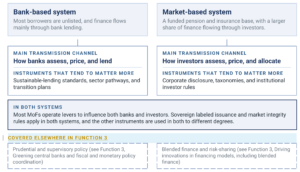
Which policy instruments matter most depends on how private finance is intermediated. In many economies, private finance flows mainly through the banking system (World Bank, 2022b). Where finance is largely bank-based, the transmission to private finance runs mainly through lending decisions. Instruments that shape how banks assess and price climate and nature exposures, as well as how they lend against credible sector pathways, may carry more weight than other policy types. Because most borrowers are unlisted, the bank-channel is also how the largest share of firms is reached in these economies.
The picture differs where capital markets are deeper. In economies with a funded pension and insurance base, a larger share of finance flows through investors (OECD, 2025). Because their liabilities are long-dated, these investors look for long-duration assets and have a commercial interest in an orderly transition, within their mandates and regulatory limits. Disclosure, taxonomy, and institutional investor rules therefore tend to matter more. Most MoFs have some levers to influence both banks and investors, and the instruments set out in the next section can be combined and weighted to fit the structure of their own financial system.
Country context shapes the financial sector’s role in the transition
Energy and trade exposure shape the financing priorities of the transition. Fuel-importing economies may place greater weight on financing domestic clean energy capacity and reducing energy demand as part of efforts to reduce exposure to fuel price and geopolitical shocks. Since 2022, the euro area has illustrated how dependence on imported fossil fuels can amplify the inflationary and macroeconomic effects of energy price shocks, which can in turn contribute to tighter financial conditions (Elderson, 2026). Fuel exporters face different exposure through export receipts and fiscal revenue, making economic diversification a transition priority. Financial sector measures affect the terms on which transition investment is financed, while energy, trade, and industrial policies shape the underlying project economics and demand for that investment.
Countries differ in how exposed they are to climate and nature shocks, both through the financial system and through the sovereign balance sheet. These shocks affect borrower income and asset values, and the resulting financial losses can tighten credit and weaken output. Public finances are exposed through lower revenue, additional expenditure and, when guarantees are called or governments intervene, financial-sector losses. Sovereign borrowing conditions also affect institutions holding government debt (BCBS, 2021; Gardes-Landolfini et al., 2024). In a panel of 52 developed and developing economies, the effect of weather-related disasters on sovereign borrowing costs differed with income level and fiscal space at the time of the shock and yields in highly indebted countries tended to rise as acute physical risk increased (Anyfantaki et al., 2025).
Market depth also shapes what a country can realistically pursue. Where an established market already exists, some jurisdictions have adopted sustainable finance measures early to build a financial center role, for example, Luxembourg and Singapore. In 2025, the Luxembourg Stock Exchange accounted for 41% of new international sustainable bond listings (through its Luxembourg Green Exchange) and 32% of all new international bond listings (LuxSE, 2026). This suggests that its sustainable bond listings were built on an existing international listing base. The Monetary Authority of Singapore introduced a grant scheme in June 2017 to offset the additional cost of issuing green bonds (MAS, 2020). By 2024, Singapore accounted for more than half of the green, social, sustainability, and sustainability-linked bond and loan market of the Association of Southeast Asian Nations (ASEAN) (MAS, 2025). In both centers, these measures helped deepen and differentiate existing markets rather than creating them from scratch.
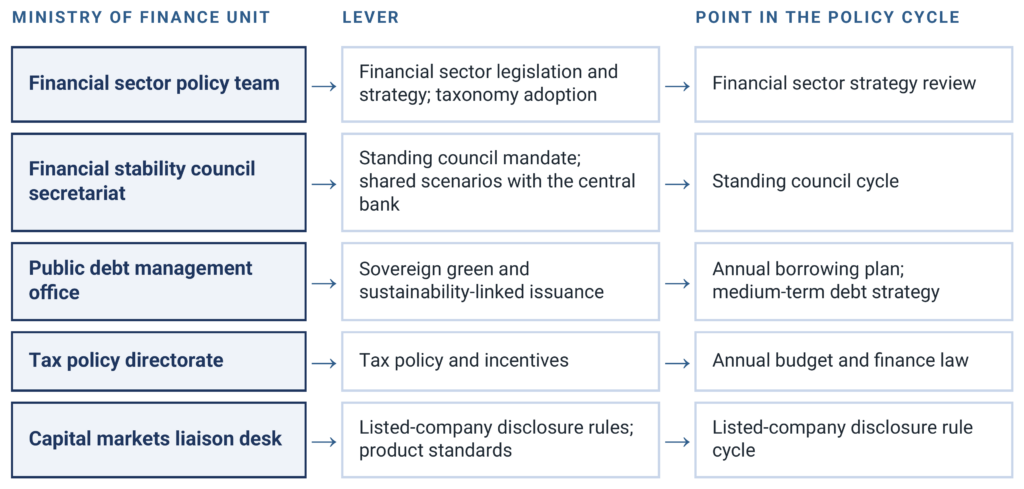
Country context also shapes how responsibility for financial sector policy is allocated across government, and therefore how directly a MoF can act. Prudential policy commonly sits with the central bank or supervisor, while conduct and securities regulators hold market integrity responsibilities. Within government, responsibilities may be distributed across teams within MoFs covering:
- Financial sector policy
- Banking
- Insurance and pensions
- Debt management
- Tax
- Budget
- Macrofiscal policy.
Legislative responsibilities depend on national mandates, and supervision and individual investment decisions remain with the competent authorities and institutions. Project bankability may also involve a public–private partnership or infrastructure-finance unit and the liaison function for multilateral development banks (see Function 3, Using blended finance and risk-sharing instruments and Leveraging international climate finance and reforming the global financial architecture).
Figure 1. Institutional responsibility and timing for financial sector policy levers
Source: Authors’ compilation.
Note: Units and responsibilities are illustrative and vary with national mandates. Responsibility for banking, insurance, and pension policy differs across jurisdictions and may belong to the MoF, a sector supervisor, or both.
Policy instruments and how they mobilize private capital
MoFs have a set of financial sector policy instruments, each with a distinct job. Some make activities and risks visible and comparable or define what counts as eligible, while others protect the credibility of labeled markets or channel demand toward long-dated investment. Many now have international reference points, such as the International Sustainability Standards Board (ISSB) baseline for disclosure (IFRS Foundation, 2025), and interoperability among them lowers cost and helps capital move across borders.
Several instruments originated in advanced economies, so their value depends on adapting them to local priorities rather than adopting them wholesale. Each is set out below in the same way: why a MoF would use it and how it helps bring private capital in, followed by an example in practice. How much they actually mobilize is hard to measure, because the counterfactual is unobservable. What they mainly do is change the conditions under which private capital is committed by making eligible activities easier to identify, lowering the cost of verifying claims, and widening the investor base.
Figure 2. The financial sector toolkit for mobilizing private capital for the transition
Source: Authors’ compilation based on ISSB (2023a, 2023b); IFRS Foundation (2024, 2026b); TNFD (2023); G20 SFWG (2021); ICMA (2025); NGFS (2020); and UNEP FI and PRI (2020).
Note: Responsibility for each instrument varies with national mandates (see Figure 1).
Taxonomies
A classification system that defines the conditions under which an economic activity makes a substantial contribution to a stated objective and therefore counts as green, transition-aligned, or nature-positive.
Rationale and mobilization. A taxonomy provides a common language for all actors in the financial system, offering clear guidance on which activities qualify as contributing to climate, environmental, or nature objectives (World Bank, 2020). Taxonomies that are interoperable can act as a shared reference that allows cross-border investors to recognize eligible assets across jurisdictions, gives issuers a credible basis for labeling debt (green debt issuance) and, if combined with disclosure rules, makes taxonomy-aligned exposures visible. Periodic review keeps transition classifications consistent with changes in technologies, sector pathways, and access to lower-emissions energy (ASEAN Taxonomy Board, 2024).
In practice. China’s onshore green bond market, issued under its domestic taxonomy, reached about RMB 1.09tn (US$162bn) in 2025, up roughly 57% on the year (Yang et al., 2026). This figure measures bond issuance and does not estimate additional investment generated by the taxonomy. The European Union case study below reports taxonomy-aligned capital expenditure.
Corporate disclosure
Requirements for companies, including banks and insurers, to report climate- and nature-related risks, opportunities, and aligned capital expenditure (CapEx).
Rationale and mobilization. Comparable, decision-useful information lets investors and lenders price exposures and judge the credibility of a transition strategy, reducing information gaps that can affect risk assessment. Corporate disclosure lets international investors assess issuers on the same basis, supporting cross-border allocation. Taxonomy-aligned CapEx disclosure makes transition CapEx visible, so investors and the MoF can monitor where investment is going. The ISSB’s IFRS S1 standard covers sustainability-related financial information, while IFRS S2 addresses climate. The EU’s Corporate Sustainability Reporting Directive (CSRD) and European Sustainability Reporting Standards (ESRS) cover both financial materiality and impacts on people and the environment. The EU Sustainable Finance Disclosure Regulation covers sustainability disclosures by financial market participants and advisers at entity and product level but does not require every investment to meet green criteria (European Union, 2019).
ESRS–ISSB guidance supports interoperability between these distinct systems (ISSB, 2023a, 2023b; European Union, 2022; IFRS Foundation and EFRAG, 2024). In 2026, the ISSB agreed to propose a nature-related Practice Statement drawing on work by the Taskforce on Nature-related Financial Disclosures (TNFD), subject to consultation (IFRS Foundation, 2026a, 2026b).
In practice. Disclosure is now widespread among large issuers, with 94% of energy sector companies by market capitalization making some sustainability disclosure, although comparability depends on the scope and quality of reporting (CPI, 2026). On the nature side, where reporting is far less developed, disclosure is beginning to shape financing terms directly: in Chile, Rabobank structured a sustainability-linked loan for a farming client around TNFD-aligned targets for soil, biodiversity, and reduced agrochemical use, though such deals are still early and small in scale (TNFD, 2025a).
Transition plans
Expectations or requirements that companies and financial institutions publish credible, forward-looking plans for aligning with a low-carbon, climate-resilient pathway, including targets, planned investment, and implementation steps.
Rationale and mobilization. A transition plan sets out where an entity intends to go and how, with targets, planned investment, and the steps to get there (UNEP FI, 2025). This forward-looking view lets lenders and investors judge whether a borrower’s or issuer’s strategy is credible. On this basis, they can finance transition activities in higher-emitting sectors, which a static green-or-not-green classification would exclude, as well as those that are already green. Plans can integrate nature dependencies and impacts, including water, land use, and supply chains. Preparation and updating require data and expertise, particularly for smaller firms (TNFD, 2025b).
In practice. An International Transition Plan Network and Chronos Sustainability study of 35 investors representing over US$10tn in assets found that they used transition plans to assess long-term value and resilience. The selected sample does not measure global uptake (ITPN and Chronos Sustainability, 2026).
Market integrity rules
Standards for labeled products, bond frameworks, external review, and enforcement against unsupported sustainability claims.
Rationale and mobilization. Where labels are unverified, unsupported claims are hard to tell from genuine ones, and that uncertainty erodes trust in the labeled market. Credible labels and enforcement sustain investor confidence in green debt issuance, particularly among international investors who cannot easily verify claims themselves. They also lower the due-diligence cost of taking part, which keeps the market open to continued inflows.
In practice. The EU case study below reports first-year issuance under the EU Green Bond Standard, which requires taxonomy alignment and external review.
Sovereign labeled issuance
Green, social, sustainability, or sustainability-linked bonds issued by a government under a published framework, with external review and allocation and impact reporting.
Rationale and mobilization. Domestic issuers often lack established labeled markets to issue into, pricing references, and demonstrated demand to build on. A sovereign program is itself green debt issuance, and can broaden and diversify the investor base, while a regular sovereign benchmark curve gives domestic corporate issuers a pricing reference and helps deepen the market (World Bank, 2022a).
In practice. The Indonesia and Colombia case studies below describe the sovereign green sukuk program and a local-currency sovereign green bond program, respectively.
Institutional investor rules
Investment regulations, fiduciary-duty interpretations, and stewardship codes that shape how pension funds and insurers treat climate and nature in investment and stewardship.
Rationale and mobilization. Fiduciary-duty rules and mandates are often silent or ambiguous on whether pension funds and insurers may weigh climate and nature, which can deter long-term allocation. Where a funded pension and insurance base exists, clearer rules can create demand for transition assets that match long-term liabilities, deepening the domestic investor base on which a mobilization strategy ultimately rests. The MoF’s role depends on national mandates, while individual portfolio allocation decisions remain with investors and their governing bodies.
In practice. Japan’s Government Pension Investment Fund—the world’s largest with assets of around US$1.5tn—reallocated part of its passive equity holdings to selected ESG indices after adopting an ESG approach under Japan’s Stewardship Code (GPIF, 2023). France’s 2015 Energy Transition Law (Article 173-6) required investors to disclose their climate-related exposure from 2016. Banque de France researchers found that investors subject to the requirement cut their financing of fossil-energy firms by about 40% relative to a control group, redirecting an estimated EUR 28bn (US$32.5bn) out of the sector (Mésonnier and Nguyen, 2021).
Bank-channel instruments
The standards and expectations that affect how banks lend toward the transition, as distinct from the prudential tools that shape how they hold capital against climate and nature risk (see Function 3, Greening central banks and fiscal and monetary policy coordination).
Rationale and mobilization. In bank-based systems, banks are the main channel for private finance. However, they often lack a common reference for judging whether a borrower’s transition is credible and worth lending to. Sustainable-lending standards, such as green loan and sustainability-linked loan principles, can give this lending a credible labeled form much as market integrity rules do for bonds. Sector pathways give banks a shared reference for what to lend.
In practice. Global green and sustainability-linked syndicated loans, the labeled-lending market in which these sustainable-lending standards operate, reached about US$638bn in 2024 (Natixis, 2025).
These financial sector policy instruments can also be used within blended finance structures, which combine public or concessional capital with private capital so that projects that would not attract private finance on their own become investable (see Function 3, Using blended finance and risk-sharing instruments).
Barriers to action and ways to overcome them
Each issue below pairs a typical barrier with actions a MoF could consider. A wider range of Opportunities for action is given in the next section.
Policy implementation responsibility is distributed across institutions and teams, and analytical capacity is often thin
Taxonomy design, disclosure supervision, and market regulation may sit in different bodies, and in the Coalition of Finance Ministers for Climate Action’s global survey, 82% of responding MoFs reported staffing and skill constraints in climate-economy analytics (CFMCA, 2025). The survey did not cover nature.
Approach
Fragmentation and limited interoperability across frameworks raise compliance cost
International, regional, and national frameworks differ in legal basis, scope, and materiality, which raises compliance costs. Where several reporting regimes apply, costs accumulate, particularly for smaller firms. The 2026 amendments to the EU’s corporate sustainability reporting and due diligence requirements show early adopters recalibrating as implementation experience builds (European Union, 2026).
Approach
Information and data are incomplete, especially on nature and in smaller markets
Thin data limits the classification and pricing the instruments rely on.
Approach
Shallow markets, the cost of capital, and project pipelines cap what financial sector policy can achieve
On the market side, small investor bases and limited liquidity may reduce issuance scale. Sovereign and currency risk can also enter financing costs that no taxonomy, disclosure, or labeling rule can offset, costs that depend mainly on macroeconomic and monetary conditions. On the demand side, uncertain revenues, missing infrastructure, and slow permitting can keep projects below investors’ risk-adjusted return requirements. Financial sector policy interacts with these constraints but does not resolve them.
Approach
Unclear definitions make unsupported sustainability claims harder to identify and sanction
Enforcement and assurance also add costs for issuers, particularly smaller firms.
Approach
Opportunities for action
MoFs can combine financial sector policy instruments according to their mandates, the structure of the financial system, and national investment priorities. The opportunities below draw together approaches used in different country settings, reflecting the market and implementation constraints described above.
Source: Authors’ compilation.
Choose instruments according to how firms raise finance and the composition of the domestic investor base. In bank-based systems, use sustainable-lending standards, transition plans, and credible sector pathways to give banks references for assessing borrowers and structuring transition finance. Use corporate disclosure to support these assessments, recognizing that listed-company requirements cover only part of the borrower base and that information gathered through lending relationships could extend coverage to unlisted firms. In deeper capital markets, use taxonomies and public disclosure to inform investment decisions, and institutional investor rules to clarify how pension funds and insurers consider climate and nature within their mandates.
Use international and regional frameworks as reference points for national taxonomies and disclosure requirements, according to domestic legal obligations and policy priorities. These include ISSB standards, applicable EU disclosure requirements, TNFD recommendations, and regional taxonomies such as the ASEAN Taxonomy, each of which serves a different purpose. Referencing them can reduce the cost of developing national systems and help cross-border investors assess activities and issuers. Design national requirements to be interoperable with these frameworks, adding national elements that reflect domestic investment priorities.
Use sovereign labeled issuance to provide a reference for domestic issuers and to help establish investor demand. Issue repeatedly, so that the program contributes to a benchmark curve and gives corporate issuers working examples of issuance frameworks, external review, and reporting. Plan the program within a debt-management strategy that supports regular issuance, since its contribution to domestic market development also depends on market depth and credible reporting. The Colombia and Indonesia case studies above describe two approaches.
Set the scope and timing of disclosure and market integrity requirements according to the capacity of firms to report and of responsible authorities to oversee compliance. Use phased application, size thresholds, and reuse of existing filings to manage reporting costs as coverage expands. For labeled products, start with a limited range of instruments so that external-review arrangements and enforcement capacity can develop alongside the market.
Coordinate with the central bank, supervisors, and relevant sector ministries to connect financial sector instruments with the conditions affecting investment. Use existing councils or working groups to align taxonomy criteria, disclosure requirements, and transition-plan expectations with national sector pathways, within each institution’s mandate. Identify complementary work on project preparation (see Function 1, Identifying and developing bankable projects and programs); price signals (see Function 2, Transforming economic incentives through carbon pricing, subsidy reform and other fiscal policy measures); and risk-sharing (see Function 3, Using blended finance and risk-sharing instruments).
Real-world examples
Country experience shows how these policy instruments combine, though clean evidence of their additional impact on investment remains limited. The case studies below emphasize combinations rather than single measures and note where attribution is difficult.
Spain
The Sustainable Finance Council, chaired by the Minister of Economy, Trade and Business, was established in January 2025 as a public–private governance platform. It brings together government bodies, financial supervisors, financial institutions, business associations, companies, academia, civil society organizations, and independent experts. The Council’s mandate is to support the mobilization of private and public capital for the green transition; promote the uptake of sustainable finance instruments; facilitate implementation of the European sustainable finance framework in Spain; and identify barriers to financing decarbonization. Two deliverables show the approach. Eco-Track is a simplified tool helping small and medium-sized enterprises assess and communicate their environmental performance in a form that supports access to sustainable bank financing. Eco-Lab is an innovation platform where companies and financial institutions test methodologies, projects, and proposals with supervisors and public authorities.
Japan
Sovereign climate transition bonds sit alongside the Basic Guidelines on Climate Transition Finance and sector-specific technology roadmaps. The MoF issues Japan Climate Transition Bonds under a dedicated framework with external review, allocation reporting, and impact reporting, while the roadmaps covering high-emissions sectors are maintained by the Ministry of Economy, Trade and Industry (METI, 2026; Japan Ministry of Finance, n.d.). The bonds sit within the Green Transformation strategy, which pairs public bond financing with tax incentives, carbon pricing, and emissions trading. This case illustrates how transition guidance, sector-specific roadmaps, and sovereign issuance can be combined to create a common reference for transition finance.
Indonesia
The MoF published its Green Bond and Green Sukuk Framework in January 2018 after obtaining a second opinion from the CICERO Center for International Climate Research (Indonesia Ministry of Finance, 2018; CICERO, 2018). Two months later it raised US$1.25bn through the first sovereign green sukuk, and between 2018 and 2026 the program has raised approximately US$9.6bn across multiple issuances (SBFN, 2026). This illustrates how a sovereign framework, external review, and an established Islamic-finance market can be combined to develop a labeled sovereign instrument.
Colombia
Colombia’s experience combines sovereign labeled bond issuance with the development of a national classification framework. Its local-currency sovereign green bond program began in 2021, followed by the publication of the first green taxonomy in the Americas in April 2022 (MHCP and SFC, 2022). The first three placements raised about 2.1tn Colombian pesos, or roughly US$653m (Climate Bonds Initiative, 2023). The first two green-bond auctions recorded an average bid-to-cover ratio of 3.0, while the pricing difference against conventional bonds from the same issuer with the same financial characteristics widened from about 7 to 15 basis points. Foreign investors bought 40% of the debut and held 48.7% of outstanding green treasury bonds after the second auction, compared with 26% for conventional domestic bonds (World Bank Treasury, 2022). The program relied on an established auction system, benchmark curve, and World Bank Treasury technical support.
Germany
Germany has issued green Federal securities since September 2020 (Deutsche Finanzagentur, 2020). The twin-bond structure makes the pricing difference between green and conventional Federal securities observable. Each green security has the same coupon and maturity as a conventional Federal security. An interministerial working group, chaired by the Federal MoF, validates the Green Bond Framework of the Federal Government and selects eligible expenditure across transport, international cooperation, research, energy and resources, and ecosystems. The framework draws on the International Capital Market Association Green Bond Principles and the EU Taxonomy. At the end of 2025, eight green securities were outstanding, with remaining maturities of 2 to 28 years (Deutsche Finanzagentur, 2026). Monthly trading volume averaged about EUR 10bn (US$11.6bn), equivalent to annual turnover of almost 1.5 times the outstanding volume. The twin-bond structure has also recorded a pricing advantage over conventional Federal securities.
European Union
The EU applies its taxonomy, corporate disclosure under the CSRD and ESRS, and the Green Bond Standard together, so classification, disclosure, and labeled issuance reinforce one another (European Union, 2020, 2022, 2023). Taxonomy reporting recorded about EUR 742bn (US$860bn) in aligned CapEx from disclosing companies in the EU, Norway, Switzerland, and the United Kingdom between 2022 and 2024 (European Commission, 2025). Issuance under the EU Green Bond Standard exceeded EUR 22bn (US$25.5bn) in its first year, mainly for utilities and infrastructure, demonstrating uptake of the standard and its use to channel financing toward eligible green activities (European Union, 2023; Leung, 2026). These figures describe reported taxonomy-aligned CapEx and labeled bond issuance. They demonstrate use of the frameworks but do not establish how much additional investment were generated by them.
WWF (Karen Ellis, Maud Abdelli, Amanda Ansermino, Phoebe Cochrane, Vassilis Gkoumas, Regula Hess, Andrew Deutz); Finance for Biodiversity Foundation; UNDRR and the Climate Bonds Initiative; OECD (Robert Youngman, Emily Berger, Yuji Nakahama)
Anyfantaki S, Blix Grimaldi M, Madeira C, Malovana S, Papadopoulos G (2025) Decoding climate-related risks in sovereign bond pricing: A global perspective. BIS Working Paper 1275. Basel: Bank for International Settlements.
ASEAN Taxonomy Board (2024) ASEAN Taxonomy for Sustainable Finance, Version 3. Jakarta: ASEAN Secretariat.
Basel Committee on Banking Supervision [BCBS] (2021) Climate-related risk drivers and their transmission channels. Basel: Bank for International Settlements.
Bhattacharya A, Songwe V, Soubeyran E, Stern N (2024) Raising ambition and accelerating delivery of climate finance. Third report of the Independent High-Level Expert Group on Climate Finance. London: Grantham Research Institute on Climate Change and the Environment, London School of Economics and Political Science.
Center for International Climate Research [CICERO] (2018) Second opinion on the Republic of Indonesia’s Green Bond and Green Sukuk Framework. Oslo: CICERO Shades of Green.
Climate Bonds Initiative (2023) Colombia sustainable finance state of the market 2022. London: Climate Bonds Initiative.
Climate Policy Initiative [CPI] (2026) Global landscape of climate finance 2026. San Francisco: Climate Policy Initiative.
Coalition of Finance Ministers for Climate Action [CFMCA] (2025) A global survey of Ministries of Finance: The pressing policy questions Ministries of Finance face in driving green and resilient transitions and their use of analytical tools to address them. Washington, DC: Coalition of Finance Ministers for Climate Action.
Colombia Ministry of Finance and Public Credit [MHCP], Financial Superintendence of Colombia [SFC] (2022) Taxonomía Verde de Colombia [Green Taxonomy of Colombia]. Bogotá: Ministerio de Hacienda y Crédito Público and Superintendencia Financiera de Colombia.
Deutsche Finanzagentur (2026) Federal Republic of Germany green bond investor presentation, January 2026. Frankfurt am Main: Bundesrepublik Deutschland Finanzagentur.
Deutsche Finanzagentur (2020) First Green Federal bond. Press release, 2 September. Frankfurt am Main: Bundesrepublik Deutschland Finanzagentur.
Elderson F (2026) Europe’s fossil fuel dependence poses risks to price stability. Blog post, 7 April. The ECB Blog, European Central Bank.
European Commission (2025) The EU Taxonomy’s uptake on the ground. Brussels: European Commission, Directorate-General for Financial Stability, Financial Services and Capital Markets Union.
European Union (2026) Directive (EU) 2026/470 as regards certain corporate sustainability reporting requirements and certain corporate sustainability due diligence requirements. OJ L, 26 February 2026.
European Union (2023) Regulation (EU) 2023/2631 on European Green Bonds and optional disclosures for bonds marketed as environmentally sustainable and for sustainability-linked bonds. OJ L, 30 November 2023.
European Union (2022) Directive (EU) 2022/2464 as regards corporate sustainability reporting. OJ L 322, 16 December 2022.
European Union (2020) Regulation (EU) 2020/852 on the establishment of a framework to facilitate sustainable investment. OJ L 198, 22 June 2020.
European Union (2019) Regulation (EU) 2019/2088 on sustainability-related disclosures in the financial services sector. OJ L 317, 9 December 2019.
G20 Sustainable Finance Working Group [G20 SFWG] (2021) G20 Sustainable Finance Roadmap. Rome: G20 Italian Presidency.
Gardes-Landolfini C, Oman W, Fraser J, Montes de Oca Leon M, Yao B (2024) Embedded in nature: Nature-related economic and financial risks and policy considerations. IMF Staff Climate Note 2024/002. Washington, DC: International Monetary Fund.
Government Pension Investment Fund [GPIF] (2023) ESG report 2022. Tokyo: Government Pension Investment Fund.
IFRS Foundation (2026a) Nature-related disclosures: Frequently asked questions on form of standard-setting. London: IFRS Foundation.
IFRS Foundation (2026b) ISSB agrees on the proposed way forward for nature-related disclosures. Web page. https://www.ifrs.org/news-and-events/news/2026/05/issb-agrees-proposed-way-forward-nature-related-disclosures/
IFRS Foundation (2025) Jurisdictional profiles: Progress towards adoption of ISSB Standards. London: IFRS Foundation.
IFRS Foundation (2024) Inaugural jurisdictional guide for the adoption or other use of ISSB Standards. London: IFRS Foundation.
IFRS Foundation, European Financial Reporting Advisory Group [EFRAG] (2024) ESRS–ISSB Standards interoperability guidance. London and Brussels: IFRS Foundation and European Financial Reporting Advisory Group.
Indonesia Ministry of Finance (2018) Republic of Indonesia Green Bond and Green Sukuk Framework. Jakarta: Directorate General of Budget Financing and Risk Management, Ministry of Finance.
International Capital Market Association [ICMA] (2025) Green Bond Principles, June 2025. Zurich: International Capital Market Association.
International Energy Agency [IEA] (2023) Cost of Capital Observatory. Paris: International Energy Agency.
International Sustainability Standards Board [ISSB] (2023a) IFRS S1 General Requirements for Disclosure of Sustainability-related Financial Information. London: IFRS Foundation.
International Sustainability Standards Board [ISSB] (2023b) IFRS S2 Climate-related Disclosures. London: IFRS Foundation.
International Transition Plan Network [ITPN], Chronos Sustainability (2026) Enhancing long-term value and resilience: A study of how global investors are using transition plans.
Japan Ministry of Economy, Trade and Industry [METI] (2026) Transition finance. Web page. https://www.meti.go.jp/english/policy/energy_environment/transition_finance/index.html
Japan Ministry of Finance (n.d.) Japan Climate Transition Bonds. Web page. https://www.mof.go.jp/english/policy/jgbs/topics/JapanClimateTransitionBonds/index.html
Leung K (2026) EU Green Bond Standard: A strong first year, but more to be done. IEEFA Briefing Note. Lakewood, OH: Institute for Energy Economics and Financial Analysis.
Luxembourg Stock Exchange [LuxSE] (2026) LuxSE reports all-time high listing numbers and strong financial results for 2025. Press release, 25 June. Luxembourg: Luxembourg Stock Exchange.
Mésonnier J-S, Nguyen B (2021) Showing off cleaner hands: Mandatory climate-related disclosure by financial institutions and the financing of fossil energy. Banque de France Working Paper 800. Paris: Banque de France.
Monetary Authority of Singapore [MAS] (2025) Sustainability report 2024/2025. Singapore: Monetary Authority of Singapore.
Monetary Authority of Singapore [MAS] (2020) Developing green finance solutions and markets. Annual report 2019/2020. Singapore: Monetary Authority of Singapore.
Natixis (2025) Sustainable debt in focus: 2024 summary and 2025 outlook. Paris: Natixis Green & Sustainable Hub.
Network for Greening the Financial System [NGFS] (2020) Guide for supervisors: Integrating climate-related and environmental risks into prudential supervision. Paris: Network for Greening the Financial System.
Organisation for Economic Co-operation and Development [OECD] (2025) Pension markets in focus 2025. Paris: OECD Publishing.
Securities and Exchange Board of India [SEBI] (2021) Business Responsibility and Sustainability Reporting by listed entities. Mumbai: Securities and Exchange Board of India.
Sustainable Banking and Finance Network [SBFN] (2026) Indonesia’s green sukuk program: Mobilizing private capital for climate finance.
Sustainable Banking and Finance Network [SBFN] (n.d.) About the SBF Network. Web page. https://sbfnetwork.org/about-sbf-network
Taskforce on Nature-related Financial Disclosures [TNFD] (2025a) Financial innovation case study. London: Taskforce on Nature-related Financial Disclosures.
Taskforce on Nature-related Financial Disclosures [TNFD] (2025b) Guidance on nature in transition plans. Version 1.0. London: Taskforce on Nature-related Financial Disclosures.
Taskforce on Nature-related Financial Disclosures [TNFD] (2023) Recommendations of the Taskforce on Nature-related Financial Disclosures. London: Taskforce on Nature-related Financial Disclosures.
United Nations Environment Programme [UNEP] (2026) State of finance for nature 2026: Nature in the red. Nairobi: United Nations Environment Programme.
United Nations Environment Programme Finance Initiative [UNEP FI] (2025) A guide to transition plans for banks: The path from targets to implementation. Geneva: UNEP Finance Initiative.
United Nations Environment Programme Finance Initiative [UNEP FI], Principles for Responsible Investment [PRI] (2020) Fiduciary duty in the 21st century: Final activity report 2015–2019. Geneva and London: UNEP Finance Initiative and Principles for Responsible Investment.
World Bank (2022a) Sovereign green, social, and sustainability bonds: Unlocking the potential for emerging markets and developing economies. Washington, DC: World Bank.
World Bank (2022b) Global Financial Development Database. Washington, DC: World Bank.
World Bank (2021) Analyzing the determinants of EMDE local-currency sovereign yields: A simple comparative approach. Washington, DC: World Bank.
World Bank (2020) Developing a national green taxonomy: A World Bank guide. Washington, DC: World Bank.
World Bank Treasury (2022) Colombia: The first sovereign green bond in local currency in Latin America. Washington, DC: World Bank Treasury.
Yang F, Li J, Nedopil C (2026) China green finance status and trends 2025–2026. Brisbane and Shanghai: Griffith Asia Institute and Green Finance and Development Center, Fudan University